. 2021 May;32(5):459-471.
doi: 10.1007/s10552-021-01411-7. Epub 2021 Mar 11.

The hidden curve behind COVID-19 outbreak: the impact of delay in treatment initiation in cancer patients and how to mitigate the additional risk of dying-the head and neck cancer model

Affiliations

The hidden curve behind COVID-19 outbreak: the impact of delay in treatment initiation in cancer patients and how to mitigate the additional risk of dying-the head and neck cancer model

Leandro L Matos et al. Cancer Causes Control. 2021 May.

Abstract

Purpose: The rapid spread of the SARS-CoV-2 pandemic around the world caused most healthcare services to turn substantial attention to treatment of these patients and also to alter the structure of healthcare systems to address an infectious disease. As a result, many cancer patients had their treatment deferred during the pandemic, increasing the time-to-treatment initiation, the number of untreated patients (which will alter the dynamics of healthcare delivery in the post-pandemic era) and increasing their risk of death. Hence, we analyzed the impact on global cancer mortality considering the decline in oncology care during the COVID-19 outbreak using head and neck cancer, a known time-dependent disease, as a model.

Methods: An online practical tool capable of predicting the risk of cancer patients dying due to the COVID-19 outbreak and also useful for mitigation strategies after the peak of the pandemic has been developed, based on a mathematical model. The scenarios were estimated by information of 15 oncological services worldwide, given a perspective from the five continents and also some simulations were conducted at world demographic data.

Results: The model demonstrates that the more that cancer care was maintained during the outbreak and also the more it is increased during the mitigation period, the shorter will be the recovery, lessening the additional risk of dying due to time-to-treatment initiation.

Conclusions: This impact of COVID-19 pandemic on cancer patients is inevitable, but it is possible to minimize it with an effort measured by the proposed model.

Keywords: COVID-19; Head and Neck Neoplasms; Mortality; Risk Evaluation and Mitigation; Time-to-Treatment.


Conflict of interest statement

Hisham Mehanna is the director and a shareholder of Warwickshire Head and Neck Clinic LTD, he also reports personal fees from AstraZeneca, personal fees from MSD, personal fees from Sanofi Pasteur, personal fees from Merck, grants from GSK Biologicals, grants from MSD, grants from Sanofi Pasteur, grants from AstraZeneca, non-financial support from Merck, non-financial support from MSD, all disclosures are outside the submitted work. Leandro L. Matos, Carlos Henrique Q. Forster, Gustavo N. Marta, Gilberto Castro Junior, John A. Ridge, Daisy Hirata, Adalberto Miranda-Filho, Ali Hosny, Alvaro Sanabria, Vincent Gregoire, Snehal G. Patel, Johannes J. Fagan, Anil K. D’Cruz, Lisa Licitra, Sheng-Po Hao, Amanda Psyrri, Sandro Porceddu, Thomas J. Galloway, Wojciech Golusinski, Nancy Y. Lee, Elcio H. Shiguemori, José Elias Matieli, Ana Paula A. C. Shiguemori, Letícia R. Diamantino, Luiz Felipe Schiaveto, Lysia Leão, Ana F. Castro, André Lopes Carvalho, Luiz Paulo Kowalski declare that they have no conflict of interest.

Figures
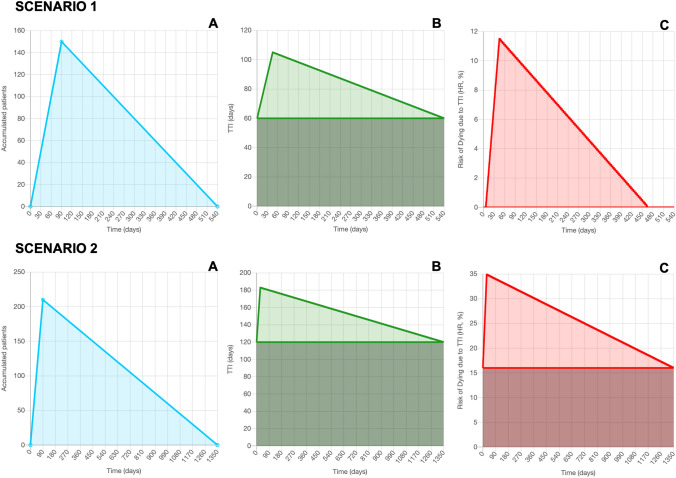
Fig. 1
Fig. 1
Graphic representation of the model considering two different simulations. Scenario one considering a baseline time-to-treatment initiation (TTI) of 60 days in a facility that usually treat 100 patients per month. During the COVID-19 outbreak the medical care volume was reduced to 50% and the service expect an increase of 10% in medical care volume after a 90 days period of pandemic. a 150 patients waiting for treatment at the peak of the outbreak, with additional 450 days to return to the baseline condition, during the mitigation period; b average additional TTI of 45 days (peak of overall 105 days), during time to return to the baseline condition (TTI of 60 days); c average of 4.4% of additional risk of dying (peak of 11.5% for overall risk) during time to return to the baseline condition (no risk); Scenario two considering a baseline time-to-treatment initiation (TTI) of 120 days in a facility that usually treat 100 patients per month. During the COVID-19 outbreak the medical care volume was reduced to 30% and the service expect an increase of 5% in medical care volume after a 90 days period of pandemic. a 210 patients waiting for treatment at the peak of the outbreak, with additional 1,260 days to return to the baseline condition, during the mitigation period; b average additional TTI of 63 days (peak of overall 183 days), during time to return to the baseline condition (TTI of 120 days); c average of 9.4% of additional risk of dying (peak of 37.5% for overall risk) during time to return to the baseline condition (risk of 16%). The difference between both scenarios is not only the shape of the curves but also the axis values
Fig. 2
Fig. 2
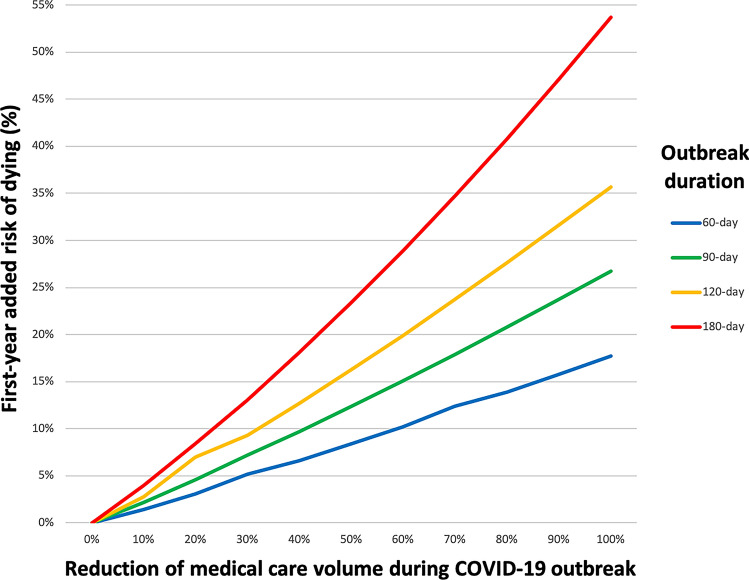
First-year added risk of dying due to delay in time-to-treatment initiation considering the reduction of medical care during four simulations of COVID-19 outbreak duration. These risks represent situations without increase in medical care volume after the pandemic
Fig. 3
Fig. 3
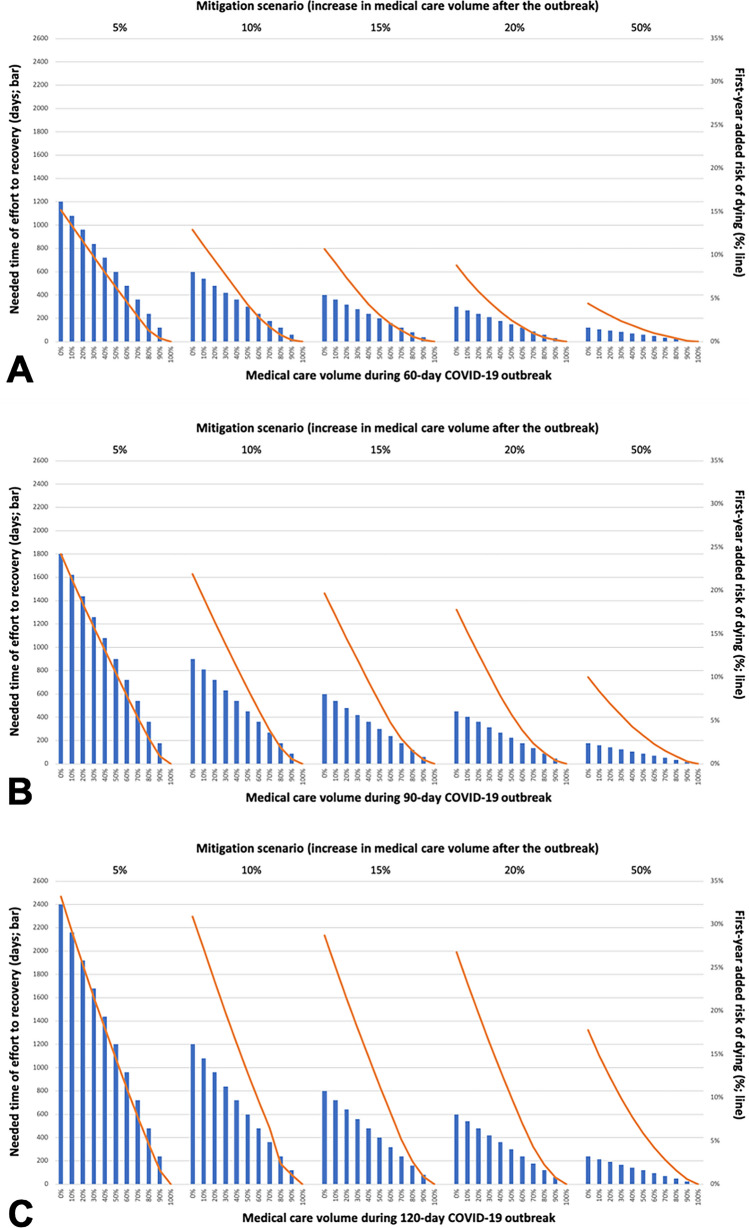
First-year added risk of dying (line) and necessary time of effort to recovery (bar) due to delay in time-to-treatment initiation considering the reduction of medical care during three simulations of COVID-19 outbreak duration (60, 90 and 120 days), and also de mitigation of these risks based on increase of medical care volume after the pandemic (increase of 5%, 10%, 15%, 20% and 50%). Complete and descriptive data of all these values are shown in Table S2 and Figure S3 (supplementary data)

References

    1. Murphy CT, Galloway TJ, Handorf EA, et al. Survival Impact of Increasing Time to Treatment Initiation for Patients With Head and Neck Cancer in the United States. J Clin Oncol. 2016;34:169–178. doi: 10.1200/JCO.2015.61.5906. - DOI - PMC - PubMed
    1. Xiao R, Ward MC, Yang K, et al. Increased pathologic upstaging with rising time to treatment initiation for head and neck cancer: A mechanism for increased mortality. Cancer. 2018;124:1400–1414. doi: 10.1002/cncr.31213. - DOI - PubMed
    1. Yao JJ, Zhang F, Gao TS, et al. Survival impact of radiotherapy interruption in nasopharyngeal carcinoma in the intensity-modulated radiotherapy era: A big-data intelligence platform-based analysis. Radiother Oncol. 2019;132:178–187. doi: 10.1016/j.radonc.2018.10.018. - DOI - PubMed
    1. Kowalski LP, Carvalho AL. Natural history of untreated head and neck cancer. Eur J Cancer. 2000;36:1032–1037. doi: 10.1016/S0959-8049(00)00054-X. - DOI - PubMed
    1. Hanna TP, Evans GA, Booth CM. Cancer, COVID-19 and the precautionary principle: prioritizing treatment during a global pandemic. Nat Rev Clin Oncol. 2020 doi: 10.1038/s41571-020-0362-6. - DOI - PMC - PubMed