. 2021 Jul;93(7):4461-4468.
doi: 10.1002/jmv.26931. Epub 2021 Mar 25.

Immunoinformatic analysis of structural and epitope variations in the spike and Orf8 proteins of SARS-CoV-2/B.1.1.7

Affiliations

Immunoinformatic analysis of structural and epitope variations in the spike and Orf8 proteins of SARS-CoV-2/B.1.1.7

Mushtaq Hussain et al. J Med Virol. 2021 Jul.

Abstract

A newly emerged strain of SARS-CoV-2 of B.1.1.7 lineage has caused a significant surge in the SARS-CoV-2 infections in the UK. In this study, changes in the epitopes of spike and orf8 proteins in SARS-CoV-2 of B.1.1.7 lineage were investigated. Genomic alignment of the SARS-CoV-2/B.1.1.7 with SARS-CoV-2/Wuhan showed the presence of several mutations in orf1a/b, spike, orf8, and N proteins of SARS-CoV-2/B.1.1.7. Molecular models of spike and orf8 proteins were constructed by homology modeling. Superimposition between the spike proteins of SARS-CoV-2/Wuhan and SARS-CoV-2/B.1.1.7 showed noticeable variations in the spatial orientation in Val70-Asn74 and Thr250-Ser255 regions. This may have also resulted in the extension of the epitopic region at Ser244-Gly249 in the SARS-CoV-2/B.1.1.7 spike protein. Superimposition of the SARS-CoV-2/B.1.1.7 spike protein over Fab-spike protein complexes of SARS-CoV-2/Wuhan also showed subtle variations in the antibody binding affinity targeting the N-terminal domain of the spike protein. Epitopic variations were also observed between the corresponding orf8 regions of SARS-CoV-2/Wuhan and SARS-CoV-2/B.1.1.7. Moreover, the presence of a stop codon at position 27 in orf8 connotes the emergence of two frames (orf8a and orf8b) in SARS-CoV-2, which further hampers its extracellular secretion, and in turn, immunogenicity. The findings of the present study could further be used to develop targeted immunotherapeutics.

Keywords: B.1.1.7; COVID-19; Orf8; SARS-CoV-2; spike protein.


Conflict of interest statement

The authors declare that there are no conflict of interests.

Figures
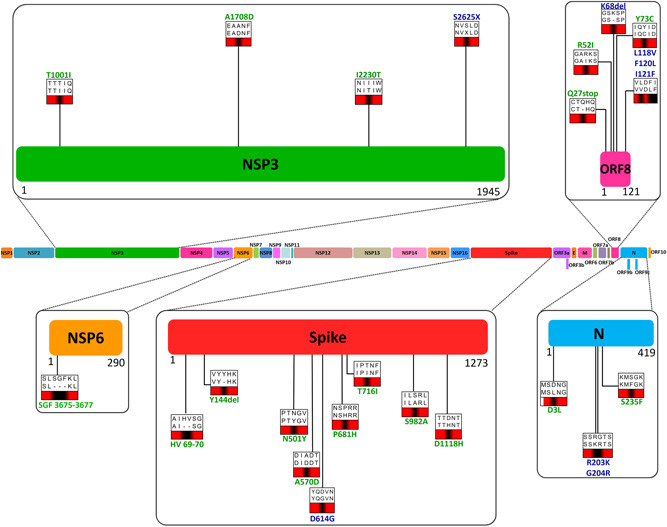
Figure 1
Figure 1
Mutations in SARS‐CoV‐2/B.1.1.7. Schematic and scaled representation of SARS‐CoV‐2 genome with mutations found in different protein‐encoding genes are shown at corresponding positions
Figure 2
Figure 2
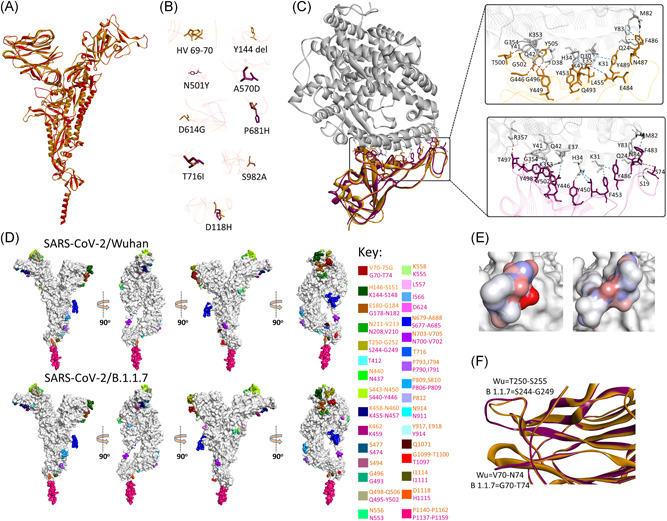
Structure and epitopes of SARS‐CoV‐2/B.1.1.7 spike protein. (A) Structural comparison in ribbon conformation of spike proteins of SARS‐CoV‐2/Wuhan (gold) and SARS‐CoV‐2/B.1.1.7 (magenta). (B) Stick representation of the spatial orientation of amino acids of SARS‐CoV‐2/Wuhan spike protein (gold) compared with substituting amino acids in SARS‐CoV‐2/B.1.1.7 spike protein (magenta). (C) Comparison of the intermolecular interactions between ACE2 receptor (gray ribbon) and RBD domain of SARS‐CoV‐2/Wuhan spike (gold ribbon) and SARS‐CoV‐2/B.1.1.7 spike (magenta ribbon). Intermolecular hydrogen bonds and non‐hydrogen bond intermolecular interactions (electrostatic and hydrophobic) are shown with brown and blue‐dotted lines, respectively, in the enlarged views. (D) Surface topology view with 360° rotation of epitope distribution in the spike proteins of SARS‐CoV‐2/Wuhan and SARS‐CoV‐2/B.1.1.7, as labeled. Corresponding epitopes in terms of position within spike protein are colored differently as mentioned in key. (E) Electrostatic surface of the corresponding epitope found variable between SARS‐CoV‐2/Wuhan (left) and SARS‐CoV‐2/B.1.1.7 spike proteins (right). (F) Structural variation in the loops between β3 and β4 (bottom) and β14 and β15 (top) are shown in ribbon conformation, where spike protein of SARS‐CoV‐2/Wuhan and SARS‐CoV‐2/B.1.1.7 are shown with gold and magenta colors, respectively
Figure 3
Figure 3
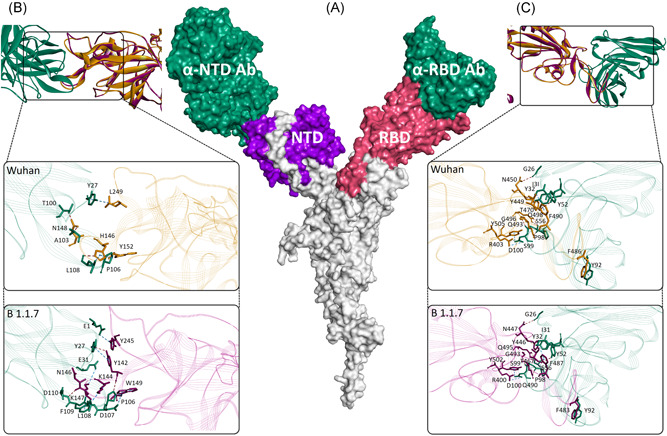
Interaction between SARS‐CoV‐2 spike protein and antibodies. (A) Cartoon showing surface topology of antibodies (sea green) interaction with the NTD (purple) and RBD (pink) of the SARS‐CoV‐2 spike protein. Intermolecular interactions between, (B) NTD and, (C) RBD of SARS‐CoV‐2/Wuhan (gold) and SARS‐CoV‐2/B.1.1.7 (magenta) spike proteins in ribbon conformation. The enlarged views in each showing stick models of intermolecular interactions between the antibody residues (sea green) and amino acids of spike proteins of SARS‐CoV‐2/Wuhan (gold) and SARS‐CoV‐2/B.1.1.7 (magenta). Intermolecular hydrogen bonds and non‐hydrogen bond intermolecular interactions (electrostatic and hydrophobic) are shown with brown and blue‐dotted lines, respectively
Figure 4
Figure 4
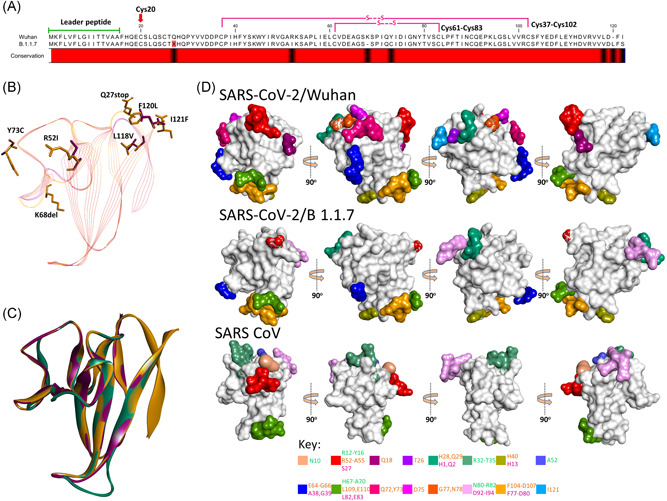
Comparison of SARS‐CoV‐2/Wuhan and SARS‐CoV‐2/B.1.1.7 orf8. (A) Sequence alignment of orf8 of SARS‐CoV‐2/Wuhan and SARS‐CoV‐2/B.1.1.7 showing leader peptide region and cysteine involved in intramolecular disulfide bonds. Note the presence of the stop codon at position 27 in SARS‐CoV‐2/B.1.1.7. The variable amino acids are indicated by the black color in the conservation bar. (B) Stick representation of the spatial orientation of amino acids of SARS‐CoV‐2/Wuhan orf8 (gold) compared with substituting amino acids in SARS‐CoV‐2/B.1.1.7 orf8 (magenta). (C) Structural comparison of orf8 in ribbon conformation of SARS‐CoV (green), SARS‐CoV‐2/Wuhan (gold), and SARS‐CoV‐2/B.1.1.7 (magenta). (D) Surface topology view with 360° rotation of epitope distribution in the orf8 of SARS‐CoV‐2/Wuhan and orf8b of SARS‐CoV and SARS‐CoV‐2/B.1.1.7, as labeled. Corresponding epitopes in terms of position within orf8/8b are colored differently (key given at the bottom)

References

    1. WHO . Weekly operational update on COVID‐19 ‐ 13 February 2021. https://www.who.int/publications/m/item/weekly-operational-update-on-cov...
    1. GISAID . https://www.gisaid.org/epiflu-applications/phylodynamics/
    1. Chand M, Hopkins S, Dabrera G, et al. Investigation of novel SARS‐COV‐2 variant: Variant of Concern 202012/01. Public Health England. 2020. https://www.gov.uk/government/publications/investigation-of-novel-sars-c...
    1. Rambaut A, Loman N, Pybus O, et al. Preliminary genomic characterisation of an emergent SARS‐CoV‐2 lineage in the UK defined by a novel set of spike mutations. Written on behalf of COVID‐19 Genomics Consortium UK. 2020. https://virological.org/t/preliminary-genomic-characterisation-of-an-eme...
    1. Umair M, Ikram A, Salman M, et al. Importation of SARS‐CoV‐2 variant B.1.1.7 in Pakistan. J Med Virol. 2021:jmv.26869. 10.1002/jmv.26869 - DOI - PMC - PubMed

Publication types