Review
. 2021 Mar 11;17(3):e1009374.
doi: 10.1371/journal.pgen.1009374. eCollection 2021 Mar.

Human genetic admixture

Affiliations
Review

Human genetic admixture

Katharine L Korunes et al. PLoS Genet. .

Abstract

Throughout human history, large-scale migrations have facilitated the formation of populations with ancestry from multiple previously separated populations. This process leads to subsequent shuffling of genetic ancestry through recombination, producing variation in ancestry between populations, among individuals in a population, and along the genome within an individual. Recent methodological and empirical developments have elucidated the genomic signatures of this admixture process, bringing previously understudied admixed populations to the forefront of population and medical genetics. Under this theme, we present a collection of recent PLOS Genetics publications that exemplify recent progress in human genetic admixture studies, and we discuss potential areas for future work.


Conflict of interest statement

The authors have declared that no competing interests exist.

Figures
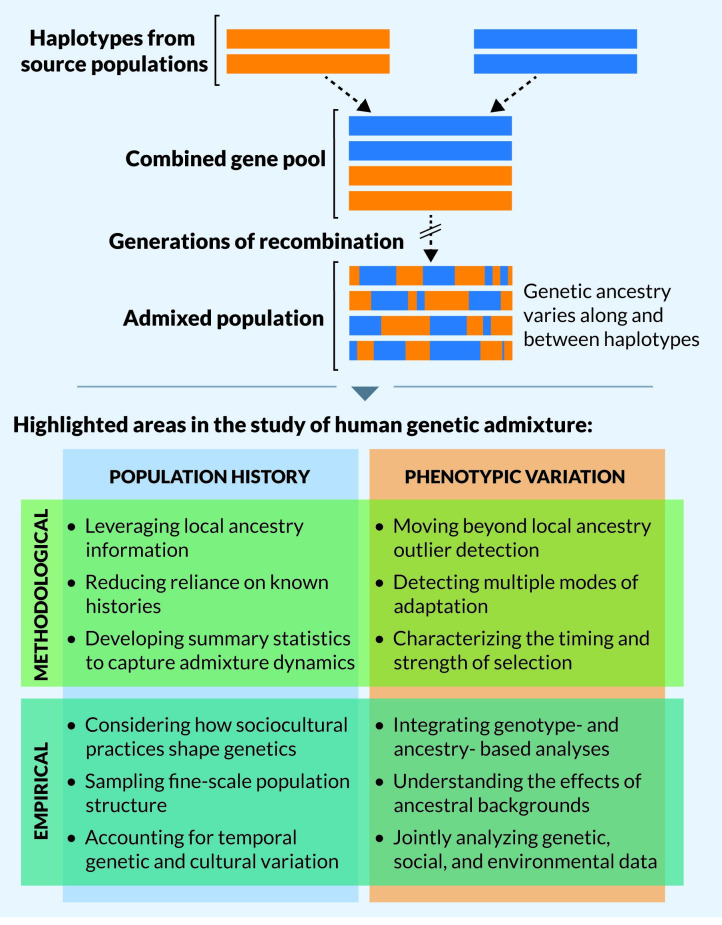
Fig 1
Fig 1
(Top) Large-scale movements of individuals allow haplotypes from previously isolated populations to come together in a combined gene pool. Generations of recombination between these haplotypes lead to an admixed population with genetic ancestry that varies between individuals and along haplotypes. The distribution of this variation is governed by the demographic and selection history of the admixed population and its sources. (Bottom) To leverage these patterns of admixed ancestry to better understand human history and phenotypic variation, we highlight key areas of recent progress and possible future directions in the study of human genetic admixture.

References

    1. Mathias RA, Taub MA, Gignoux CR, Fu W, Musharoff S, O’Connor TD, et al.. A continuum of admixture in the Western Hemisphere revealed by the African Diaspora genome. Nat Commun. 2016. November;7(1):12522. 10.1038/ncomms12522 - DOI - PMC - PubMed
    1. Hellenthal G, Busby GBJ, Band G, Wilson JF, Capelli C, Falush D, et al.. A Genetic Atlas of Human Admixture History. Science. 2014. February 14;343(6172):747–51. 10.1126/science.1243518 - DOI - PMC - PubMed
    1. Busby GB, Band G, Si Le Q, Jallow M, Bougama E, Mangano VD, et al.. Admixture into and within sub-Saharan Africa. Pickrell JK, editor. Elife. 2016. June 21;5:e15266. 10.7554/eLife.15266 - DOI - PMC - PubMed
    1. Nielsen R, Akey JM, Jakobsson M, Pritchard JK, Tishkoff S, Willerslev E. Tracing the peopling of the world through genomics. Nature. 2017. January;541(7637):302–10. 10.1038/nature21347 - DOI - PMC - PubMed
    1. Hudjashov G, Karafet TM, Lawson DJ, Downey S, Savina O, Sudoyo H, et al.. Complex Patterns of Admixture across the Indonesian Archipelago. Mol Biol Evol. 2017. 01;34(10):2439–52. 10.1093/molbev/msx196 - DOI - PMC - PubMed

Publication types

LinkOut - more resources