Louse-borne relapsing fever-A systematic review and analysis of the literature: Part 1-Epidemiology and diagnostic aspects
- PMID: 33705384
- PMCID: PMC7951878
- DOI: 10.1371/journal.pntd.0008564
Louse-borne relapsing fever-A systematic review and analysis of the literature: Part 1-Epidemiology and diagnostic aspects
Abstract
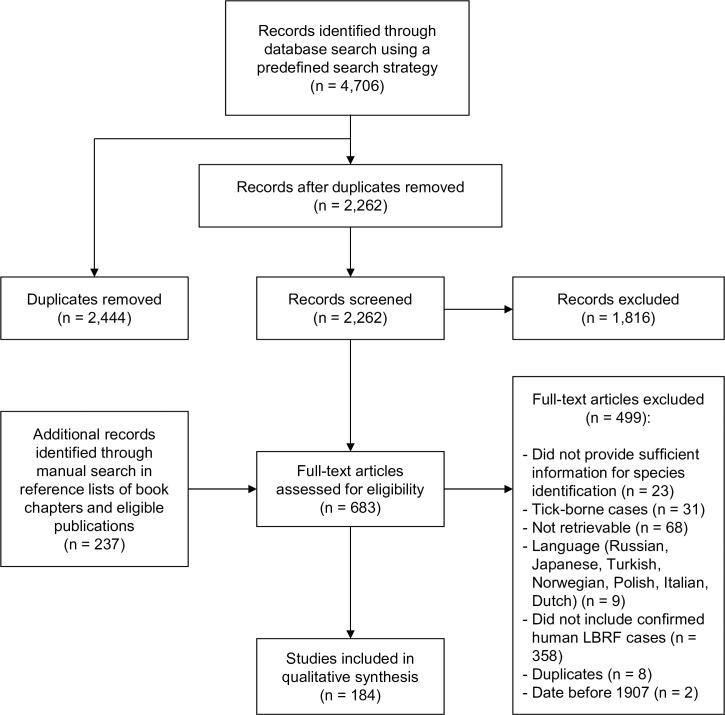
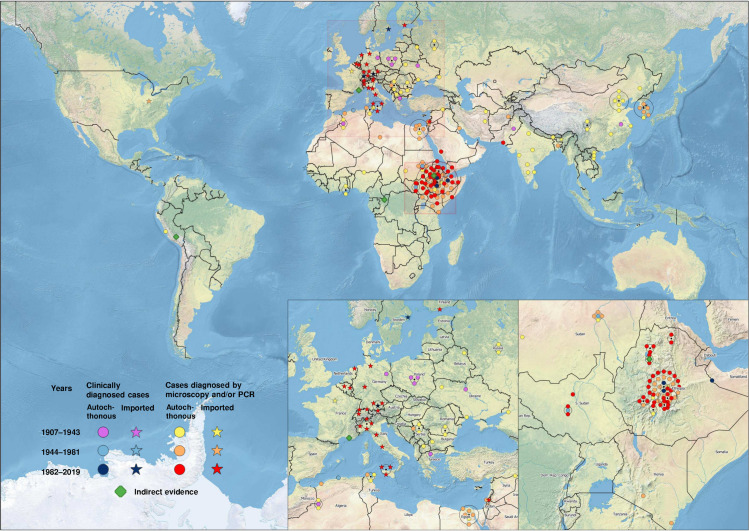
Louse-borne relapsing fever (LBRF) is a classical epidemic disease, which in the past was associated with war, famine, poverty, forced migration, and crowding under poor hygienic conditions around the world. The disease's causative pathogen, the spirochete bacterium Borrelia recurrentis, is confined to humans and transmitted by a single vector, the human body louse Pediculus humanus. Since the disease has had its heyday before the days of modern medicine, many of its aspects have never been formally studied and to date, remain incompletely understood. In order to shed light on some of these aspects, we have systematically reviewed the accessible literature on LBRF, since the recognition of its mode of transmission in 1907, and summarized the existing data on epidemiology and diagnostic aspects of the disease. Publications were identified by using a predefined search strategy on electronic databases and a subsequent review of the reference lists of the obtained publications. All publications reporting patients with a confirmed diagnosis of LBRF published in English, French, German, and Spanish since 1907 were included. Data extraction followed a predefined protocol and included a grading system to judge the certainty of the diagnosis of reported cases. Historically, Ethiopia is considered a stronghold of LBRF. The recognition of LBRF among East African migrants (originating from Somalia, Eritrea, and Ethiopia) arriving to Europe in the course of the recent migration flow from this region suggests that this epidemiological focus ostensibly persists. Currently, there is neither evidence to support or refute active transmission foci of LBRF elsewhere on the African continent, in Latin America, or in Asia. Microscopy remains the most commonly used method to diagnose LBRF. Data are lacking on sensitivity and specificity of most diagnostic methods.
Conflict of interest statement
The authors have declared that no competing interests exist.
Figures
References
-
- Hippocrates, Chadwick J, Mann WN. The Medical Works of Hippocrates. A new translation… by John Chadwick… and W.N. Mann. [With a portrait.]. Blackwell Scientific Publications: Oxford; 1950.
-
- Balthazard M. Relapsing fevers. In: National Academy of Sciences WDC, editor. Tropical Health; a Report on a Study of Needs and Resources1962. p. 497.
-
- Greig EDW. An Epidemic of Relapsing Fever in Edinburgh In 1843. Edinb Med J 1943;50(11):681–6.
Publication types
MeSH terms
Supplementary concepts
LinkOut - more resources
Full Text Sources
Other Literature Sources
Miscellaneous