


Serological markers and risk factors associated with Hepatitis B virus infection among Federal Capital Territory prison inmates, Nigeria: Should we be concerned?
- PMID: 33705419
- PMCID: PMC7951833
- DOI: 10.1371/journal.pone.0248045
Serological markers and risk factors associated with Hepatitis B virus infection among Federal Capital Territory prison inmates, Nigeria: Should we be concerned?
Abstract
Introduction: Hepatitis B virus (HBV) infection is hyper-endemic in Nigeria. Prisons are high-risk environments for the spread of infectious diseases. Worldwide, seroprevalence of HBV infection is substantially higher among individuals in correctional facilities when compared to general population. We determined the seroprevalence and risk factors associated with HBV infection among Kuje prison inmates, Nigeria.
Material and methods: We conducted a prison facility based cross-sectional study. Interviewer administered questionnaires were used to obtain information on participants socio-demographic characteristics, HBV risk factors, previous HBV test and vaccination history. Blood samples collected from participants were analysed for HBsAg, HBsAb, HBcAb, HBeAg and HBeAb markers using rapid lateral chromatographic immunoassay kit. Univariate, bivariate, and multivariate analysis were performed.
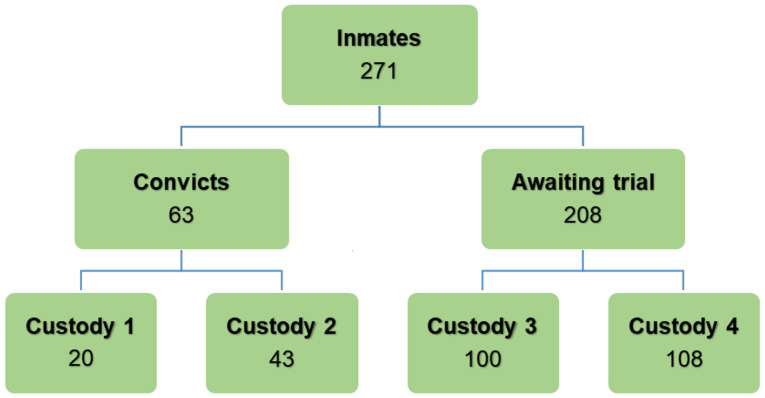
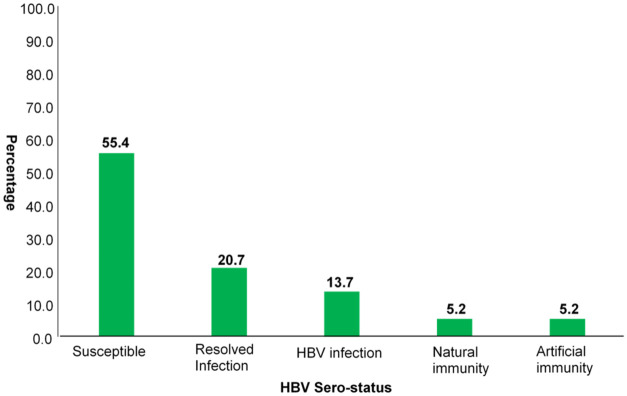
Results: A total of 271 inmates (63 convicts and 208 awaiting trial inmates) were recruited into the study as participants. The mean age of the participants was 32.7 SD±9 years. HBV seroprevalence (HBsAg) of 13.7% (95% CI: 9.8-18.3) was found. 55.4% (95% CI: 49.2-61.4) of inmates were susceptible to HBV infection, 20.7% (95%CI; 16.0-26.0) had past HBV infection while 10.3% (95% CI: 7.0-14.6) had acquired natural or artificial HBV immunity. Factors found to be associated with current HBV infection (HBsAg) include age-group ≤25years (aOR = 8.0,95% CI: 2.9-22.3), being ever married (aOR = 4.2, 95% CI: 1.7-10.4) and history of alcohol consumption (aOR = 3.4, 95% CI: 1.3-8.4).
Conclusion: This study reveals a high seroprevalence of HBV infection among Kuje Prison inmates, hence the need to introduce prison-focused health intervention initiatives such as HBV screening, vaccination and care to reduce the transmission of HBV infection among inmates and ultimately the general population.
Conflict of interest statement
The authors have declared that no competing interests exist.
Figures
References
-
- Adoga PM, Banwat EB, Forbi JC, et al.. Human immunodeficiency virus, hepatitis B virus and hepatitis C virus: Sero-prevalence, co-infection and risk factors among prison inmates in Nasarawa State, Nigeria. J Infect Dev Ctries 2009; 3(7)539–547. https://pubmed.ncbi.nlm.nih.gov/19762972/ 10.3855/jidc.472 - DOI - PubMed
-
- Nigeria Prison Service http://www.prisons.gov.ng/statistics
-
- Adjei AA, Armah BA Gbagbo F Ampofo, et al.. Prevalence of Human Immunodeficiency virus, Hepatitis B virus, Hepatitis C virus and Syphilis among prison inmates and officers at Nsawam and Accra, Ghana. J Med Micro 2006; 5(5)593–597. https://pubmed.ncbi.nlm.nih.gov/16585647/ 10.1099/jmm.0.46414-0 - DOI - PubMed
-
- Khan AJ, Simard EP, Bower WA, et al.. Ongoing transmission of hepatitis B virus infection among inmates at a state correctional facility. Am J Public Health. 2005; 95(10) https://www.ncbi.nlm.nih.gov/pmc/articles/PMC1449438/ - PMC - PubMed
-
- Musa B, Bussell S, Borodo MM, Samaila AA, Femi OL. Prevalence of hepatitis B virus infection in Nigeria, 2000–2013: A systematic review and meta-analysis. Niger J ClinPract 2015; (18)163–72. https://pubmed.ncbi.nlm.nih.gov/25665986/ 10.4103/1119-3077.151035 - DOI - PubMed
MeSH terms
Substances
LinkOut - more resources
Full Text Sources
Other Literature Sources
Medical
Miscellaneous
