


Don't put all social network sites in one basket: Facebook, Instagram, Twitter, TikTok, and their relations with well-being during the COVID-19 pandemic
- PMID: 33705462
- PMCID: PMC7951844
- DOI: 10.1371/journal.pone.0248384
Don't put all social network sites in one basket: Facebook, Instagram, Twitter, TikTok, and their relations with well-being during the COVID-19 pandemic
Abstract
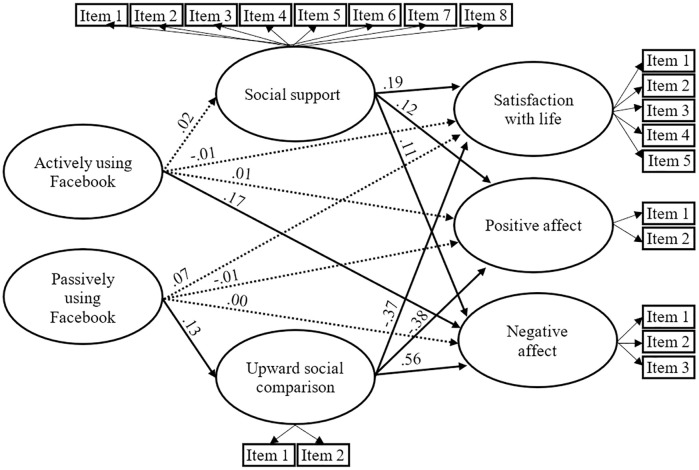
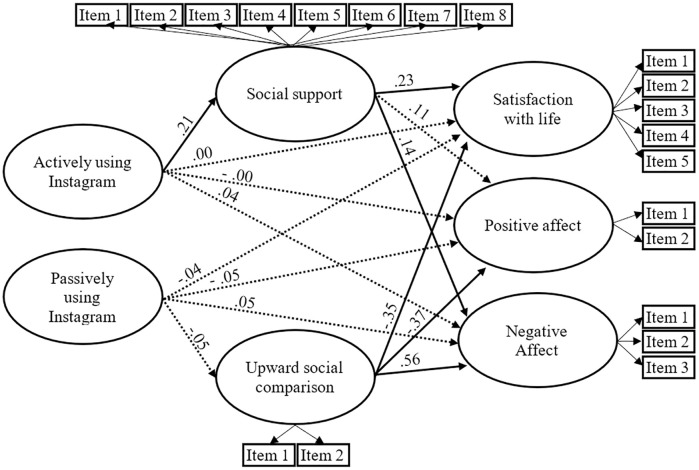
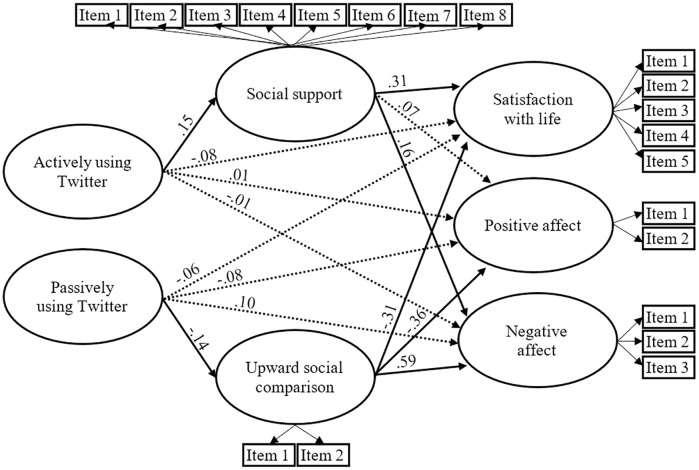
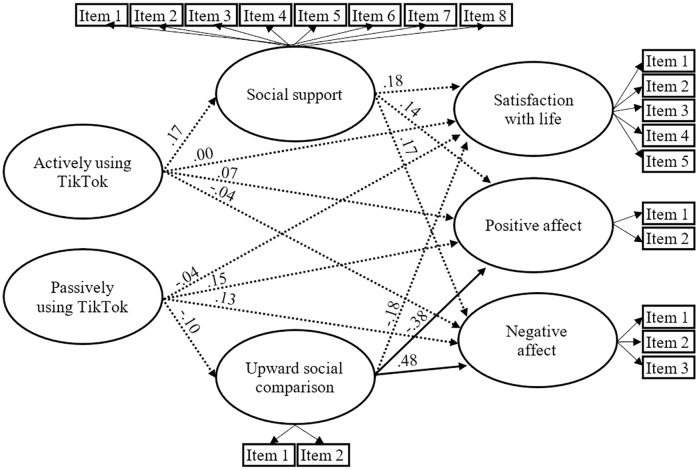
Prior studies indicated that actively using social network sites (SNSs) is positively associated with well-being by enhancing social support and feelings of connectedness. Conversely, passively using SNSs is negatively associated with well-being by fostering upward social comparison and envy. However, the majority of these studies has focused on Facebook. The present research examined the relationships between well-being-satisfaction with life, negative affect, positive affect-and using actively or passively various SNSs-Facebook, Instagram, Twitter, TikTok-during the COVID-19 pandemic. In addition, two mediators were tested: social support and upward social comparison. One thousand four persons completed an online survey during the quarantine measures; the analyses employed structural equation modeling. Results showed that passive usage of Facebook is negatively related to well-being through upward social comparison, whereas active usage of Instagram is positively related to satisfaction with life and negative affect through social support. Furthermore, active usage of Twitter was positively related to satisfaction with life through social support; while passive usage was negatively related to upward social comparison, which, in turn, was associated with more negative affect. Finally, TikTok use was not associated with well-being. Results are discussed in line with SNSs' architectures and users' motivations. Future research is required to go beyond methodological and statistical limitations and allow generalization. This study concludes that SNSs must be differentiated to truly understand how they shape human interactions.
Conflict of interest statement
The authors have declared that no competing interests exist.
Figures
References
-
- Jetten J, Haslam SA, Haslam C. The case for a social identity analysis of health and well-being. In: Jetten J, Haslam SA, Haslam C, editors. The social cure: Identity, health and well-being. Psychology Press; 2012. p. 1–19.
-
- Altena E, Baglioni C, Espie CA, Ellis J, Gavriloff D, Holzinger B, et al. Dealing with sleep problems during home confinement due to the COVID-19 outbreak: Practical recommendations from a task force of the European CBT-I Academy. Journal of Sleep Research. 2020;29(4):e13052. 10.1111/jsr.13052 - DOI - PubMed
-
- Qiu J, Shen B, Zhao M, Wang Z, Xie B, Xu Y. A nationwide survey of psychological distress among Chinese people in the COVID-19 epidemic: implications and policy recommendations. Gen Psychiatr [Internet]. 2020. March 6 [cited 2020 Sep 2];33(2). Available from: https://www.ncbi.nlm.nih.gov/pmc/articles/PMC7061893/. 10.1136/gpsych-2020-100213 - DOI - PMC - PubMed
-
- Casey N. How social networks can do good while we’re all trapped indoors. The Verge [Internet]. 2020. March 13; https://www.theverge.com/interface/2020/3/13/21176880/covid-19-quarantin....
MeSH terms
LinkOut - more resources
Full Text Sources
Other Literature Sources
Medical
