


The prognostic impact of the tumour stroma fraction: A machine learning-based analysis in 16 human solid tumour types
- PMID: 33706249
- PMCID: PMC7960932
- DOI: 10.1016/j.ebiom.2021.103269
The prognostic impact of the tumour stroma fraction: A machine learning-based analysis in 16 human solid tumour types
Abstract
Background: The development of a reactive tumour stroma is a hallmark of tumour progression and pronounced tumour stroma is generally considered to be associated with clinical aggressiveness. The variability between tumour types regarding stroma fraction, and its prognosis associations, have not been systematically analysed.
Methods: Using an objective machine-learning method we quantified the tumour stroma in 16 solid cancer types from 2732 patients, representing retrospective tissue collections of surgically resected primary tumours. Image analysis performed tissue segmentation into stromal and epithelial compartment based on pan-cytokeratin staining and autofluorescence patterns.
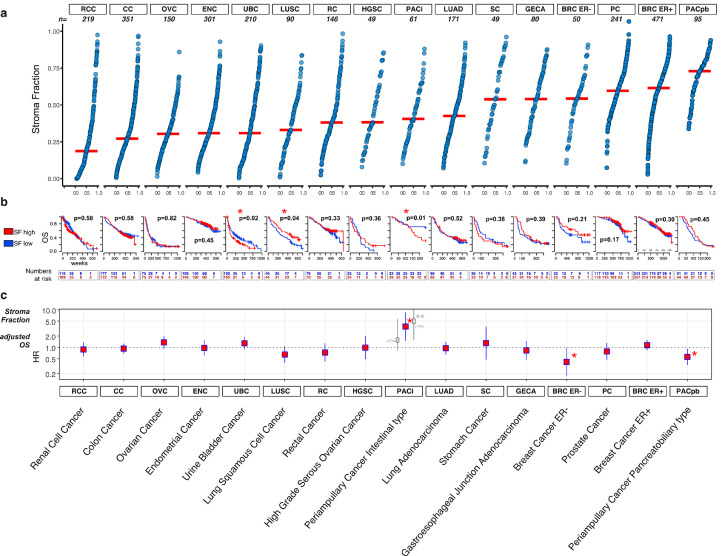
Findings: The stroma fraction was highly variable within and across the tumour types, with kidney cancer showing the lowest and pancreato-biliary type periampullary cancer showing the highest stroma proportion (median 19% and 73% respectively). Adjusted Cox regression models revealed both positive (pancreato-biliary type periampullary cancer and oestrogen negative breast cancer, HR(95%CI)=0.56(0.34-0.92) and HR(95%CI)=0.41(0.17-0.98) respectively) and negative (intestinal type periampullary cancer, HR(95%CI)=3.59(1.49-8.62)) associations of the tumour stroma fraction with survival.
Interpretation: Our study provides an objective quantification of the tumour stroma fraction across major types of solid cancer. Findings strongly argue against the commonly promoted view of a general associations between high stroma abundance and poor prognosis. The results also suggest that full exploitation of the prognostic potential of tumour stroma requires analyses that go beyond determination of stroma abundance.
Funding: The Swedish Cancer Society, The Lions Cancer Foundation Uppsala, The Swedish Government Grant for Clinical Research, The Mrs Berta Kamprad Foundation, Sweden, Sellanders foundation, P.O.Zetterling Foundation, and The Sjöberg Foundation, Sweden.
Copyright © 2021 The Author(s). Published by Elsevier B.V. All rights reserved.
Conflict of interest statement
Declaration of Competing Interest Conflict of interest statement: Artur Mezheyeuski, Carina Strell and Patrick Micke own shares in the company HistoOne AB, Uppsala, Sweden, which infrastructure was used for the pathology assessment of tissue samples in the study. The other authors have no conflicts of interest to disclose.
Figures
References
-
- Micke P, Ostman A. Tumour-stroma interaction: cancer-associated fibroblasts as novel targets in anti-cancer therapy? Lung Cancer. 2004;45(Suppl 2):S163–S175. - PubMed
-
- Paulsson J, Micke P. Prognostic relevance of cancer-associated fibroblasts in human cancer. Semin Cancer Biol. 2014;25:61–68. - PubMed
MeSH terms
LinkOut - more resources
Full Text Sources
Other Literature Sources
Medical
