Breastfeeding and Childhood Dental Caries: Results from a Socially Diverse Birth Cohort Study
- PMID: 33706311
- PMCID: PMC8117384
- DOI: 10.1159/000514502
Breastfeeding and Childhood Dental Caries: Results from a Socially Diverse Birth Cohort Study
Abstract
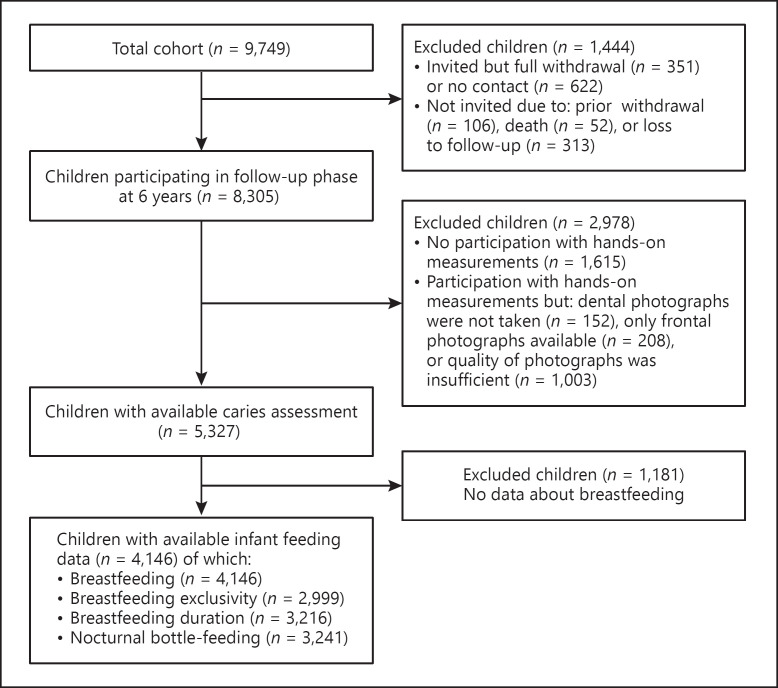
Previous studies showed that prolonged breastfeeding increases the risk of caries. However, the observed associations were mainly based on non-European populations, and important confounding and mediating factors like socioeconomic position (SEP) and diet were often neglected. The aim of this study was to investigate the role of breastfeeding and bottle-feeding practices on dental caries during childhood while accounting for SEP, ethnic background, and sugar intake. This study was part of the Generation R Study, a prospective multiethnic cohort study conducted in Rotterdam, The Netherlands. In total, 4,146 children were included in the analyses. Information about feeding practices was derived from delivery reports and questionnaires during infancy. Caries was measured via intraoral photographs at the age of 6 years and defined as decayed, missing, and filled teeth (dmft). Negative binomial hurdle regression analyses were used to study the associations between several infant feeding practices and childhood caries. The prevalence of dental caries at the age of 6 years was 27.9% (n = 1,158). Prolonged breastfeeding (for >12 months) was associated with dental caries (OR 1.35, 95% CI 1.04-1.74) and the number of teeth affected by dental caries (RR 1.27, 95% CI 1.03-1.56). Furthermore, nocturnal bottle-feeding was associated with dental caries (OR 1.52, 95% CI 1.20-1.93). All associations were independent of family SEP, ethnic background, and sugar intake. Results from this Dutch cohort study confirmed the previously observed associations between prolonged breastfeeding and nocturnal bottle-feeding and the increased risk of childhood dental caries, even after proper adjustments for indicators of SEP, ethnic background, and sugar intake. Future studies are encouraged to elaborate further on possible explanations for the observed relationships. Healthcare professionals should be aware and advise caregivers about the potential risk of prolonged breastfeeding on caries development by applying the current recommendations on breastfeeding, oral hygiene, and feeding frequency.
Keywords: Breastfeeding; Dental caries; Infant feeding; Infants; Nutritional epidemiology; Pediatric dentistry.
© 2021 The Author(s) Published by S. Karger AG, Basel.
Conflict of interest statement
The authors declare no potential conflicts of interest with respect to the authorship and/or publication of this article.
Figures
References
-
- Bowen WH, Lawrence RA. Comparison of the cariogenicity of cola, honey, cow milk, human milk, and sucrose. Pediatrics. 2005 Oct;116((4)):921–6. - PubMed
-
- CBS . Den Haag/Heerlen: Statistics Netherlands. Centraal Bureau voor de Statistiek; 2004. Immigrants in the Netherlands 2004 (Allochtonen in Nederland 2004).
-
- CBS Income, welfare and spending of households and individuals. Den Haag/Heerlen: Statistics Netherlands (Centraal Bureau voor de Statistiek); 2012
-
- CBS . Den Haag/Heerlen: Statistics Netherlands. Centraal Bureau voor de Statistiek; 2017. The Dutch Standard Classification of Education (Standaard onderwijsindeling 2016)