


Outbreaks of publications about emerging infectious diseases: the case of SARS-CoV-2 and Zika virus
- PMID: 33706715
- PMCID: PMC7948668
- DOI: 10.1186/s12874-021-01244-7
Outbreaks of publications about emerging infectious diseases: the case of SARS-CoV-2 and Zika virus
Abstract
Background: Outbreaks of infectious diseases generate outbreaks of scientific evidence. In 2016 epidemics of Zika virus emerged, and in 2020, a novel severe acute respiratory syndrome coronavirus 2 (SARS-CoV-2) caused a pandemic of coronavirus disease 2019 (COVID-19). We compared patterns of scientific publications for the two infections to analyse the evolution of the evidence.
Methods: We annotated publications on Zika virus and SARS-CoV-2 that we collected using living evidence databases according to study design. We used descriptive statistics to categorise and compare study designs over time.
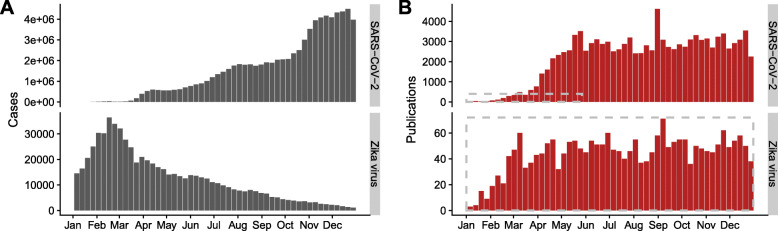
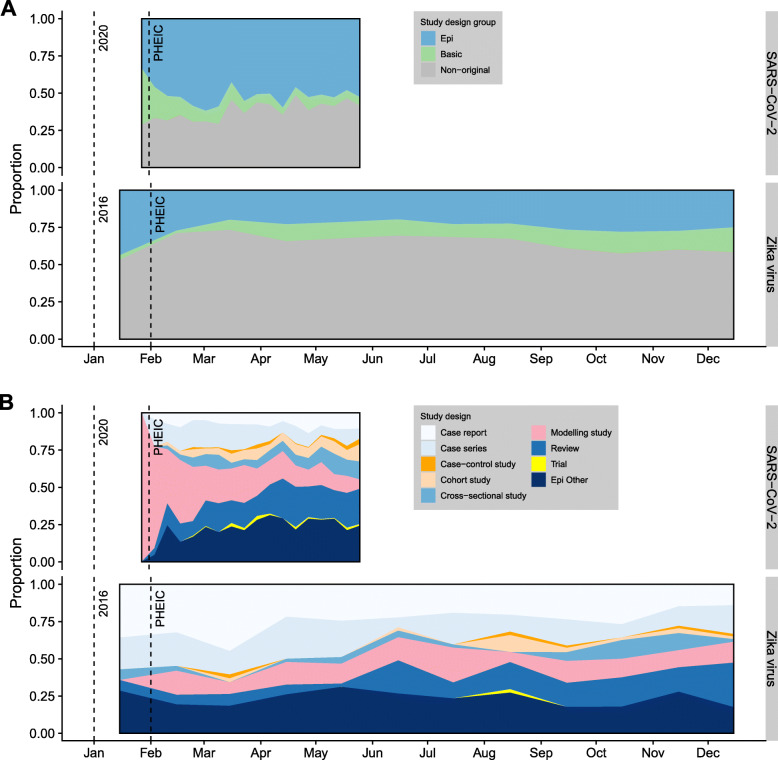
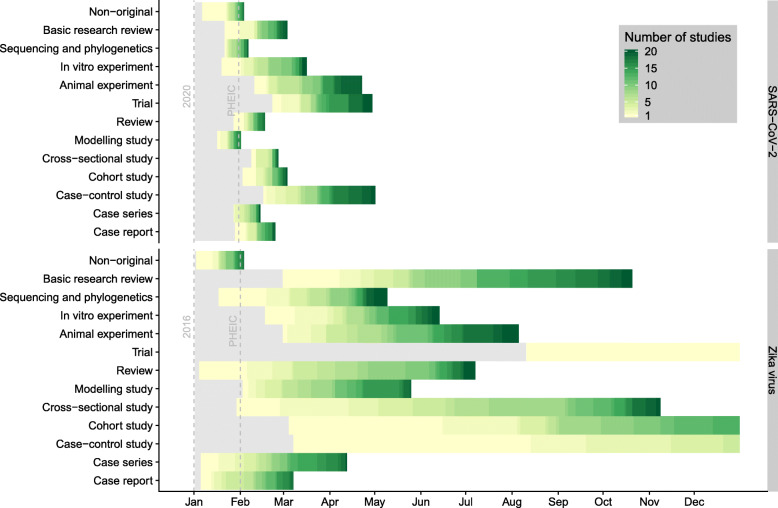
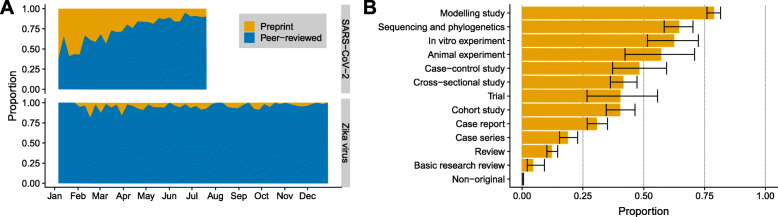
Results: We found 2286 publications about Zika virus in 2016 and 21,990 about SARS-CoV-2 up to 24 May 2020, of which we analysed a random sample of 5294 (24%). For both infections, there were more epidemiological than laboratory science studies. Amongst epidemiological studies for both infections, case reports, case series and cross-sectional studies emerged first, cohort and case-control studies were published later. Trials were the last to emerge. The number of preprints was much higher for SARS-CoV-2 than for Zika virus.
Conclusions: Similarities in the overall pattern of publications might be generalizable, whereas differences are compatible with differences in the characteristics of a disease. Understanding how evidence accumulates during disease outbreaks helps us understand which types of public health questions we can answer and when.
Conflict of interest statement
The funders of this study had no role in the study design, data analysis, data interpretation, or writing of the report. All authors had full access to all of the data and final responsibility for the decision to submit for publication.
Figures
References
-
- World Health Organization. WHO statement on the first meeting of the International Health Regulations (2005) (IHR 2005) Emergency Committee on Zika virus and observed increase in neurological disorders and neonatal malformations 2016 [Last accessed: 10/10/2020)]. Available from: https://www.who.int/news-room/detail/01-02-2016-who-statement-on-the-fir...(2005)-(ihr-2005)-emergency-committee-on-zika-virus-and-observed-increase-in-neurological-disorders-and-neonatal-malformations.
-
- World Health Organization. COVID-19 Public Health Emergency of International Concern (PHEIC) Global research and innovation forum 2020 [Last accessed: 10/10/2020)]. Available from: https://www.who.int/publications/m/item/covid-19-public-health-emergency...(pheic)-global-research-and-innovation-forum.
Publication types
MeSH terms
Grants and funding
LinkOut - more resources
Full Text Sources
Other Literature Sources
Medical
Miscellaneous
