


Reducing youth suicide: systems modelling and simulation to guide targeted investments across the determinants
- PMID: 33706764
- PMCID: PMC7952221
- DOI: 10.1186/s12916-021-01935-4
Reducing youth suicide: systems modelling and simulation to guide targeted investments across the determinants
Abstract
Background: Reducing suicidal behaviour (SB) is a critical public health issue globally. The complex interplay of social determinants, service system factors, population demographics, and behavioural dynamics makes it extraordinarily difficult for decision makers to determine the nature and balance of investments required to have the greatest impacts on SB. Real-world experimentation to establish the optimal targeting, timing, scale, frequency, and intensity of investments required across the determinants is unfeasible. Therefore, this study harnesses systems modelling and simulation to guide population-level decision making that represent best strategic allocation of limited resources.
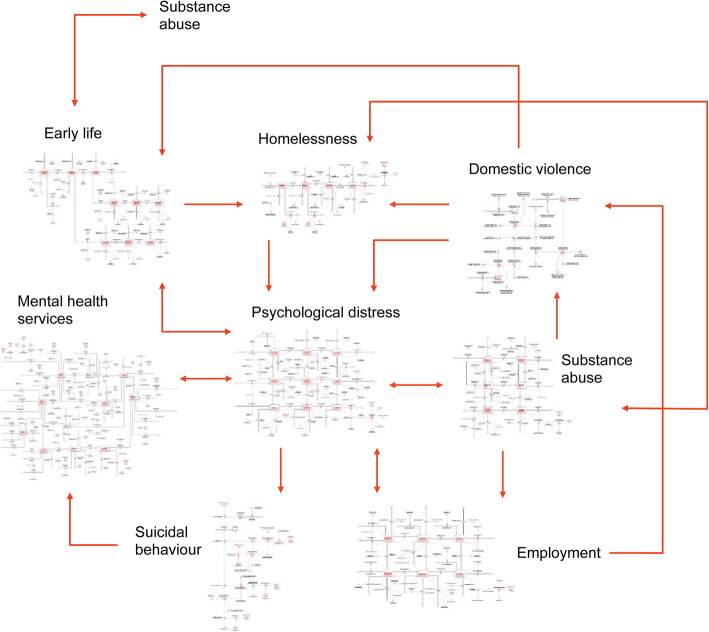
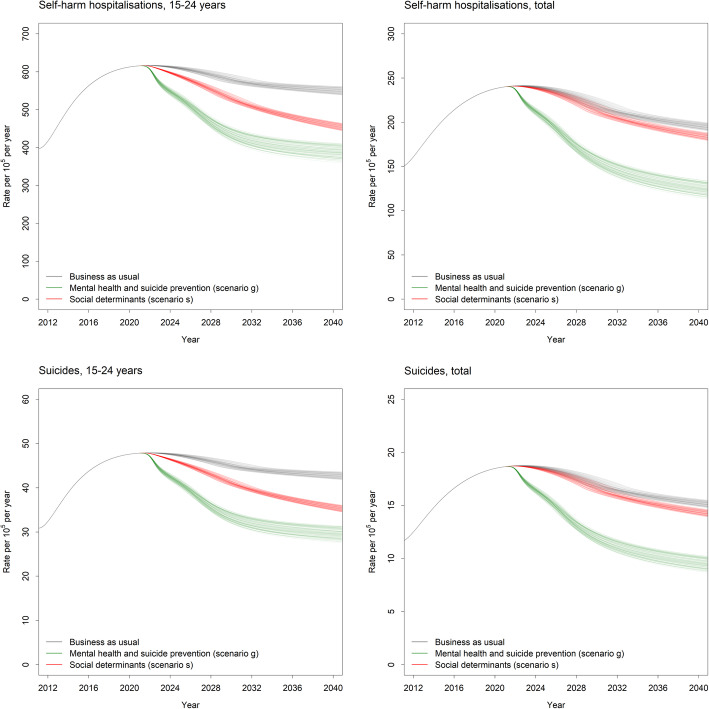
Methods: Using a participatory approach, and informed by a range of national, state, and local datasets, a system dynamics model was developed, tested, and validated for a regional population catchment. The model incorporated defined pathways from social determinants of mental health to psychological distress, mental health care, and SB. Intervention scenarios were investigated to forecast their impact on SB over a 20-year period.
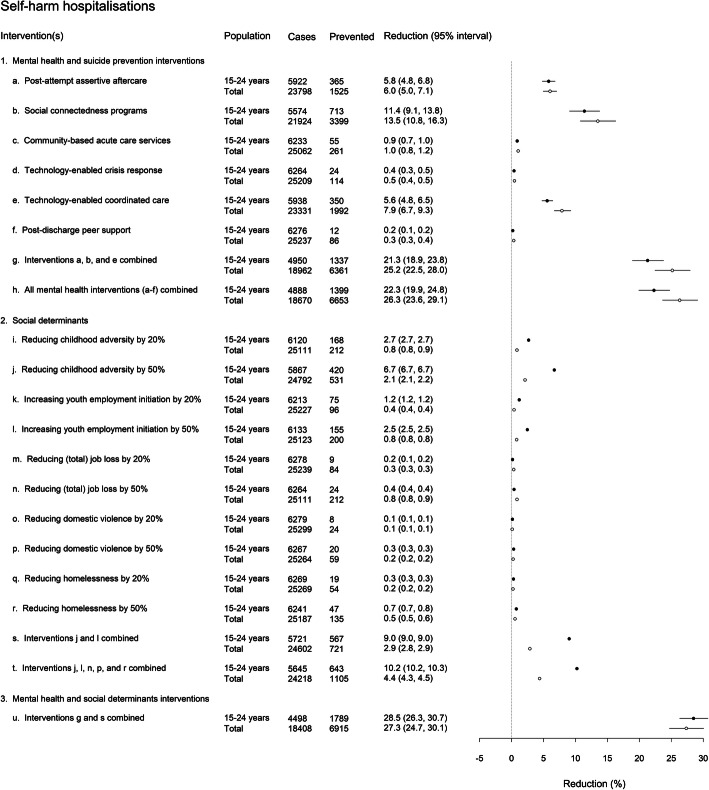
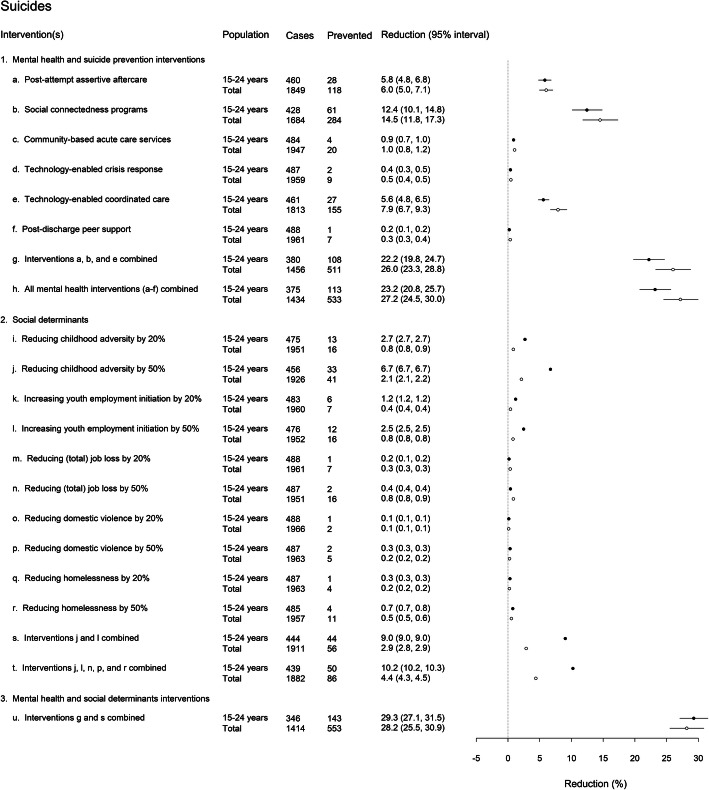
Results: A combination of social connectedness programs, technology-enabled coordinated care, post-attempt assertive aftercare, reductions in childhood adversity, and increasing youth employment projected the greatest impacts on SB, particularly in a youth population, reducing self-harm hospitalisations (suicide attempts) by 28.5% (95% interval 26.3-30.8%) and suicide deaths by 29.3% (95% interval 27.1-31.5%). Introducing additional interventions beyond the best performing suite of interventions produced only marginal improvement in population level impacts, highlighting that 'more is not necessarily better.'
Conclusion: Results indicate that targeted investments in addressing the social determinants and in mental health services provides the best opportunity to reduce SB and suicide. Systems modelling and simulation offers a robust approach to leveraging best available research, data, and expert knowledge in a way that helps decision makers respond to the unique characteristics and drivers of SB in their catchments and more effectively focus limited health resources.
Keywords: Decision analysis; Simulation; Strategic planning; Suicide prevention; Systems modelling.
Conflict of interest statement
Authors AS, FI, KL, JS, WB, TD, and DH declare they have no conflicts of interest relevant to this work.
A/Professor Jo-An Occhipinti (née Atkinson) is both Head of Systems Modelling, Simulation & Data Science at the University of Sydney’s Brain and Mind Centre and Managing Director of Computer Simulation & Advanced Research Technologies (CSART). Professor Ian Hickie was an inaugural Commissioner on Australia’s National Mental Health Commission (2012–2018). He is the Co-Director, Health and Policy at the Brain and Mind Centre (BMC) University of Sydney, Australia. The BMC operates an early-intervention youth services at Camperdown under contract to headspace. Professor Hickie has previously led community-based and pharmaceutical industry-supported (Wyeth, Eli Lily, Servier, Pfizer, AstraZeneca) projects focused on the identification and better management of anxiety and depression. He was a member of the Medical Advisory Panel for Medibank Private until October 2017, a Board Member of Psychosis Australia Trust and a member of Veterans Mental Health Clinical Reference group. He is the Chief Scientific Advisor to, and a 5% equity shareholder in, InnoWell Pty Ltd. InnoWell was formed by the University of Sydney (45% equity) and PwC (Australia; 45% equity) to deliver the $30 M Australian Government-funded Project Synergy (2017–2020; a 3-year program for the transformation of mental health services) and to lead transformation of mental health services internationally through the use of innovative technologies.
Figures
References
-
- Australian Bureau of Statistics: 3303.0 Causes of death, Australia, 2019. In. Canberra: ABS: https://www.abs.gov.au/statistics/health/causes-death/causes-death-austr... 2020.
Publication types
MeSH terms
LinkOut - more resources
Full Text Sources
Other Literature Sources
