. 2021 Mar 12;20(1):68.
doi: 10.1186/s12934-021-01551-0.

Efficient bioconversion of raspberry ketone in Escherichia coli using fatty acids feedstocks

Affiliations

Efficient bioconversion of raspberry ketone in Escherichia coli using fatty acids feedstocks

Chen Chang et al. Microb Cell Fact. .

Abstract

Background: Phenylpropanoid including raspberry ketone, is a kind of important natural plant product and widely used in pharmaceuticals, chemicals, cosmetics, and healthcare products. Bioproduction of phenylpropanoid in Escherichia coli and other microbial cell factories is an attractive approach considering the low phenylpropanoid contents in plants. However, it is usually difficult to produce high titer phenylpropanoid production when fermentation using glucose as carbon source. Developing novel bioprocess using alternative sources might provide a solution to this problem. In this study, typical phenylpropanoid raspberry ketone was used as the target product to develop a biosynthesis pathway for phenylpropanoid production from fatty acids, a promising alternative low-cost feedstock.

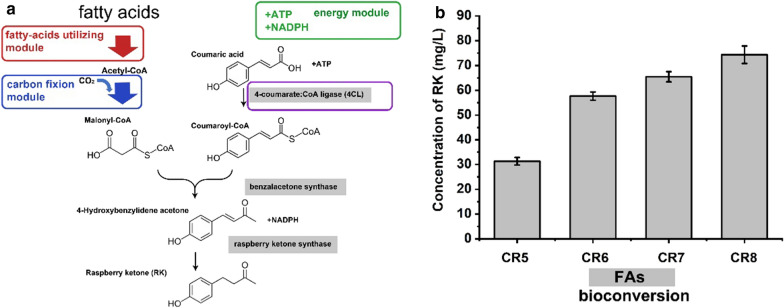
Results: A raspberry ketone biosynthesis module was developed and optimized by introducing 4-coumarate-CoA ligase (4CL), benzalacetone synthase (BAS), and raspberry ketone reductase (RZS) in Escherichia coli strains CR1-CR4. Then strain CR5 was developed by introducing raspberry ketone biosynthesis module into a fatty acids-utilization chassis FA09 to achieve production of raspberry ketone from fatty acids feedstock. However, the production of raspberry ketone was still limited by the low biomass and unable to substantiate whole-cell bioconversion process. Thus, a process by coordinately using fatty-acids and glycerol was developed. In addition, we systematically screened and optimized fatty acids-response promoters. The optimized promoter Pfrd3 was then successfully used for the efficient expression of key enzymes of raspberry ketone biosynthesis module during bioconversion from fatty acids. The final engineered strain CR8 could efficiently produce raspberry ketone repeatedly using bioconversion from fatty acids feedstock strategy, and was able to produce raspberry ketone to a concentration of 180.94 mg/L from soybean oil in a 1-L fermentation process.

Conclusion: Metabolically engineered Escherichia coli strains were successfully developed for raspberry ketone production from fatty acids using several strategies, including optimization of bioconversion process and fine-tuning key enzyme expression. This study provides an essential reference to establish the low-cost biological manufacture of phenylpropanoids compounds.

Keywords: Bioconversion; Escherichia coli; Fatty acids feedstock; Phenylpropanoids; Raspberry ketone.


Conflict of interest statement

The authors declare that they have no competing interests.

Figures
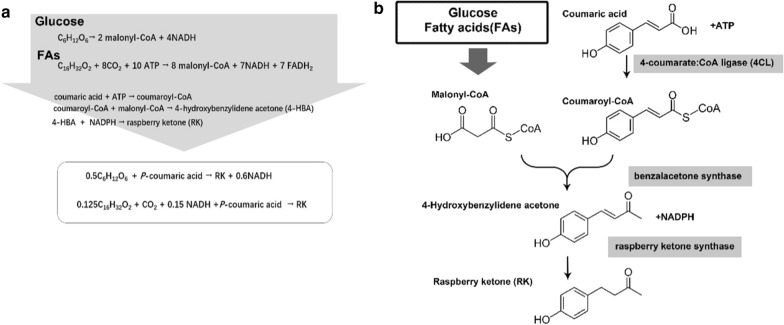
Fig. 1
Fig. 1
Production route of raspberry ketone (RK) from glucose, and fatty acids (FAs). a Equations from different carbon sources to RK; equations in the box show overall theoretical stoichiometry. b Enzymes involved in RK biosynthesis pathway
Fig. 2
Fig. 2
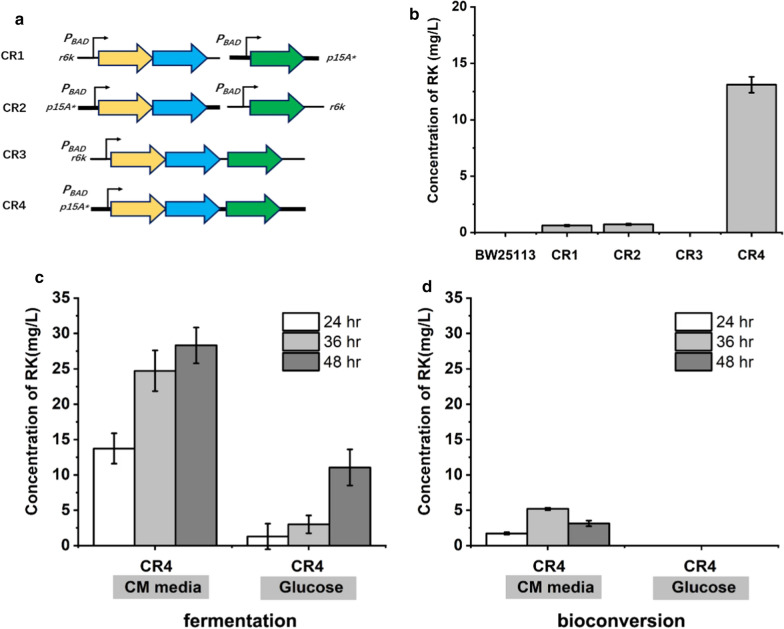
Strains optimization and RK production using a different strategy. a Construction of different RK strains. Thick lines indicate medium-copy-number plasmids; thin lines indicate low-copy-number plasmids; yellow arrows represent RiRZS1; blue arrows represent RpBAS, and green arrows represent At4CL1. b RK production by five different strains containing different plasmids singly or in combination. One-step fermentations were performed at 30 °C and 200 rpm for 24 h. CM medium containing 5 mM p-coumaric acid was used for RK production. c RK production by one-step fermentation by strain CR4. CM medium and M9-glucose medium containing 5 mM p-coumaric acid was used for RK production. One-step fermentations were performed at 30 °C and 200 rpm for 48 h. d RK production by bioconversion by strain CR4. CR4 was induced in the shake flasks containing CM medium at 30 °C and 200 rpm for 16 h. Cells were harvested, then suspended in CM medium or M9-glucose medium containing 5 mM p-coumaric acid (OD600 = 30). Bioconversions were performed at 30 °C and 200 rpm for 48 h
Fig. 3
Fig. 3
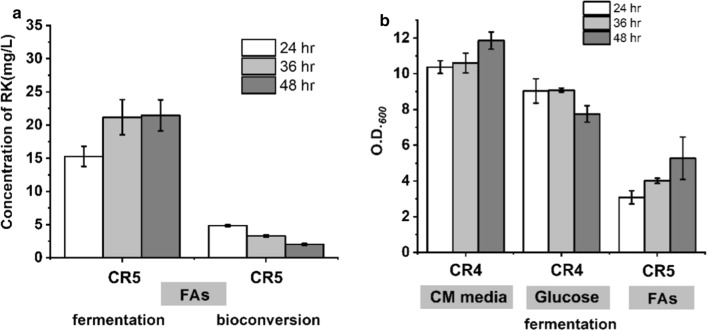
a RK production by CR5 strain in FAs medium using both fermentation and bioconversion strategy. M9-FAs medium containing 5 mM p-coumaric acid was used for fermentation. CM medium was used for bioconversion. CR5 was induced first in CM medium and harvested, then suspended in CM-FAs medium containing 5 mM p-coumaric acid (OD600 = 30). Fermentations and bioconversion were performed at 30 °C and 200 rpm. b Comparison of biomass in the different fermentation medium. CM medium, M9-glucose, and M9-FAs medium containing 5 mM p-coumaric acid were used for fermentation. Fermentations were performed at 30 °C and 200 rpm for 48 h
Fig. 4
Fig. 4
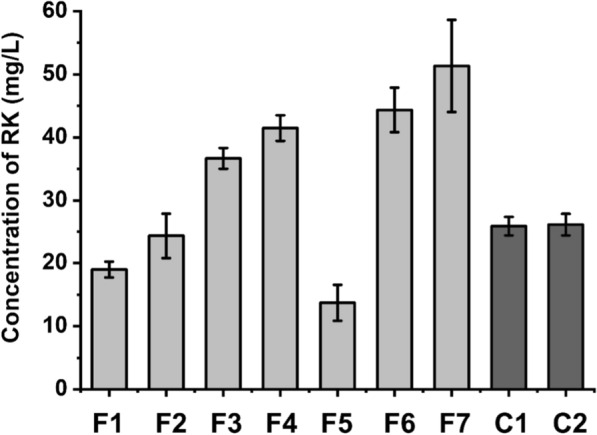
RK production under different fermentation conditions for CR5. MCM medium containing 5 mM p-coumaric acid was used for F1-F7 fermentation. The concentrations of different compositions used were: F1: none; F2: 0.2% FA; F3: 0.5% FA; F4:1% FA; F5: 1%FA + 0.5%glucose; F6: 1%FA + 0.5% glycerol; F7: 1%FA + 1% glycerol. Fermentations were performed at 30 °C and 200 rpm for 24 h. MCM7 medium was used for C1 and C2 bioconversion. C1: cells were induced by MCM7 medium and harvested, then suspended in MCM7 medium containing 5 mM p-coumaric acid (OD600 = 30); C2: Cells from CR5 cultured in MCM7 medium were harvested and suspended in MCM7 medium (OD600 = 30). Bioconversions were performed at 30 °C and 200 rpm for 24 h
Fig. 5
Fig. 5
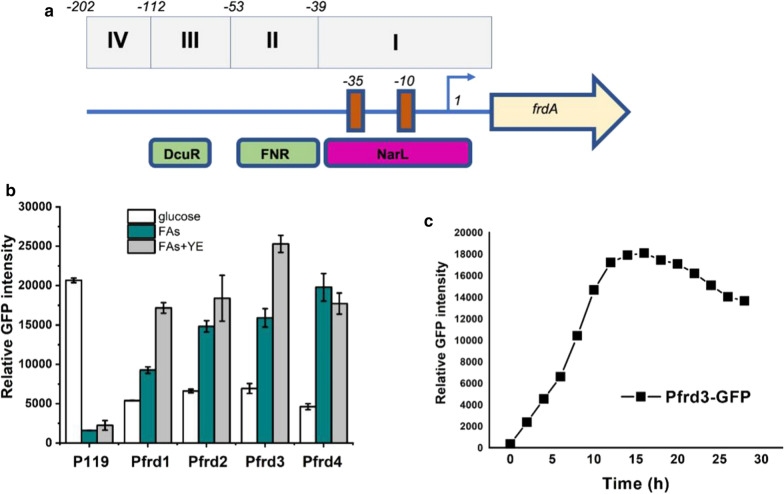
Screening FAs response promoters. a Length of truncations of the native frdA promoter. Symbols are grey filled rectangle: four truncated promoters; red filled rectangle: -10 region and -35 region of frdA gene; yellow rightwards arrow: frdA gene. b Comparison of the relative GFP intensity of different truncated promoters under different substrates. Growth in the M9 medium containing different carbon sources (1% glucose, 1%FA, 1% FAs A and 0.03% yeast extract) for 24 h. The control for these experiments was P119. c The relative GFP intensity of the Pfrd3 promoter at different times. Growth in the M9 medium containing 1% FAs and 0.03% yeast extract
Fig. 6
Fig. 6
Metabolic engineering for RK production from FAs and RK production by different strains. a RK biosynthesis pathway from FAs; b RK production by different strains. Bioconversions were performed at 30 °C and 200 rpm. A palmitic acid concentration of 1% was used for RK production
Fig. 7
Fig. 7
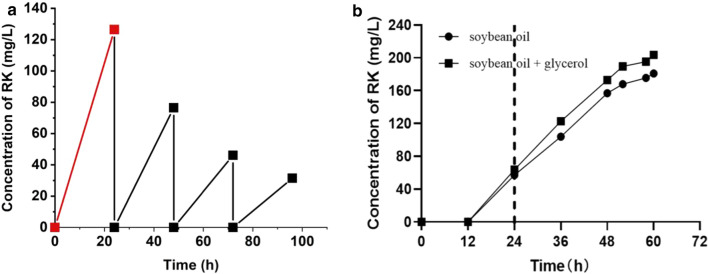
A. RK production by repeat bioconversion process. Red line indicates induction and cell growth stage. Bioconversion were performed at 30 °C and 220 rpm. A palmitic acid concentration of 1% was used for RK production. B. Fed-batch bioconversion in 1-L bioreactors for RK production using soybean oil or soybean oil + glycerol as substrate. The left side of the dotted line represents the cell growth and protein induction phase

References

    1. Erickson B. Nelson, Winters P: Perspective on opportunities in industrial biotechnology in renewable chemicals. Biotechnol J. 2012;7:176–185. doi: 10.1002/biot.201100069. - DOI - PMC - PubMed
    1. Du J, Shao Z, Zhao H. Engineering microbial factories for synthesis of value-added products. J Ind Microbiol Biotechnol. 2011;38:873–890. doi: 10.1007/s10295-011-0970-3. - DOI - PMC - PubMed
    1. Gustavsson M, Lee SY. Prospects of microbial cell factories developed through systems metabolic engineering. Microb Biotechnol. 2016;9:610–617. doi: 10.1111/1751-7915.12385. - DOI - PMC - PubMed
    1. Nielsen J, Keasling Jay D. Engineering cellular metabolism. Cell. 2016;164:1185–1197. doi: 10.1016/j.cell.2016.02.004. - DOI - PubMed
    1. Vogt T. Phenylpropanoid biosynthesis. Mol Plant. 2010;3:2–20. doi: 10.1093/mp/ssp106. - DOI - PubMed