Review
. 2021 Mar 11;7(1):26.
doi: 10.1038/s41523-021-00230-y.

Novel evolutionary dynamics of small populations in breast cancer adjuvant and neoadjuvant therapy

Affiliations
Review

Novel evolutionary dynamics of small populations in breast cancer adjuvant and neoadjuvant therapy

Yael Artzy-Randrup et al. NPJ Breast Cancer. .

Abstract

Disseminated cancer cells (DCCs) are detected in the circulation and bone marrow of up to 40% of breast cancer (BC) patients with clinically localized disease. The formation of metastases is governed by eco-evolutionary interactions of DCCs with the tissue during the transition from microscopic populations to macroscopic disease. Here, we view BC adjuvant and neoadjuvant treatments in the context of small population extinction dynamics observed in the Anthropocene era. Specifically, the unique eco-evolutionary dynamics of small asexually reproducing cancer populations render them highly vulnerable to: (1) environmental and demographic fluctuations, (2) Allee effects, (3) genetic drift and (4) population fragmentation. Furthermore, these typically interact, producing self-reinforcing, destructive dynamics-termed the Extinction Vortex-eradicating the population even when none of the perturbations is individually capable of causing extinction. We propose that developing BC adjuvant and neoadjuvant protocols may exploit these dynamics to prevent recovery and proliferation of small cancer populations during and after treatment-termed "Eco-evolutionary rescue" in natural extinctions. We hypothesize more strategic application of currently available agents based on the extinction vulnerabilities of small populations could improve clinical outcomes.


Conflict of interest statement

The authors declare no competing interests.

Figures
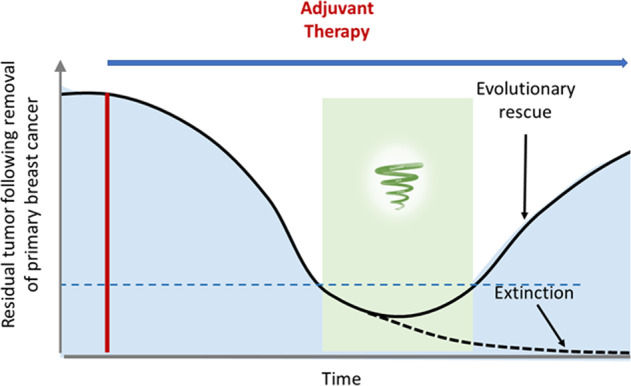
Fig. 1
Fig. 1. Evolutionary dynamics of adjuvant therapy.
Initial treatment causes a decline in the global tumor population. This sets off a “race to extinction”. If the initial treatment imparts sufficient evolutionary force, the population will be forced into an extinction vortex and become extinct with no additional perturbations. However, if resistance develops and manages to successfully produce a growing cohort before fading out, a surviving population could permit “evolutionary rescue” such that the tumor recovers and proliferates, eventually forming a clinical metastasis. The period of time in which the tumor is in the extinction vortex represents an opportunity to add new treatments for accelerating the extinction process and for reducing the risk of evolutionary rescue.

References

    1. Sparano JA, et al. Adjuvant chemotherapy guided by a 21-gene expression assay in breast cancer. N. Engl. J. Med. 2018;379:111–121. doi: 10.1056/NEJMoa1804710. - DOI - PMC - PubMed
    1. Mansour EG, et al. Efficacy of adjuvant chemotherapy in high-risk node-negative breast cancer. An intergroup study. N. Engl. J. Med. 1989;320:485–490. doi: 10.1056/NEJM198902233200803. - DOI - PubMed
    1. Parikh M, Galkin M, Brunson A, Keegan T, Chew HK. Breast cancer-specific survival in patients with HER2-positive, node-negative T1a and T1b breast cancer. Cancer Treat. Res. Commun. 2018;16:38–44. doi: 10.1016/j.ctarc.2018.06.001. - DOI - PubMed
    1. Gatenby RA, Artzy-Randrup Y, Epstein T, Reed DR, Brown JS. Eradicating metastatic cancer and the eco-evolutionary dynamics of anthropocene extinctions. Cancer Res. 2020;80:613–623. doi: 10.1158/0008-5472.CAN-19-1941. - DOI - PMC - PubMed
    1. Gatenby RA, Zhang J, Brown JS. First strike-second strike strategies in metastatic cancer: lessons from the evolutionary dynamics of extinction. Cancer Res. 2019;79:3174–3177. doi: 10.1158/0008-5472.CAN-19-0807. - DOI - PMC - PubMed

LinkOut - more resources
