


APTES monolayer coverage on self-assembled magnetic nanospheres for controlled release of anticancer drug Nintedanib
- PMID: 33707549
- PMCID: PMC7952395
- DOI: 10.1038/s41598-021-84770-0
APTES monolayer coverage on self-assembled magnetic nanospheres for controlled release of anticancer drug Nintedanib
Abstract
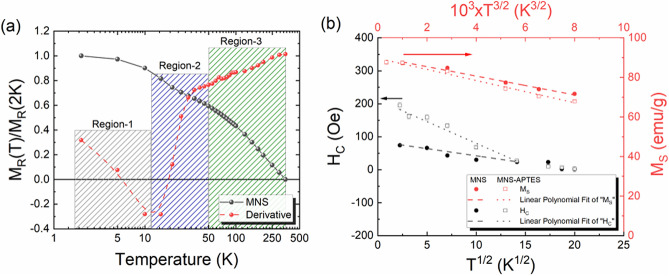
The use of an appropriate delivery system capable of protecting, translocating, and selectively releasing therapeutic moieties to desired sites can promote the efficacy of an active compound. In this work, we have developed a nanoformulation which preserves its magnetization to load a model anticancerous drug and to explore the controlled release of the drug in a cancerous environment. For the preparation of the nanoformulation, self-assembled magnetic nanospheres (MNS) made of superparamagnetic iron oxide nanoparticles were grafted with a monolayer of (3-aminopropyl)triethoxysilane (APTES). A direct functionalization strategy was used to avoid the loss of the MNS magnetization. The successful preparation of the nanoformulation was validated by structural, microstructural, and magnetic investigations. X-ray photoelectron spectroscopy (XPS) and Fourier transform infrared spectroscopy (FTIR) were used to establish the presence of APTES on the MNS surface. The amine content quantified by a ninhydrin assay revealed the monolayer coverage of APTES over MNS. The monolayer coverage of APTES reduced only negligibly the saturation magnetization from 77 emu/g (for MNS) to 74 emu/g (for MNS-APTES). Detailed investigations of the thermoremanent magnetization were carried out to assess the superparamagnetism in the MNS. To make the nanoformulation pH-responsive, the anticancerous drug Nintedanib (NTD) was conjugated with MNS-APTES through the acid liable imine bond. At pH 5.5, which mimics a cancerous environment, a controlled release of 85% in 48 h was observed. On the other hand, prolonged release of NTD was found at physiological conditions (i.e., pH 7.4). In vitro cytotoxicity study showed dose-dependent activity of MNS-APTES-NTD for human lung cancer cells L-132. About 75% reduction in cellular viability for a 100 μg/mL concentration of nanoformulation was observed. The nanoformulation designed using MNS and monolayer coverage of APTES has potential in cancer therapy as well as in other nanobiological applications.
Conflict of interest statement
The authors declare no competing interests.
Figures




References
-
- Sbeity H, Younes R. Review of optimization methods for cancer chemotherapy treatment planning. J. Comput. Sci. Syst. Biol. 2015;8:74–95. doi: 10.4172/jcsb.1000173. - DOI
Publication types
MeSH terms
Substances
LinkOut - more resources
Full Text Sources
Other Literature Sources
