


Comparison of clinical characteristics and disease outcome of COVID-19 and seasonal influenza
- PMID: 33707550
- PMCID: PMC7970952
- DOI: 10.1038/s41598-021-85081-0
Comparison of clinical characteristics and disease outcome of COVID-19 and seasonal influenza
Abstract
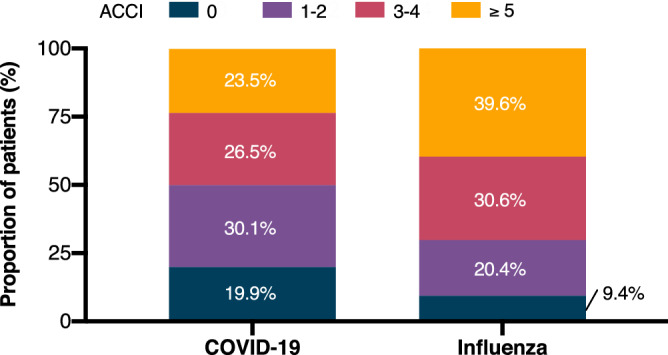
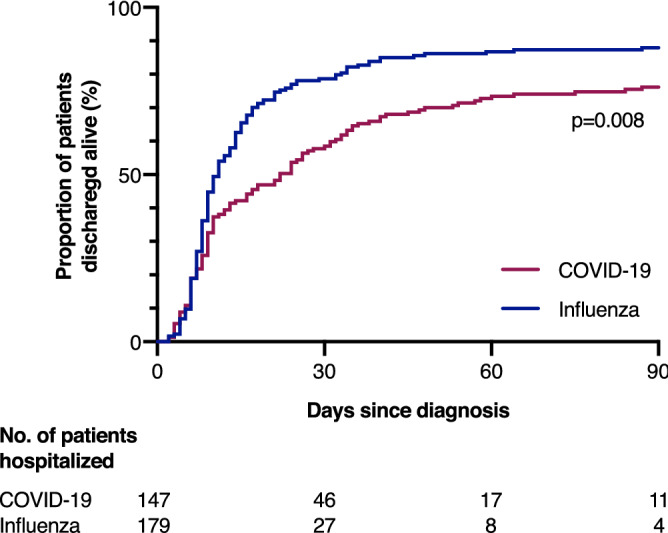
While several studies have described the clinical course of patients with coronavirus disease 2019 (COVID-19), direct comparisons with patients with seasonal influenza are scarce. We compared 166 patients with COVID-19 diagnosed between February 27 and June 14, 2020, and 255 patients with seasonal influenza diagnosed during the 2017-18 season at the same hospital to describe common features and differences in clinical characteristics and course of disease. Patients with COVID-19 were younger (median age [IQR], 59 [45-71] vs 66 [52-77]; P < 0001) and had fewer comorbidities at baseline with a lower mean overall age-adjusted Charlson Comorbidity Index (mean [SD], 3.0 [2.6] vs 4.0 [2.7]; P < 0.001) than patients with seasonal influenza. COVID-19 patients had a longer duration of hospitalization (mean [SD], 25.9 days [26.6 days] vs 17.2 days [21.0 days]; P = 0.002), a more frequent need for oxygen therapy (101 [60.8%] vs 103 [40.4%]; P < 0.001) and invasive ventilation (52 [31.3%] vs 32 [12.5%]; P < 0.001) and were more frequently admitted to the intensive care unit (70 [42.2%] vs 51 [20.0%]; P < 0.001) than seasonal influenza patients. Among immunocompromised patients, those in the COVID-19 group had a higher hospital mortality compared to those in the seasonal influenza group (13 [33.3%] vs 8 [11.6%], P = 0.01). In conclusion, we show that COVID-19 patients were younger and had fewer baseline comorbidities than seasonal influenza patients but were at increased risk for severe illness. The high mortality observed in immunocompromised COVID-19 patients emphasizes the importance of protecting these patient groups from SARS-CoV-2 infection.
Conflict of interest statement
Axel Nierhaus declares that he received lecture honoraria and travel reimbursement from Thermo Fisher Scientific and CytoSorbents Europe. The authors declare they have no competing financial interest.
Figures
References
-
- World Health Organization. Rolling updates on coronavirus disease (COVID-19). https://www.who.int/emergencies/diseases/novel-coronavirus-2019/events-a.... Accessed 17 Oct 2020.
Publication types
MeSH terms
LinkOut - more resources
Full Text Sources
Other Literature Sources
Medical
Miscellaneous
