Comparison of Total Immunoglobulin G in Ante- and Postmortem Blood Samples from Tissue Donors
- PMID: 33708050
- PMCID: PMC7923840
- DOI: 10.1159/000513662
Comparison of Total Immunoglobulin G in Ante- and Postmortem Blood Samples from Tissue Donors
Abstract
Background: A serology testing for infectious diseases (HIV, hepatitis B and C, syphilis) is mandatory in tissue donors. In many donors postmortem blood is the only sample available. Even though serological tests and nucleic acid amplification tests (NAT) used are validated for postmortem blood, a characterization of those blood samples is not yet established. We therefore investigated the total immunoglobulin G (IgG) content in postmortem blood of tissue donors and compared it to a corresponding antemortem blood sample.
Methods: Ante- and postmortem blood samples were obtained from 100 consecutive tissue donors. The total IgG of all samples was measured using an immune-turbidometric test on the AU 480 Chemistry Analyzer (Beckman Coulter).
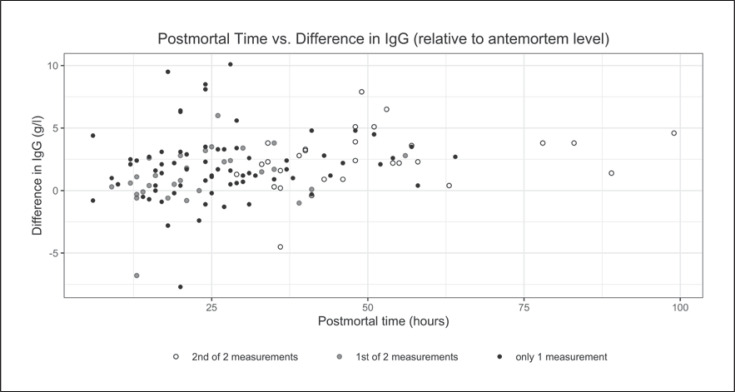
Results: The mean total IgG concentration of antemortem blood samples from all 100 donors was 8.9 g/L ± 3.7 g/L (median 8.9 g/L, range 1.5 to 23.8 g/L). In 80 donors the IgG concentration in the antemortem blood sample was within the normal range with values ≥6 g/L (mean 10.0 g/L ± 3.3 g/L, median 9.3 g/L,). The total IgG concentration of the postmortem blood samples was lower with 7.2 g/L ± 3.2 g/L (median 6.7 g/L, range 0.6 to 18.2 g/L). The difference between the values of the antemortem and postmortem blood samples was 1.7 g/L ± 2.6 g/L (16.3%) (median 1.6 g/L, range -7.7 to 10.1 g/L). In 36 donors this difference was less than 10%, in 23 it was between 10 and 25%, in 33 between 26 and 50%, and in 8 over 50%. In 57 donors the total IgG in the postmortem blood sample was within the normal range with ≥6 g/L, in 53 of them also the value of the antemortem blood sample was within the normal range. No correlation for total IgG was found regarding the donor characteristics (age, sex, disease) and the sample characteristics (hemolysis, postmortem time).
Conclusion: Total IgG values in antemortem samples were below the lower limit of 6 g/L in 20% of the cases. Total IgG was significantly lower in the postmortem samples compared to the antemortem samples, while 57% were still above the lower limit. No correlation with the postmortem time could be found. This lowered IgG levels should be payed attention to when using postmortem blood for infectious serology testing. Additional NAT testing should be considered.
Keywords: Donor screening; Immunoglobulin; Postmortem blood; Tissue bank; Tissue donation.
Copyright © 2021 by S. Karger AG, Basel.
Conflict of interest statement
The authors have no conflicts of interest to declare.
Figures
References
-
- Gain P, Jullienne R, He Z, Aldossary M, Acquart S, Cognasse F, et al. Global Survey of Corneal Transplantation and Eye Banking. JAMA Ophthalmol. 2016 Feb;134((2)):167–73. - PubMed
-
- Flockerzi E, Maier P, Böhringer D, Reinshagen H, Kruse F, Cursiefen C, et al. all German Keratoplasty Registry Contributors Trends in Corneal Transplantation from 2001 to 2016 in Germany: A Report of the DOG-Section Cornea and its Keratoplasty Registry. Am J Ophthalmol. 2018 Apr;188:91–8. - PubMed
-
- Schroeter J, Maier P, Bednarz J, Blüthner K, Quenzel M, Pruss A, et al. [Procedural guidelines. Good tissue practice for cornea banks] Ophthalmologe. 2009 Mar;106((3)):265–74. - PubMed
-
- Heck E, Brown A, Cavanagh HD. Nucleic acid testing and tissue safety: an eye bank's five-year review of HIV and hepatitis testing for donor corneas. Cornea. 2013 Apr;32((4)):503–5. - PubMed
-
- Edler C, Wulff B, Schröder A, Wilkemeyer I, Polywka S, Meyer T, et al. A prospective time-course study on serological testing for human immunodeficiency virus, hepatitis B virus and hepatitis C virus with blood samples taken up to 48 h after death. J Med Microbiol. 2011;60:920–26. - PubMed
LinkOut - more resources
Full Text Sources
Other Literature Sources