Innovative transcatheter procedures for the treatment of heart failure
- PMID: 33708500
- PMCID: PMC7944200
- DOI: 10.21037/cdt-20-335
Innovative transcatheter procedures for the treatment of heart failure
Abstract
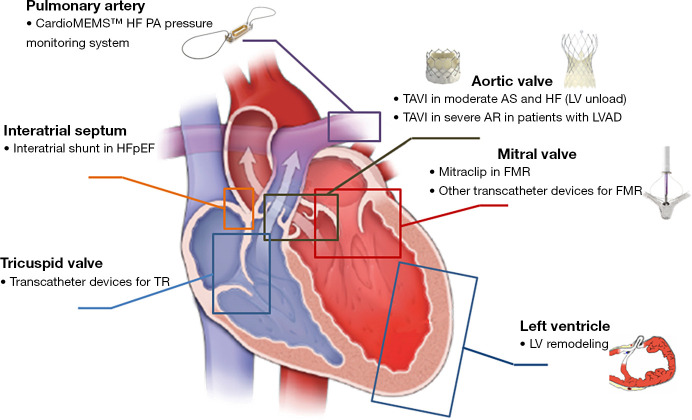
The prevalence of heart failure (HF) continues to rise over time, with aging of the population and increased survival of incident cases. Major improvements occurred in drug therapy but morbidity and mortality of HF patients remain high. Some non-pharmacologic approaches to HF are already part of standard treatment for HF, including implantable cardioverter-defibrillators, cardiac resynchronization therapy (CRT) and left ventricular assist devices (LVADs). A number of transcatheter treatments and devices have been developed to improve management of valvular heart diseases (VHD), and some of them are being used or tested in specific HF conditions. For example, transcatheter aortic valve implantation (TAVI) to unload the left ventricle in patients with moderate aortic stenosis (AS) and HF or TAVI for severe aortic regurgitation (AR) in patients with LVADs. Similarly, percutaneous mitral valve repair can be used to improve prognosis and quality of life in patients with functional mitral valve regurgitation, and has been proposed as a bridge-to-LVAD or to heart transplant in selected patients. Other devices have been specifically developed for the treatment of chronic HF. In this review we describe the main devices used in the treatment of HF associated with aortic and mitral valve disease, as well as novel transcatheter interventions for chronic HF with different pathophysiologic targets.
Keywords: Heart failure (HF); left ventricular assist device (LVAD); left ventricular dysfunction; percutaneous mitral valve repair; secondary mitral regurgitation; transcatheter aortic valve replacement.
2021 Cardiovascular Diagnosis and Therapy. All rights reserved.
Conflict of interest statement
Conflicts of Interest: All authors have completed the ICMJE uniform disclosure forms (available at http://dx.doi.org/10.21037/cdt-20-335). The series “Heart Failure in the Young and Old: Insights into Various Therapies” was commissioned by the editorial office without any funding or sponsorship. FS reports personal fees from Abbott Vascular, personal fees from Edwards, personal fees from Medtronic, personal fees from Boston Scientific, personal fees from Astra Zeneca, personal fees from Daiichy-Sankyo, personal fees from Amgen, personal fees from Bayer, personal fees from Boheringer-Ingelheim, outside the submitted work. The authors have no other conflicts of interest to declare.
Figures
Similar articles
-
Transcatheter valvular therapies in patients with left ventricular assist devices.Front Cardiovasc Med. 2023 Mar 13;10:1071805. doi: 10.3389/fcvm.2023.1071805. eCollection 2023. Front Cardiovasc Med. 2023. PMID: 36993995 Free PMC article. Review.
-
Continuous-Flow Left Ventricular Assist Devices and Valvular Heart Disease: A Comprehensive Review.Can J Cardiol. 2020 Feb;36(2):244-260. doi: 10.1016/j.cjca.2019.11.022. Epub 2019 Nov 25. Can J Cardiol. 2020. PMID: 32036866 Review.
-
Reciprocal interferences of the left ventricular assist device and the aortic valve competence.Front Cardiovasc Med. 2023 Jan 9;9:1094796. doi: 10.3389/fcvm.2022.1094796. eCollection 2022. Front Cardiovasc Med. 2023. PMID: 36698950 Free PMC article. Review.
-
Transcatheter Mitral Valve Repair in Patients With and Without Cardiac Resynchronization Therapy: The COAPT Trial.Circ Heart Fail. 2020 Nov;13(11):e007293. doi: 10.1161/CIRCHEARTFAILURE.120.007293. Epub 2020 Nov 12. Circ Heart Fail. 2020. PMID: 33176460 Clinical Trial.
-
A case report: transfemoral transcatheter aortic valve replacement with a dedicated valve system for severe aortic regurgitation in a patient with a left ventricular assist device.Eur Heart J Case Rep. 2023 Jun 1;7(6):ytad267. doi: 10.1093/ehjcr/ytad267. eCollection 2023 Jun. Eur Heart J Case Rep. 2023. PMID: 37323530 Free PMC article.
Cited by
-
In-Hospital Outcomes of Heart Failure Patients with Valvular Heart Disease: Insights from Real-World Claims Data.Clinicoecon Outcomes Res. 2023 May 18;15:349-360. doi: 10.2147/CEOR.S405079. eCollection 2023. Clinicoecon Outcomes Res. 2023. PMID: 37223825 Free PMC article.
-
Transition to Advanced Heart Failure: From Identification to Improving Prognosis.J Cardiovasc Dev Dis. 2025 Mar 17;12(3):104. doi: 10.3390/jcdd12030104. J Cardiovasc Dev Dis. 2025. PMID: 40137102 Free PMC article. Review.
References
-
- Ponikowski P, Voors AA, Anker SD, et al. 2016 ESC Guidelines for the diagnosis and treatment of acute and chronic heart failure: The Task Force for the diagnosis and treatment of acute and chronic heart failure of the European Society of Cardiology (ESC). Developed with the special contribution of the Heart Failure Association (HFA) of the ESC. Eur J Heart Fail 2016;18:891-975. 10.1002/ejhf.592 - DOI - PubMed
-
- Nishimura RA, Otto CM, Bonow RO, et al. 2017 AHA/ACC Focused Update of the 2014 AHA/ACC Guideline for the Management of Patients With Valvular Heart Disease: A Report of the American College of Cardiology/American Heart Association Task Force on Clinical Practice Guidelines. J Am Coll Cardiol 2017;70:252-89. 10.1016/j.jacc.2017.03.011 - DOI - PubMed
Publication types
LinkOut - more resources
Full Text Sources
Other Literature Sources
Research Materials
Miscellaneous