Clinico-Radiological Outcome of Single-Level and Hybrid Total Disc Replacement with Spineart Baguera®-C for Cervical Myeloradiculopathy: Minimum 2-Year Follow-Up Study in Indian Population
- PMID: 33708654
- PMCID: PMC7869274
- DOI: 10.4103/ajns.AJNS_288_20
Clinico-Radiological Outcome of Single-Level and Hybrid Total Disc Replacement with Spineart Baguera®-C for Cervical Myeloradiculopathy: Minimum 2-Year Follow-Up Study in Indian Population
Abstract
Context: Cervical radiculopathy and myelopathy is one of the most frequent ailments encountered by spine surgeon. Motion-preserving surgeries in cervical spine is a standard of care due to its certain advantages such as biomechanical anatomical conformity, reduced chances of adjacent segment degeneration, and revision surgeries. While there is abundant data from some centers, data from developing countries are still limited.
Aims: The aim was to study the clinico-radiological outcome of single-level and hybrid total disc replacement (TDR) with Spineart Baguera®-C cervical prosthesis for cervical myeloradiculopathy.
Settings and design: Retrospective study.
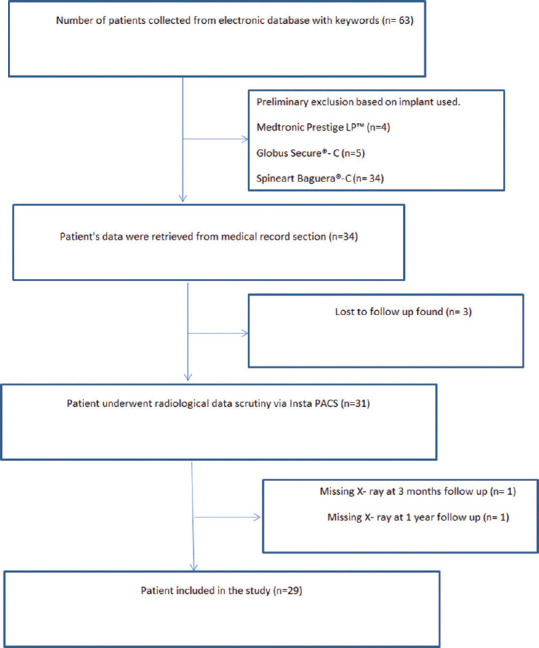
Materials and methods: Retrospective analysis of the 29 consecutive patient undergoing single level TDR and hybrid fixation (i.e., TDR with anterior cervical discectomy and fusion) with Spineart Baguera®-C cervical prosthesis for myeloradiculopathy from January 1, 2014 to December 31, 2017, was done. Radiological features and outcome were studied from data collected on Insta-picture archiving and communication system.
Statistical analysis used: SAS 9.4 was used for all computations. Results on continuous measurements were presented as mean and standard deviation (min-max) and results on categorical measurements were presented as numbers (n) and percentages.
Results: Twenty-nine patients were included in the study. The mean age was 43.31 ± 9.04 years with 14 males and 15 females. The most common level of TDR was C5-C6 (72.41%). The mean follow-up duration was 3.14 years ± 1.13 years (2-5 years). The mean hospital stay was 4.93 ± 2.12 days. The mean neck disability index (NDI) at admission was 27.24 ± 7.66 which decreased to 6.41 ± 4.29 at final follow-up.
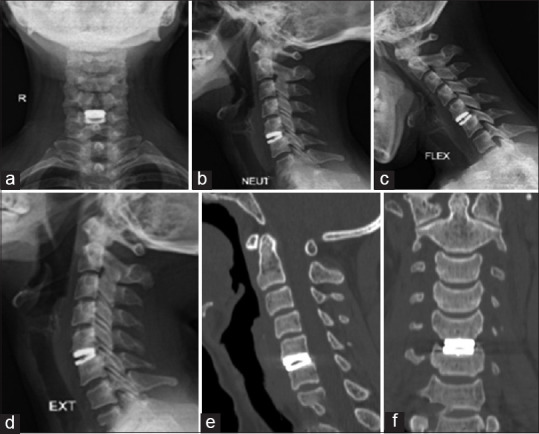
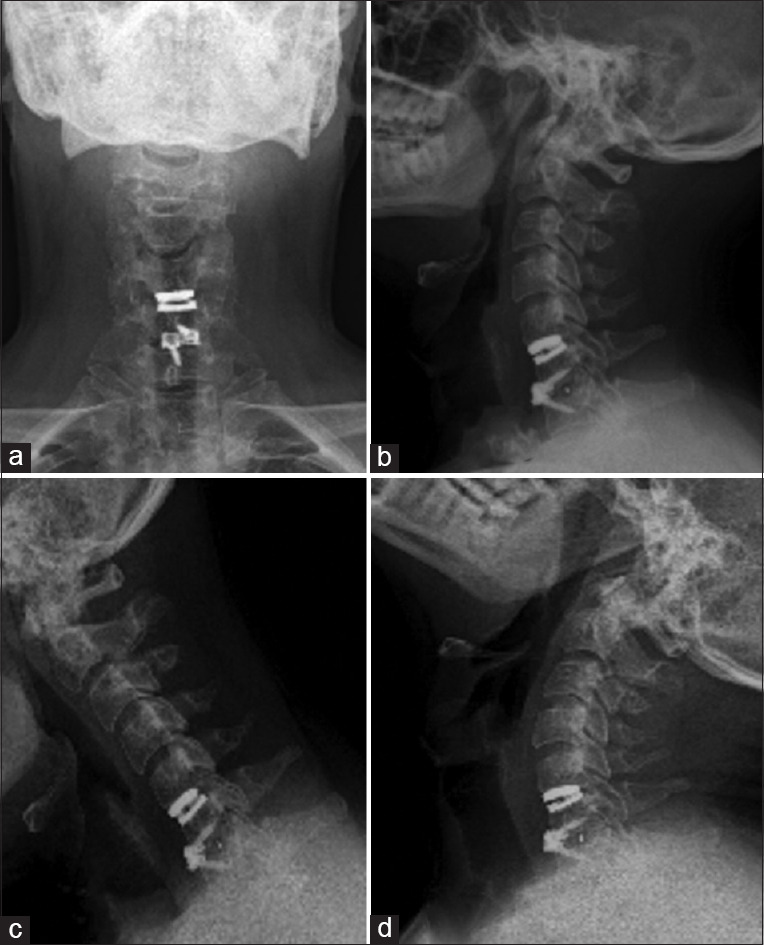
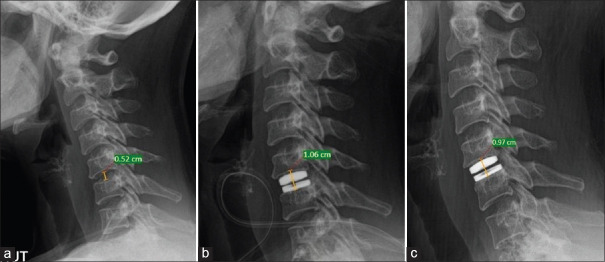
Conclusions: Two-year data on treatment with Spineart Baguera®-C cervical prosthesis shows significantly improved NDI, visual analog scale (arm) with maintenance of movement of the prosthesis.
Keywords: Cervical; Spineart Baguera®-C; myeloradiculopathy; total disc replacement.
Copyright: © 2020 Asian Journal of Neurosurgery.
Conflict of interest statement
There are no conflicts of interest.
Figures
References
-
- Fernström U. Arthroplasty with intercorporal endoprothesis in herniated disc and in painful disc. Acta Chir Scand Suppl. 1966;357:154–9. - PubMed
-
- Benmekhbi M, Mortada J, Lungu G, Eichler D, Srour R, Vital JM. Baguera cervical disc prosthesis. Interact Surg. 2008;3:201–4.
-
- Cloward R. The anterior approach for ruptured cervical discs. J Neurosurg. 1958;15:602–14. - PubMed
-
- Robinson R, Smith G. Anterolateral cervical disc removal and interbody fusion for cervical disc syndrome. Bull John Hopkins Hosp. 1955;96:223–4.
-
- Matsumoto M, Okada E, Ichihara D, Watanabe K, Chiba K, Toyama Y, et al. Anterior cervical decompression and fusion accelerates adjacent segment degeneration: Comparison with asymptomatic volunteers in a ten-year magnetic resonance imaging follow-up study. Spine (Phila Pa 1976) 2010;35:36–43. - PubMed
LinkOut - more resources
Full Text Sources
Miscellaneous