A cohort study of hepatectomy-related complications and prediction model for postoperative liver failure after major liver resection in 1,441 patients without obstructive jaundice
- PMID: 33708932
- PMCID: PMC7944277
- DOI: 10.21037/atm-20-5472
A cohort study of hepatectomy-related complications and prediction model for postoperative liver failure after major liver resection in 1,441 patients without obstructive jaundice
Abstract
Background: This cohort study, based on a large sample of extensive hepatectomy cases, aimed to analyze the distribution of hepatectomy-related complications and to develop a predictive model of posthepatectomy liver failure (PHLF).
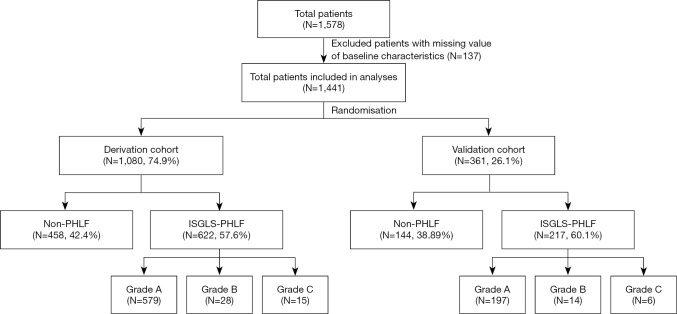
Methods: Data of patients who underwent hepatectomy of ≥3 liver segments at the Eastern Hepatobiliary Surgery Hospital from 2000 to 2016 were collected and analyzed. Information on hepatectomy-related complications was collected and risk factors were analyzed. A total of 1,441 eligible patients were randomly assigned at 3:1 ratio into the derivation (n=1,080) and validation (n=361) cohorts. The multivariable logistic regression model was used to establish the prediction model of PHLF in the derivation cohort.
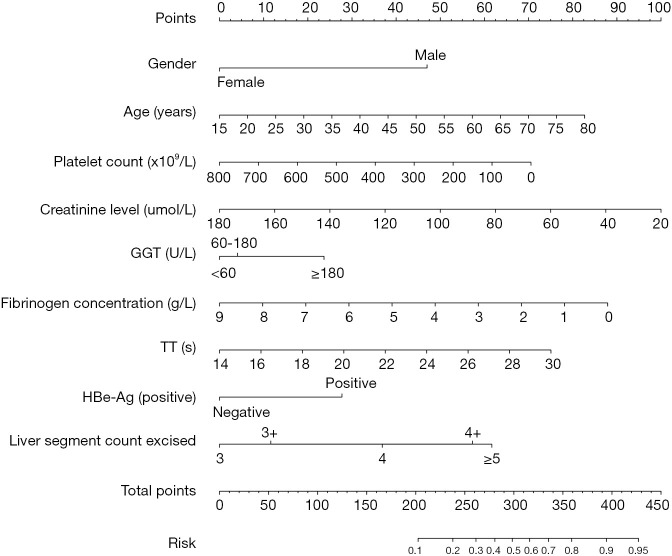
Results: The incidence rates of PHLF, ascites, bile leakage, intra-abdominal bleeding, and abscesses were 58.22%, 10.76%, 11.17%, 9.71%, and 4.16%, respectively. The 90-day perioperative mortality rate was 1.32%. Multivariate analyses found that age, gender, platelet, creatinine, gamma-glutamyltransferase, thrombin time, fibrinogen, hepatitis B e (HBe) antigen positive, and number of resected liver segments were independent prognostic factors of PHLF in the derivation cohort and included in the nomogram. The prediction model demonstrated good discrimination [area under the curve =0.726, 95% confidence interval (CI), 0.696-0.760, P<0.0001] and calibration.
Conclusions: Our study showed a high perioperative safety and a low risk of serious complications in patients who underwent major liver resection (MLR) at a large hepatobiliary surgery center. Routine preoperative clinical information can be used to develop a postoperative liver failure risk prediction model for rational planning of surgery.
Keywords: Major liver resection (MLR); liver failure; nomogram; postoperative complications; predictive model.
2021 Annals of Translational Medicine. All rights reserved.
Conflict of interest statement
Conflicts of Interest: All authors have completed the ICMJE uniform disclosure form (available at http://dx.doi.org/10.21037/atm-20-5472). All the authors report grants from National Natural Science Foundation of China and from Science and Technology Commission of Shanghai Municipality, during the conduct of the study.
Figures
References
LinkOut - more resources
Full Text Sources
Other Literature Sources