


Effect of Complex Weight-Reducing Interventions on Rhythm Control in Obese Individuals with Atrial Fibrillation Following Catheter Ablation: A Study Protocol
- PMID: 33710588
- PMCID: PMC7953371
- DOI: 10.1007/s12325-021-01667-0
Effect of Complex Weight-Reducing Interventions on Rhythm Control in Obese Individuals with Atrial Fibrillation Following Catheter Ablation: A Study Protocol
Abstract
Introduction: Obesity and atrial fibrillation (AF) pose a significant burden on healthcare systems worldwide. Reduction of body weight has been documented to reduce the risk of AF. Little is known about the effect of different weight-reducing interventions including bariatric surgery in obese individuals on the risk of arrhythmia recurrence following catheter ablation (CA) for AF, and about the pathophysiological mechanisms linking these two conditions.
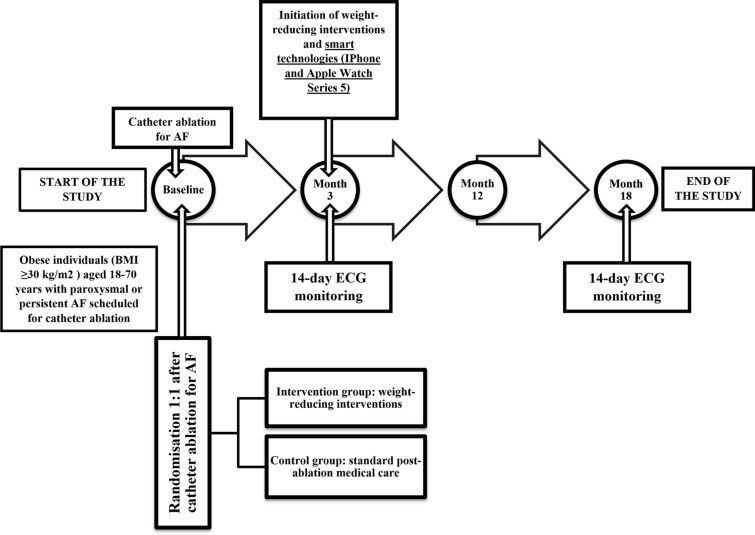
Methods: The Effect of complex weigHt-reducing interventiOns on rhythm control in oBese subjects wITh Atrial Fibrillation (HOBIT-AF) is a single-blinded, parallel-group randomised controlled trial with 18-month follow-up to assess the effect of complex weight-reducing interventions supported by the use of smart technologies and bariatric surgery on the arrhythmia burden in obese individuals following CA for AF. One hundred and sixty individuals (age 18-70 years, body mass index ≥ 30 kg/m2) will be randomised in a 1:1 fashion to undergo a structured weight reduction programme and sleeve gastrectomy (when indicated and preferred by the patient) aiming to achieve greater than 10% weight reduction from baseline (intervention group) or standard post-ablation medical care (control group). Two-week continuous ECG monitoring will be used 3 and 18 months after CA to assess the arrhythmia burden. Other investigations will include transthoracic echocardiography with quantification of epicardial adipose tissue, and markers of low-grade inflammation and circulating adipokines.
Planned outcomes: The main objective is to assess the effect of complex weight-reducing interventions on the arrhythmia burden and quality of life. Subgroup analyses to identify patient subgroups preferentially benefiting from weight loss related to a decrease in arrhythmia burden will be performed. Exploratory objectives will include investigation of potential mechanisms linking weight reduction with amelioration of arrhythmia burden such as changes in markers of low-grade inflammation, circulating adipokines, cytokines, monocytes or reduction of epicardial adipose tissue volume.
Trial registration: NCT04560387.
Keywords: Atrial fibrillation; Bariatric surgery; Low-grade inflammation; Obesity; Sleeve gastrectomy; Weight reduction.
Figures
References
-
- WHO. Obesity and overweight. 2016. https://www.who.int/news-room/fact-sheets/detail/obesity-and-overweight. Accessed 25 Oct 2020.
-
- Colilla S, Crow A, Petkun W, Singer DE, Simon T, Liu X. Estimates of current and future incidence and prevalence of atrial fibrillation in the U.S. adult population. Am J Cardiol. 2013;112(8):1142–7. - PubMed
Publication types
MeSH terms
Associated data
LinkOut - more resources
Full Text Sources
Other Literature Sources
Medical
