


Neurobiological mechanisms of early life adversity, blunted stress reactivity and risk for addiction
- PMID: 33711348
- PMCID: PMC9195251
- DOI: 10.1016/j.neuropharm.2021.108519
Neurobiological mechanisms of early life adversity, blunted stress reactivity and risk for addiction
Abstract
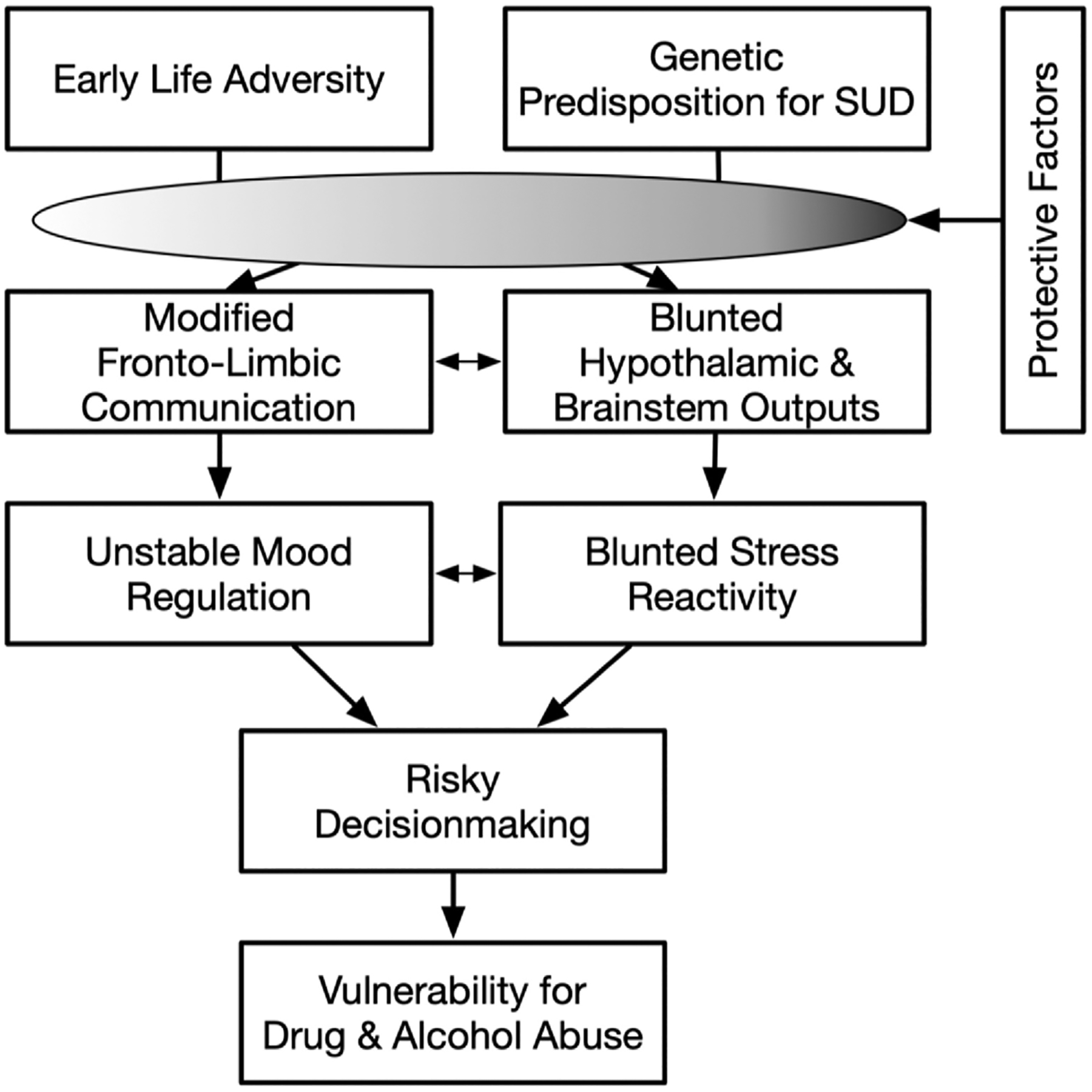
Blunted stress reactivity resulting from early exposure to stress during childhood and adolescence may increase vulnerability to addiction. Early life adversity (ELA) affects brain structure and function and results in blunted stress axis reactivity. In this review, we focus on the underlying neurobiological mechanisms associated with a blunted response to stress, ELA, and risk for addictive disorders. ELA and blunted reactivity are accompanied by unstable mood regulation, impulsive behaviors, and reduced cognitive function. Neuroimaging studies reveal cortical and subcortical changes in persons exposed to ELA and those who have a genetic disposition for addiction. We propose a model in which blunted stress reactivity may be a marker of risk for addiction through an altered motivational and behavioral reactivity to stress that contribute to disinhibited behavioral reactivity and impulsivity leading in turn to increased vulnerability for substance use. Evidence supporting this hypothesis in the context of substance use initiation, maintenance, and risk for relapse is presented. The effects of ELA on persons at risk for addiction may lead to early experimentation with drugs of abuse. Early adoption of drug intake may alter neuroregulation in such vulnerable persons leading to a permanent dysregulation of motivational responses consistent with dependence. This article is part of the special issue on 'Vulnerabilities to Substance Abuse'.
Keywords: Addiction risk; Early life adversity; HPA axis; Neurobiological mechanisms; Stress reactivity.
Copyright © 2021. Published by Elsevier Ltd.
Figures
References
-
- Acheson A, Wijtenburg SA, Rowland LM, Bray BC, Gaston F, Mathias CW, Fox PT, Lovallo WR, Wright SN, Hong LE, McGuire S, Kochunov P, Dougherty DM, 2014a. Combining diffusion tensor imaging and magnetic resonance spectroscopy to study reduced frontal white matter integrity in youths with family histories of substance use disorders. Hum. Brain Mapp 35, 5877–5887. - PMC - PubMed
-
- Acheson A, Wijtenburg SA, Rowland LM, Winkler AM, Gaston F, Mathias CW, Fox PT, Lovallo WR, Wright SN, Hong LE, Dougherty DM, Kochunov P, 2014b. Assessment of whole brain white matter integrity in youths and young adults with a family history of substance-use disorders. Hum. Brain Mapp 35, 5401–5413. - PMC - PubMed
-
- Agorastos A, Pervanidou P, Chrousos GP, Kolaitis G, 2018. Early life stress and trauma: developmental neuroendocrine aspects of prolonged stress system dysregulation. Hormones (Basel) 17, 507–520. - PubMed
Publication types
MeSH terms
Grants and funding
LinkOut - more resources
Full Text Sources
Other Literature Sources
Medical
