


Prenatal exposure to persistent organic pollutants and markers of obesity and cardiometabolic risk in Spanish adolescents
- PMID: 33711537
- PMCID: PMC7960637
- DOI: 10.1016/j.envint.2021.106469
Prenatal exposure to persistent organic pollutants and markers of obesity and cardiometabolic risk in Spanish adolescents
Abstract
Background: Prenatal exposure to persistent organic pollutants (POPs) has been linked to cardiometabolic (CM) risk factors in childhood, but there are no studies evaluating the persistence of these associations into adolescence, a period of relevant changes in endocrine-dependent organ systems and rapid increases in lean and fat mass. We examined the associations of prenatal POP exposures with body mass index (BMI) from age 4 to 18 years, and with other CM risk markers in adolescence.
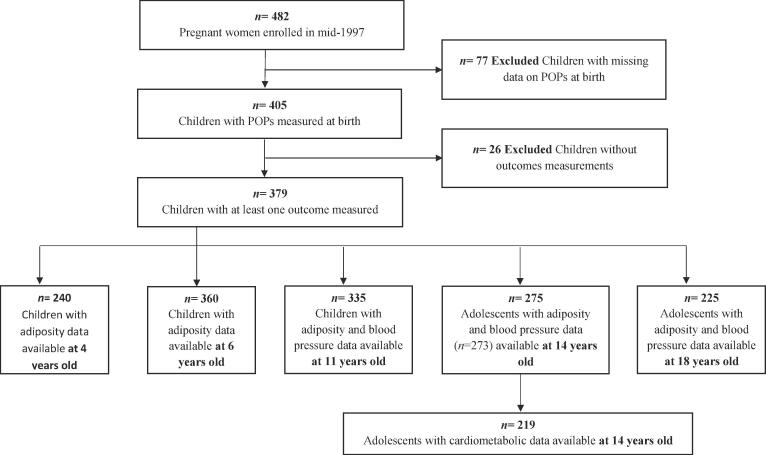
Methods: We analysed 379 children from the Spanish INMA-Menorca birth cohort study with measured cord blood POP concentrations. We calculated BMI z-scores at ages 4, 6, 11, 14 and 18 years using the WHO growth reference. Body fat % was measured at 11 and 18 years and waist-to-height ratio (WHtR) and blood pressure (BP) at 11, 14 and 18 years. We measured CM biomarkers in fasting blood collected at age 14 years and calculated a CM-risk score as the sum of the sex-, and age-specific z-scores for waist circumference, mean arterial BP, homeostatic model assessment of insulin resistance, fasting blood triglycerides, and high-density lipoprotein cholesterol (HDL-C) (n = 217). Generalised estimating equations and multivariate linear regression models assessed the associations with repeated and single time-point measures, respectively.
Results: Hexachlorobenzene (HCB) exposure in the third tertile, compared to the first tertile, was associated with higher BMI (β = 0.24; 95% CI: 0.01, 0.47) and WHtR z-score (β = 0.27; 95% CI: 0.04, 0.51). A continuous increase in HCB was associated with an elevated body fat % (β per 10-fold increase = 4.21; 95% CI: 0.51, 7.92), systolic BP (β = 0.32; 95% CI: 0.02, 0.64) and diastolic BP z-score (β = 0.32; 95% CI: 0.02, 0.62) across all ages, and with higher CM-risk score (β = 1.59; 95% CI: 0.02, 3.18) and lipid biomarkers (total cholesterol, triglycerides and low-density lipoprotein cholesterol (LDL-C)) at 14 years. Dichlorodiphenyltrichloroethane (p,p'-DDT) exposure was non-monotonically associated with BMI and systolic BP. p,p'-DDE and Σ-polychlorinated biphenyls (PCBs) (sum of congeners 118, 138, 153, 180) were not associated with adiposity or BP. p,p'-DDT exposure was associated with an increased CM-risk score, and ΣPCBs concentrations with LDL-C in all adolescents and with total cholesterol only in girls (p-sex interaction = 0.05).
Conclusion: This first longitudinal study from 4 to 18 years suggests that the previously reported POP associations with child BMI persist later in adolescence and that prenatal POP exposures are associated with major risk factors for adult CM syndrome.
Keywords: Cardiometabolic syndrome; Dichlorodiphenyltrichloroethane (p,p’-DDT); Endocrine disruptors; Hexachlorobenzene (HCB); Persistent organic pollutants (POPs); Polychlorinated biphenyls (PCBs).
Copyright © 2021 The Authors. Published by Elsevier Ltd.. All rights reserved.
Conflict of interest statement
The authors declared that there is no conflict of interest.
Figures


References
-
- Agay-Shay K., Martinez D., Valvi D., Garcia-Esteban R., Basagaña X., Robinson O., Casas M., Sunyer J., Vrijheid M. Exposure to Endocrine-Disrupting Chemicals during Pregnancy and Weight at 7 Years of Age: A Multi-pollutant Approach. Environ. Health Perspect. 2015;123(10):1030–1037. doi: 10.1289/ehp.1409049. - DOI - PMC - PubMed
-
- Ashwell, M., Gunn, P., Gibson, S., 2012. Waist-to-height ratio is a better screening tool than waist circumference and BMI for adult cardiometabolic risk factors: systematic review and meta-analysis: Waist-to-height ratio as a screening tool. Obes. Rev. 13, 275–286. https://doi.org/10.1111/j.1467-789X.2011.00952.x. - PubMed
-
- Atabek, M.E., Pirgon, O., 2007. Assessment of Insulin Sensitivity from Measurements in Fasting State and During an Oral Glucose Tolerance Test in Obese Children. J. Pediatr. Endocrinol. Metab. 20. https://doi.org/10.1515/JPEM.2007.20.2.187. - PubMed
-
- Baccarelli A., Pfeiffer R., Consonni D., Pesatori A.C., Bonzini M., Patterson D.G., Jr., Bertazzi P.A., Landi M.T. Handling of dioxin measurement data in the presence of non-detectable values: Overview of available methods and their application in the Seveso chloracne study. Chemosphere. 2005;60(7):898–906. doi: 10.1016/j.chemosphere.2005.01.055. - DOI - PubMed
Publication types
MeSH terms
Substances
Grants and funding
LinkOut - more resources
Full Text Sources
Other Literature Sources
Medical
Miscellaneous
