. 2021 Jun 11;186(2):1254-1268.
doi: 10.1093/plphys/kiab125.

The rice germin-like protein OsGLP1 participates in acclimation to UV-B radiation

Affiliations

The rice germin-like protein OsGLP1 participates in acclimation to UV-B radiation

Zhi-Dan He et al. Plant Physiol. .

Abstract

Exposure to ultraviolet B radiation (UV-B) stress can have serious effects on the growth and development of plants. Germin-like proteins (GLPs) may be involved in different abiotic and biotic stress responses in different plants, but little is known about the role of GLPs in UV-B stress response and acclimation in plants. In the present study, knockout of GLP 8-14 (OsGLP1) using the CRISPR/Cas9 system resulted in mutant rice (Oryza sativa L.) plants (herein called glp1) that exhibited UV-B-dependent formation of lesion mimic in leaves. Moreover, glp1 grown under solar radiation (including UV-B) showed decreased plant height and increased leaf angle, but we observed no significant differences in phenotypes between wild-type (WT) plants and glp1 grown under artificial light lacking UV-B. Fv/Fm, Y (II) and the expression of many genes, based on RNA-seq analysis, related to photosynthesis were also only reduced in glp1, but not in WT, after transfer from a growth cabinet illuminated with artificial white light lacking UV-B to growth under natural sunlight. The genes-associated with flavonoid metabolism as well as UV resistance locus 8 (OsUVR8), phytochrome interacting factor-like 15-like (OsPIF3), pyridoxal 5'-phosphate synthase subunit PDX1.2 (OsPDX1.2), deoxyribodipyrimidine photolyase (OsPHR), and deoxyribodipyrimidine photolyase family protein-like (OsPHRL) exhibited lower expression levels, while higher expression levels of mitogen-activated protein kinase 5-like (OsMPK3), mitogen-activated protein kinase 13-like (OsMPK13), and transcription factor MYB4-like (OsMYB4) were observed in glp1 than in WT after transfer from a growth cabinet illuminated with artificial white light to growth under natural sunlight. Therefore, mutations in OsGLP1 resulted in rice plants more sensitive to UV-B and reduced expression of some genes for UV-B protection, suggesting that OsGLP1 is involved in acclimation to UV-B radiation.


Figures

Figure 1
Figure 1
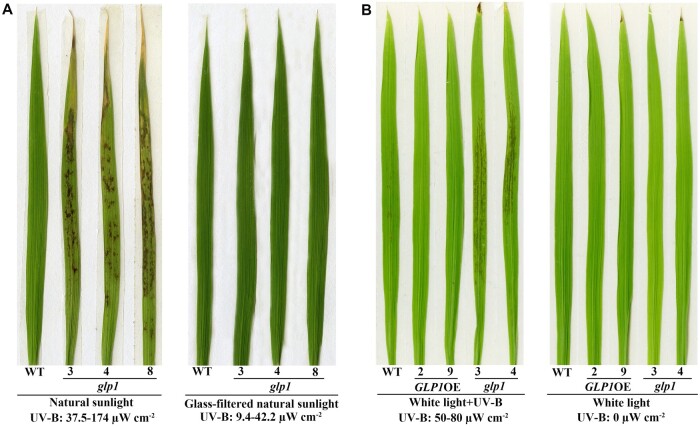
Appearance of the lesion mimic on leaves of rice glp1 mutants. A, is the second leaves from bottom to top of WT, transgenic plants overexpressing OsGLP1 (2 and 9) and glp1 mutants (3, 4, and 8) grown in a growth chamber without UV-B (12 h of 600 µmol m−2 s−1 artificial light at 30°C and 12 h of dark at 28°C) to 5-leaf stage and then exposed to natural sunlight and natural sunlight passing through a glass for 1.5 d. B, is the second leaves from bottom to top of 5-leaf stage seedlings grown in a controlled growth chamber with (left) or without (right) 50–80 µW cm−2 UV-B for 5 h, and were then grown in the chamber without UV-B for 30 h.
Figure 2
Figure 2
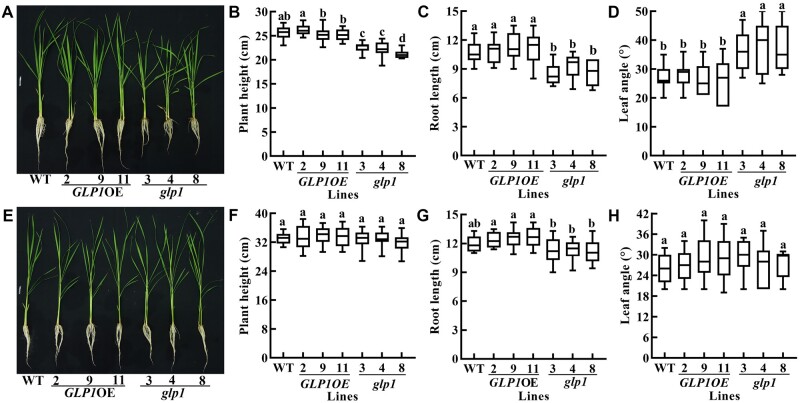
Knockout of OsGLP1 results in dwarfness and increased leaf inclination in rice plants grown under natural sunlight. In A, B, C, and D, the phenotype, plant height, root length and leaf angle (the second leaf from bottom to top), respectively, of WT, transgenic plants overexpressing OsGLP1 (2, 9, and 11) and glp1 mutants (3, 4, and 8) grown under natural sunlight until the 5-leaf stage are shown. In E, F, G, and H, the phenotype, plant height, root length and leaf angle, respectively, of WT, transgenic plants overexpressing OsGLP1 (2, 9, and 11) and glp1 mutants (3, 4, and 8) grown in a controlled growth chamber deficient in UV-B (12-h light, 600 µmol m−2 s−1, 30°C; 12-h dark, 28°C) until the 5-leaf stage are shown. The boxplots, from top to bottom, denote maximum value, upper quartile, median, lower quartile and minimum value, and whiskers denote maximum value to minimum value of the data. The means ± sd (n ≥ 16 plants) of plant height, root length or leaf angle assigned with different letters were significantly different as determined by one-way analysis of variance (ANOVA) with post hoc Bonferroni test (P <0.05).
Figure 3
Figure 3
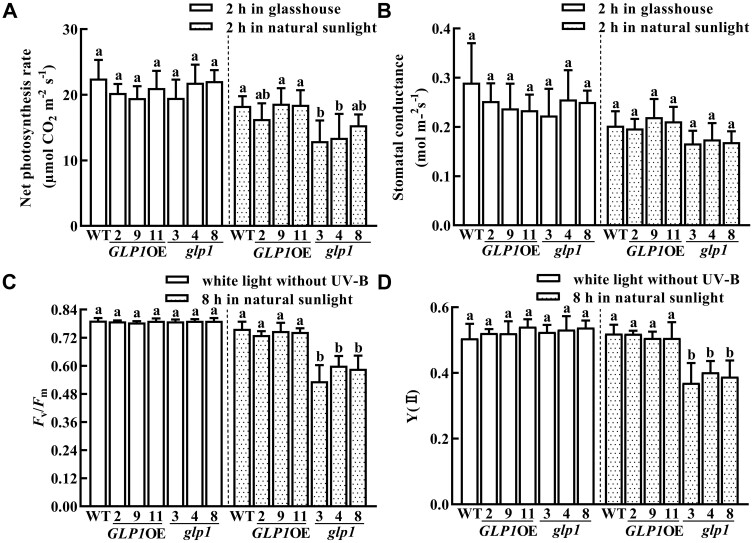
Knockout of OsGLP1 results in lower photosynthetic efficiency in glp1 compared to those in WT plants transferred from white light to natural sunlight. Determination of net photosynthesis rate (A), stomatal conductance (B), Fv/Fm (C), and Y (II) (D) in leaves of WT, transgenic plants overexpressing OsGLP1 (2, 9, and 11) and glp1 mutants (3, 4, and 8). All the plants were grown to the 6-leaf stage in a growth chamber (conditions of the growth chamber: 600 µmol m−2 s−1 white light, 0 µW cm−2 UV-B, 12 h, 30°C; dark, 12 h, 28°C). They were then exposed to different experimental conditions as specified on the figure: under glasshouse conditions, natural sunlight (320–1080 µmol m−2 s−1, 21.1–112.9 µW cm−2 UV-B, 26°C–29°C) or white light without supplementation of UV-B. From the comparative analysis of the data obtained under a specific experimental condition, the means ± sd (n ≥ 4 plants) assigned with different letters were significantly different as determined by one-way ANOVA with the means separation post hoc Student–Newman–Keuls test (P <0.05).
Figure 4
Figure 4
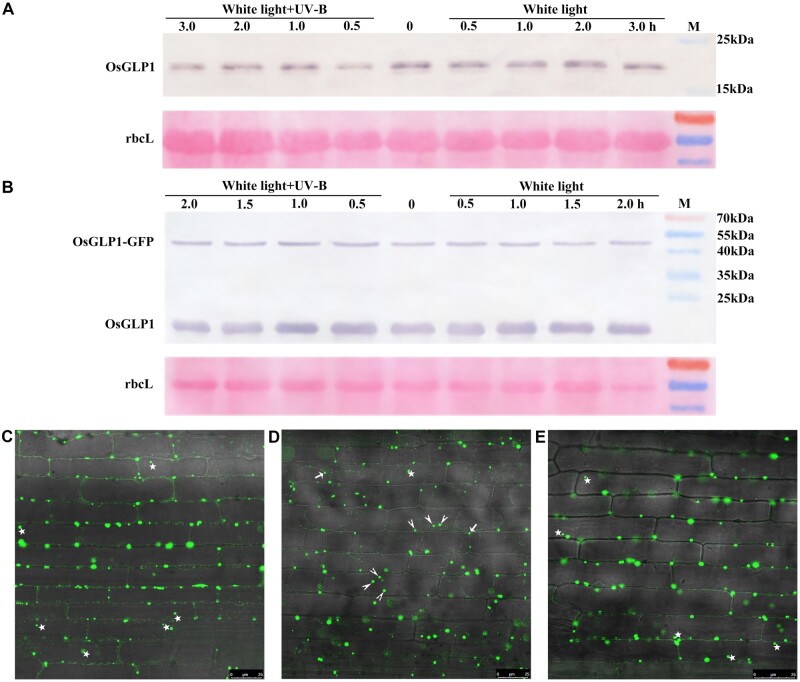
Effect of UV-B on GLP1 and GLP1-GFP protein levels as well as location. Protein gel blot, with OsGLP1-His antisera, of total protein extracts from the leaves of WT (A) grown to 4-leaf stage under 600 µmol m−2 s−1 white light in a growth chamber deficient in UV-B, and GLP1-GFPOE seedlings grown in the dark on Murashige and Skoog (MS) medium for 7 d (B) before they were exposed to 600 µmol m−2 s−1 white light supplemented with or without 50–80 µW cm−2 UV-B for different times (hours). Confocal images of GFP fluorescence in leaf sheath of transgenic plants expressing GLP1-GFP from the Ubi promoter grown in the dark on MS medium for 7 d before they were exposed to white light and white light supplemented 50–80 µW cm−2 UV-B for 2 h (C and E, respectively); confocal images of GFP fluorescence in leaf sheath from GLP1-GFPOE seedlings exposed to white light for 2 h, treated with 30% sucrose about 5 min (D). Bars = 25 µm. Stars denote fluorescence in the cell, short arrows and long arrows denote fluorescence in the plasma membrane and apoplast, respectively.
Figure 5
Figure 5
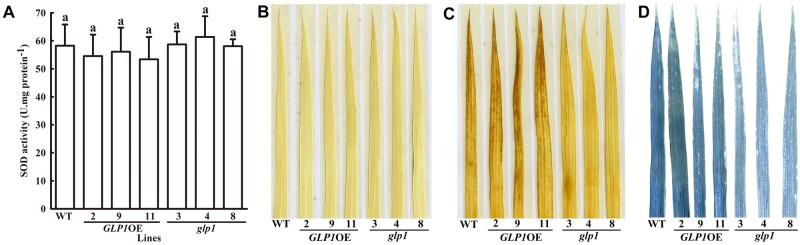
OsGLP1 encodes a protein devoid of detectable SOD activity. The levels of SOD activity (A), in situ staining for detection of H2O2 using DAB (C), O2•− using NBT (D), and staining control (water only, B) in rice leaves of WT, transgenic plants overexpressing OsGLP1 (2, 9, and 11) and glp1 mutants (3, 4, and 8) grown in a growth chamber without UV-B (600 µmol m−2 s−1 white light, 12 h, 30°C; dark, 12 h, 28°C) to the 5-leaf stage and then exposed to natural sunlight for 8 h. The means ± sd (n = 3) of SOD activity assigned with the same letter were not significantly different as determined by one-way ANOVA with post-hoc Student–Newman–Keuls test (P <0.05).
Figure 6
Figure 6
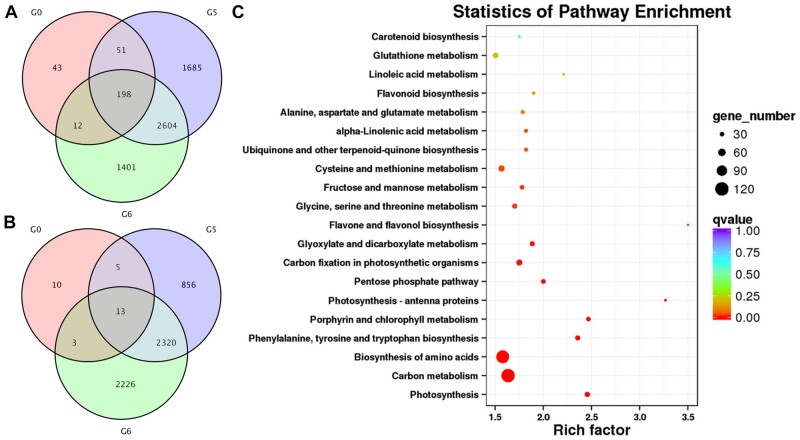
RNA-Seq analyses revealed that many genes are regulated in the leaves of glp1 mutant transferred from white light to natural sunlight. In A and B, numbers of genes that were upregulated and downregulated in the second leaf from bottom to top of glp1 seedlings by at least two-fold compared to those in WT are shown, respectively. G0, G5, and G6 denote those in WT and glp1-4 grown in a growth chamber under 600 µmol m−2 s−1 constant white light without UV-B (12-h light, 30°C; 12-h dark, 28°C) to the 4-leaf stage and then transferred under natural sunlight for 0 h (600 µmol m−2 s−1, 0 µW cm−2 UV-B, 30°C), 4 h (1,440 µmol m−2 s−1, 174 µW cm−2 UV-B, 37°C), and 8 h (810 µmol m−2 s−1, 80.2 µW cm−2 UV-B, 35°C), respectively. Statistics of pathway enrichment analyses of the differentially regulated genes in WT and glp1-4 grown under natural sunlight for 8 h (C). Scale bar denotes the q value.
Figure 7
Figure 7
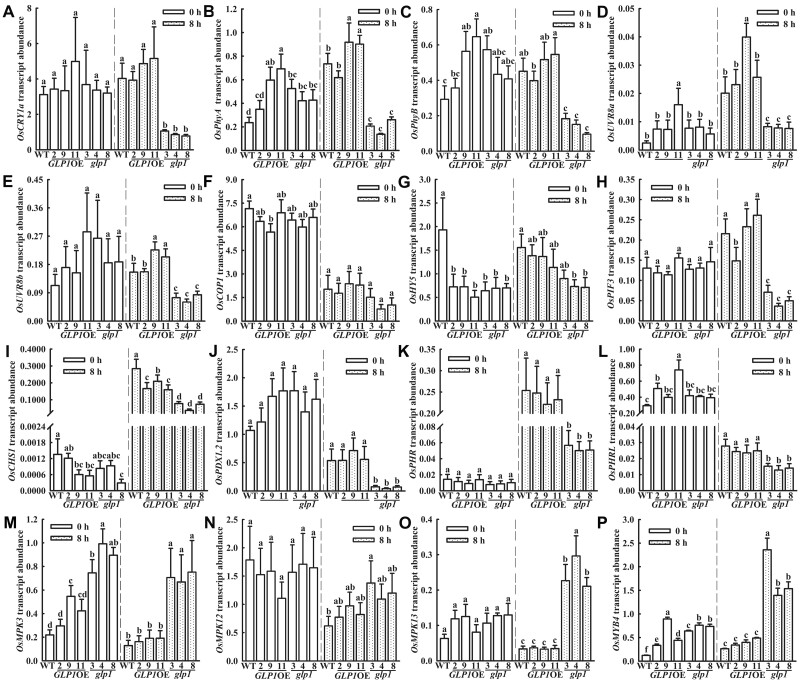
RT-qPCR analysis of the expression of UV-B-associated genes regulated in glp1 compared to WT. WT, transgenic plants overexpressing OsGLP1 (2, 9, and 11) and glp1 mutants (3, 4, and 8) were grown in a growth chamber under 600 µmol m−2 s−1 constant white light (12-h light, 30°C; 12-h dark, 28°C) to the 4-leaf stage, then transferred to natural sunlight for 0 h (600 μmol m−2 s−1, 0 μW cm−2 UV-B, 30°C) and 8 h (891.3 μmol m−2 s−1, 96.4 μW cm−2 UV-B, 34°C), respectively, and the second leaf from bottom to top of the seedlings were harvested separately. Expression levels of OsCRY1a (A), OsPhyA (B), OsPhyB (C), OsUVR8a (D), OsUVR8b (E), OsCOP1 (F), OsHY5 (G), OsPIF3 (H), OsCHS1 (I), OsPDX1.2 (J), OsPHR (K), OsPHRL (L), OsMPK3 (M), OsMPK12 (N), OsMPK13(O), and OsMYB4 (P) were analyzed and ACTIN was used an internal standard. The mean gene expression levels ± sd (n = 3) in the different plants exposed to natural sunlight at 0 h were compared statistically and those assigned with different letters were significantly different. The same analyses were performed with the plants exposed to natural sunlight for 8 h. All analyses were determined using one-way ANOVA with the means separation post hoc Student–Newman–Keuls test (P <0.05).
Figure 8
Figure 8
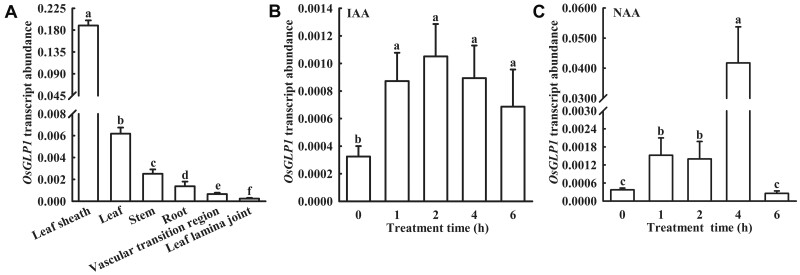
Analysis of OsGLP1 expression using RT-qPCR. OsGLP1 expression in various tissues of booting stage rice (A) and in leaves of rice seedlings at the 5-leaf stage treated with 10 μmol L−1 IAA (B) and 1 μmol L−1 NAA (C) at various time points was analyzed and ACTIN was used as an internal standard. The means ± sd (n = 3) of gene expression levels assigned with different letters were significantly different as determined by one-way ANOVA with Student–Newman–Keuls test (P <0.05).

References

    1. Banerjee J, Maiti MK (2010) Functional role of rice germin-like protein1 in regulation of plant height and disease resistance. Biochem Biophys Res Commun 394: 178–183 - PubMed
    1. Bernier F, Berna A (2001) Germins and germin-like proteins: Plant do-all proteins. But what do they do exactly? Plant Physiol Biochem 39: 39545–39554
    1. Brown BA, Cloix C, Jiang GH, Kaiserli E, Herzyk P, Kliebenstein DJ, Jenkins GI (2005) A UV-B-specific signaling component orchestrates plant UV protection. Proc Natl Acad Sci USA 102: 18225–18230 - PMC - PubMed
    1. Davey MP, Susanti NI, Wargent JJ, Findlay JE, Quick WP, Paul ND, Jenkins GI (2012) The UV-B photoreceptor UVR8 promotes photosynthetic efficiency in Arabidopsis thaliana exposed to elevated levels of UV-B. Photosynth Res 114: 121–131 - PubMed
    1. Carrillo MGC, Goodwin PH, Leach JE, Leung H, Cruz CMV (2009) Phylogenomic relationships of rice oxalate oxidases to the cupin superfamily and their association with disease resistance QTL. Rice 2: 67–79

Publication types

LinkOut - more resources