


Design of CLARO (Collaboration Leading to Addiction Treatment and Recovery from other Stresses): A randomized trial of collaborative care for opioid use disorder and co-occurring depression and/or posttraumatic stress disorder
- PMID: 33713840
- PMCID: PMC8432760
- DOI: 10.1016/j.cct.2021.106354
Design of CLARO (Collaboration Leading to Addiction Treatment and Recovery from other Stresses): A randomized trial of collaborative care for opioid use disorder and co-occurring depression and/or posttraumatic stress disorder
Abstract
Introduction: Opioid use disorder (OUD) co-occurring with depression and/or posttraumatic stress disorder (PTSD) is common and, if untreated, may lead to devastating consequences. Despite the availability of evidence-based treatments for these disorders, receipt of treatment is low. Even when treatment is provided, quality is variable. Primary care is an important and underutilized setting for treating co-occurring disorders (COD) because OUD, depression and PTSD are frequently co-morbid with medical conditions and most people visit a primary care provider at least once a year. With rising rates of OUD and opioid-related fatalities, this is a critical treatment and quality gap in a vulnerable and stigmatized population.
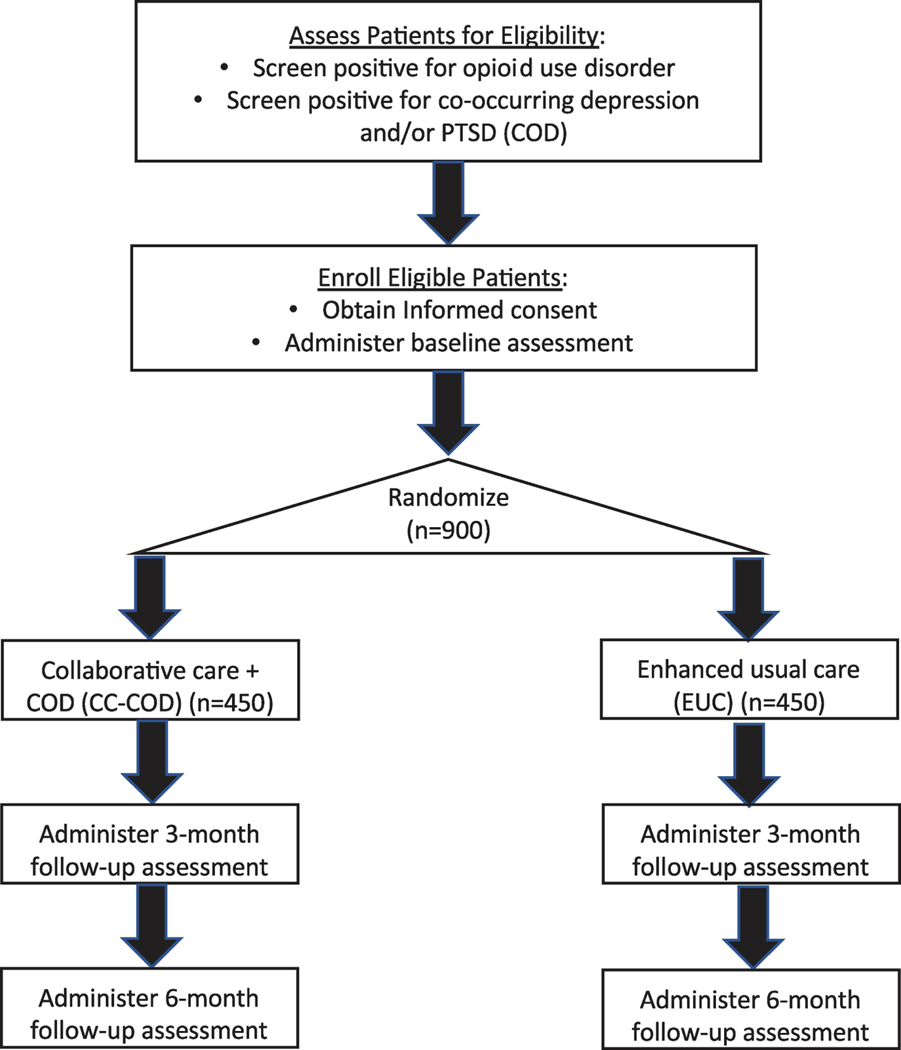
Methods: CLARO (Collaboration Leading to Addiction Treatment and Recovery from Other Stresses) is a multi-site, randomized pragmatic trial of collaborative care (CC) for co-occurring disorders in 13 rural and urban primary care clinics in New Mexico to improve care for patients with OUD and co-occurring depression and/or PTSD. CC, a service delivery approach that uses multi-faceted interventions, has not been tested with COD. We will enroll and randomize 900 patients to either CC adapted for COD (CC-COD) or enhanced usual care (EUC) and will collect patient data at baseline, 3-, and 6-month follow-up. Our primary outcomes are medications for OUD (MOUD) access, MOUD continuity of care, depression symptoms, and PTSD symptoms.
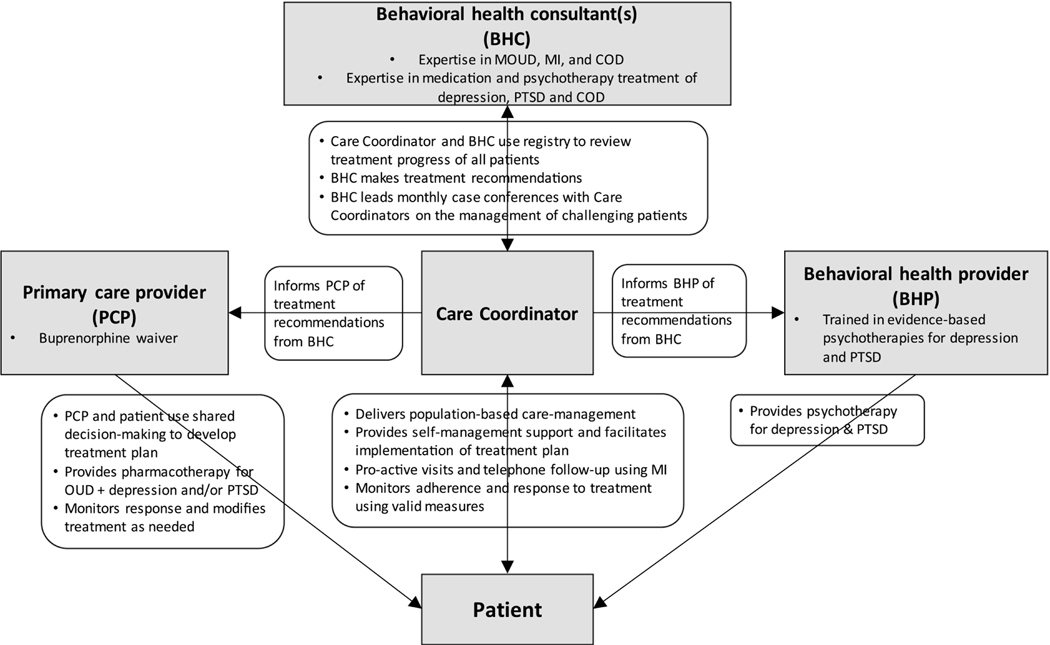
Discussion: Although CC is effective for improving outcomes in primary care among patients with mental health conditions, it has not been tested for COD. This article describes the CLARO CC-COD intervention and clinical trial.
Keywords: Collaborative care; Depression; Integrating primary care and mental health; Opioid use disorder; Post-traumatic stress disorder; Primary care; Safety net Federally Qualified Health Centers (FQHCs).
Copyright © 2021 Elsevier Inc. All rights reserved.
Figures
References
-
- Centers for Disease Control. Drug overdose deaths. 2018; https://www.cdc.gov/drugoverdose/data/statedeaths.html.Accessed March 4, 2019.
-
- Compton WM, Thomas YF, Stinson FS, Grant BF. Prevalence, correlates, disability, and comorbidity of DSM-IV drug abuse and dependence in the United States: Results from the national epidemiologic survey on alcohol and related conditions. Archives of General Psychiatry. 2007;64(5):566–576. doi: 10.1001/archpsyc.64.5.566. - DOI - PubMed
-
- National Drug Intelligence Center. The economic impact of illicit drug use on American society. Washington D.C.: U.S. Department of Justice; 2011.
-
- Grant BF, Stinson FS, Dawson DA, Chou SP, Dufour MC, Compton W, Pickering RP, Kaplan K. Prevalence and co-occurrence of substance use disorders and independent mood and anxiety disorders: Results from the National Epidemiologic Survey on Alcohol and Related Conditions. Archives of General Psychiatry. 2004;61(8):807–816. doi: 10.1001/archpsyc.61.8.807. - DOI - PubMed
Publication types
MeSH terms
Grants and funding
LinkOut - more resources
Full Text Sources
Other Literature Sources
Medical
Miscellaneous
