Review
. 2021 Apr:290:102400.
doi: 10.1016/j.cis.2021.102400. Epub 2021 Mar 4.

Chemodynamic features of nanoparticles: Application to understanding the dynamic life cycle of SARS-CoV-2 in aerosols and aqueous biointerfacial zones

Affiliations
Review

Chemodynamic features of nanoparticles: Application to understanding the dynamic life cycle of SARS-CoV-2 in aerosols and aqueous biointerfacial zones

Jérôme F L Duval et al. Adv Colloid Interface Sci. 2021 Apr.

Abstract

We review concepts involved in describing the chemodynamic features of nanoparticles and apply the framework to gain physicochemical insights into interactions between SARS-CoV-2 virions and airborne particulate matter (PM). Our analysis is highly pertinent given that the World Health Organisation acknowledges that SARS-CoV-2 may be transmitted by respiratory droplets, and the US Center for Disease Control and Prevention recognises that airborne transmission of SARS-CoV-2 can occur. In our theoretical treatment, the virion is assimilated to a core-shell nanoparticle, and contributions of various interaction energies to the virion-PM association (electrostatic, hydrophobic, London-van der Waals, etc.) are generically included. We review the limited available literature on the physicochemical features of the SARS-CoV-2 virion and identify knowledge gaps. Despite the lack of quantitative data, our conceptual framework qualitatively predicts that virion-PM entities are largely able to maintain equilibrium on the timescale of their diffusion towards the host cell surface. Comparison of the relevant mass transport coefficients reveals that virion biointernalization demand by alveolar host cells may be greater than the diffusive supply. Under such conditions both the free and PM-sorbed virions may contribute to the transmitted dose. This result points to the potential for PM to serve as a shuttle for delivery of virions to host cell targets. Thus, our critical review reveals that the chemodynamics of virion-PM interactions may play a crucial role in the transmission of COVID-19, and provides a sound basis for explaining reported correlations between episodes of air pollution and outbreaks of COVID-19.

Keywords: ACE2; COVID-19; Dispersal; Lability; Nanoparticle reactivity; Virion-particle sorption.


Conflict of interest statement

Declaration of Competing Interest The authors declare that they have no known competing financial interests or personal relationships that could have appeared to influence the work reported in this paper.

Figures
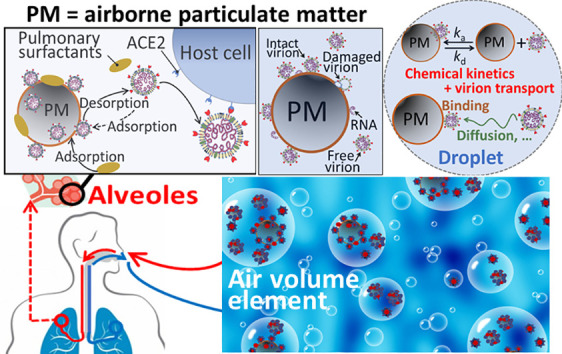
Unlabelled Image
Graphical abstract
Fig. 1
Fig. 1
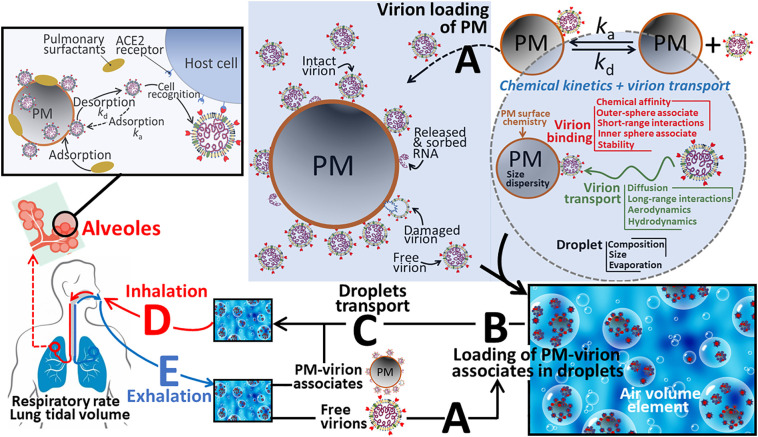
Schematic overview of the processes involved in the dynamic lifecycle of SARS-CoV-2, from (A) virion loading of airborne particulate matter (PM), (B) loading of PM-virion associates (and of unassociated or free virions) into aerosol droplets, (C) the environmental transport of loaded droplets, (D) droplet inhalation, transport to alveoles, release of virions from PM and subsequent specific binding of virions to host cells, and (E) exhalation. See text for further details.
Fig. 2
Fig. 2
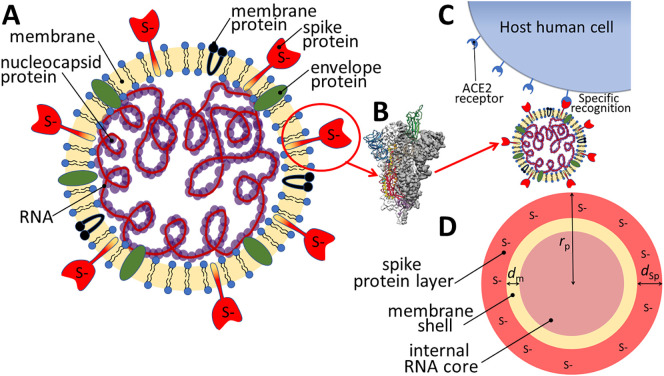
Schematic representation of (A) the SARS-CoV-2 virion, (B) a side view of the prefusion structure of spike protein with a single Receptor Binding Domain (RBD) in open (“up”) conformation (green), adapted from Wrapp et al. 2020 [4]. (C) ACE2-virion specific recognition, and (D) virion structure according to a physical-chemical relevant multilayered core-shell representation. Herein, the surface layer containing the spike protein is considered as the outer “shell” of the virion with thickness dSp (≈10 nm) hosting reactive sites S (corresponding to functional groups on the amino acid residues which may carry a negative, positive, or no net charge), the virion further comprises an intermediate membrane layer (thickness dm) and an internal RNA “core” with radius a = rp- dm- dSP (≈20 to 60 nm). In (A) and (D) the reactive sites S in the outer shell layer are nominally shown as negatively charged.
Fig. 3
Fig. 3
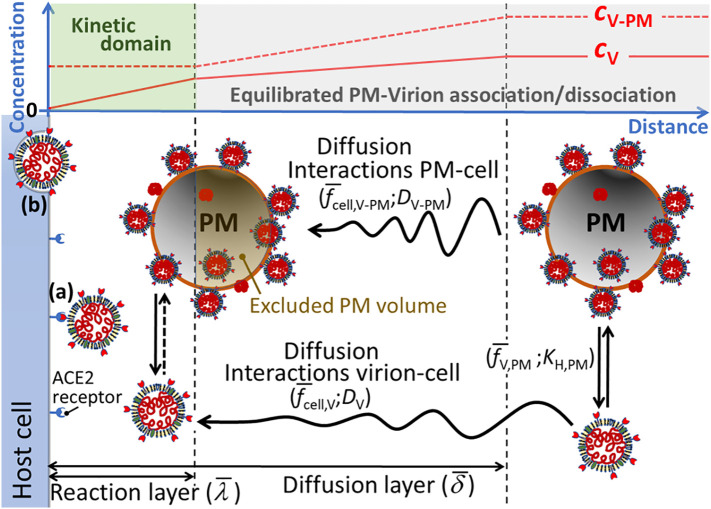
Schematic view of the processes governing the flux of a virion towards the ACE2 receptor in the presence of sorbing PM2.5 up to the stage of (a) cell recognition with the ACE2 receptor, and (b) the preliminary stage of endocytosis. The concentration of the free virion, cV, is sketched by the solid red line and the average concentration of V-PM entities, cV‐PM, is indicated by the dashed red line. In the region where V-PM maintains equilibrium with V, the change in cV‐PM follows the change in cV. For clarity arbitrary thicknesses are shown for the operational reaction layer at the host cell/medium interface (λ¯) and the mean solution diffusion layer for V and V-PM (δ¯). The various f¯ terms denote the interaction forces between V-PM and the cell surface, f¯cell,VPM, between free V and the cell surface, f¯cell,V, and between free V and PM, f¯V,PM. The diffusion coefficients for free V and V-PM are denoted by DV and DV-PM, respectively, and KH,PM is the coefficient for sorption of V onto PM in the Henry regime.
Fig. 4
Fig. 4
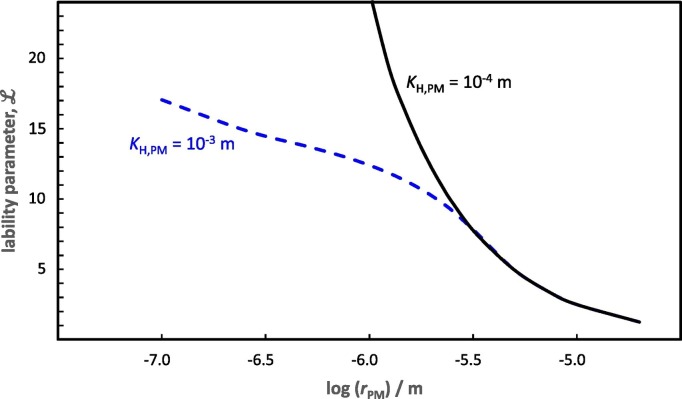
The lability parameter, ℒ (Eq. (13)), computed for virions sorbed on airborne particulate matter (PM) as a function of the radius of PM, rPM (in m). Curves are shown for a Henry adsorption coefficient, KH,PM, of 10−4 m (black curve) and 10−3 m (blue dashed curve), with δ¯ = 10−4 m (see text for explanation).

References

    1. Amin M., Sorour M.K., Kasry A. Comparing the binding interactions in the receptor binding domains of SARS-CoV-2 and SARS-CoV. J Phys Chem Lett. 2020;11:4897–4900. doi: 10.1021/acs.jpclett.0c01064. - DOI - PubMed
    1. Hassanzadeh K., Pena H.P., Dragotto J., Buccarello L., Iorio F., Pieraccini S., et al. Considerations around the SARS-CoV-2 spike protein with particular attention to COVID-19 brain infection and neurological symptoms. ACS Chem Nerosci. 2020;11:2361–2369. doi: 10.1021/acschemneuro.0c00373. - DOI - PubMed
    1. Giron C.C., Laaksonen A., da Silva F.L.B. On the interactions of the receptor-binding domain of SARS-CoV-1 and SARS-CoV-2 spike proteins with monoclonal antibodies and the receptor ACE2. Virus Res. 2020;285:198021. doi: 10.1016/j.virusres.2020.198021. - DOI - PMC - PubMed
    1. Wrapp D., Wang N., Corbett K.S., Goldsmith J.A., Hsieh C.-L., Abiona O., et al. Cryo-EM structure of the 2019-nCoV spike in the prefusion conformation. Science. 2020;367:1260–1263. doi: 10.1126/science.abb2507. - DOI - PMC - PubMed
    1. Wang Y., Liu M., Gao J. Enhanced receptor binding of SARS-Cov-2 through networks of hydrogen-bonding and hydrophobic interactions. Proc Natl Acad Sci U S A. 2020;117:13967–13974. doi: 10.1073/pnas.2008209117. - DOI - PMC - PubMed

MeSH terms