


Retracted: Diagnostic Classification and Prognostic Prediction Using Common Genetic Variants in Autism Spectrum Disorder: Genotype-Based Deep Learning
- PMID: 33714937
- PMCID: PMC8060867
- DOI: 10.2196/24754
Retracted: Diagnostic Classification and Prognostic Prediction Using Common Genetic Variants in Autism Spectrum Disorder: Genotype-Based Deep Learning
Retraction in
-
Retraction: "Diagnostic Classification and Prognostic Prediction Using Common Genetic Variants in Autism Spectrum Disorder: Genotype-Based Deep Learning".JMIR Med Inform. 2025 May 6;13:e76833. doi: 10.2196/76833. JMIR Med Inform. 2025. PMID: 40331761 Free PMC article. No abstract available.
Abstract
Background: In the United States, about 3 million people have autism spectrum disorder (ASD), and around 1 out of 59 children are diagnosed with ASD. People with ASD have characteristic social communication deficits and repetitive behaviors. The causes of this disorder remain unknown; however, in up to 25% of cases, a genetic cause can be identified. Detecting ASD as early as possible is desirable because early detection of ASD enables timely interventions in children with ASD. Identification of ASD based on objective pathogenic mutation screening is the major first step toward early intervention and effective treatment of affected children.
Objective: Recent investigation interrogated genomics data for detecting and treating autism disorders, in addition to the conventional clinical interview as a diagnostic test. Since deep neural networks perform better than shallow machine learning models on complex and high-dimensional data, in this study, we sought to apply deep learning to genetic data obtained across thousands of simplex families at risk for ASD to identify contributory mutations and to create an advanced diagnostic classifier for autism screening.
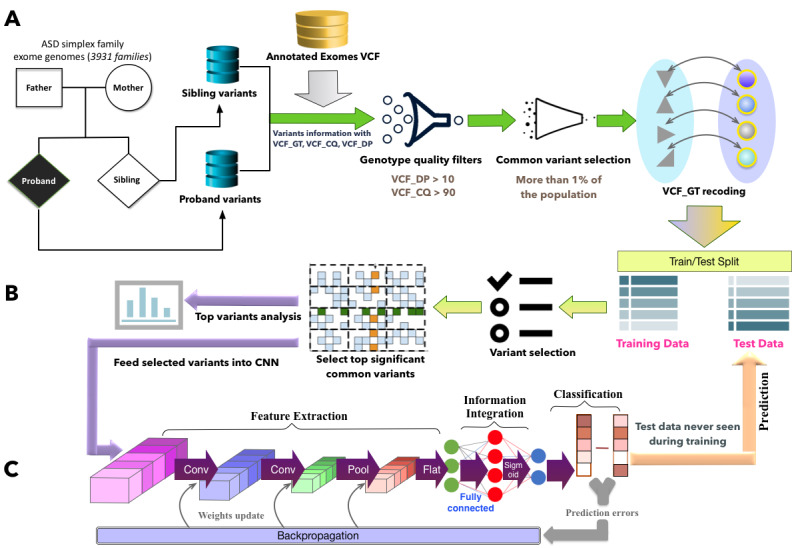
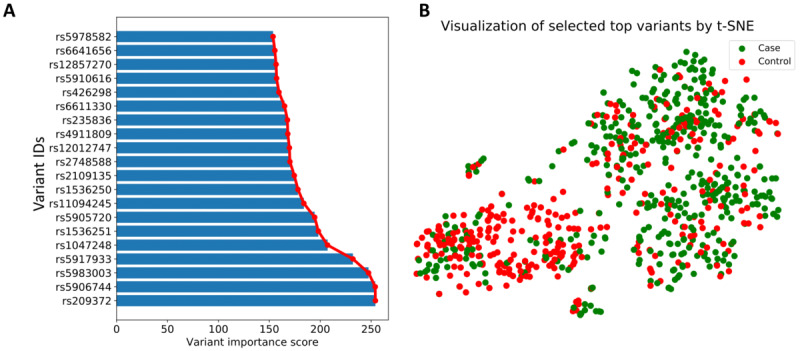
Methods: After preprocessing the genomics data from the Simons Simplex Collection, we extracted top ranking common variants that may be protective or pathogenic for autism based on a chi-square test. A convolutional neural network-based diagnostic classifier was then designed using the identified significant common variants to predict autism. The performance was then compared with shallow machine learning-based classifiers and randomly selected common variants.
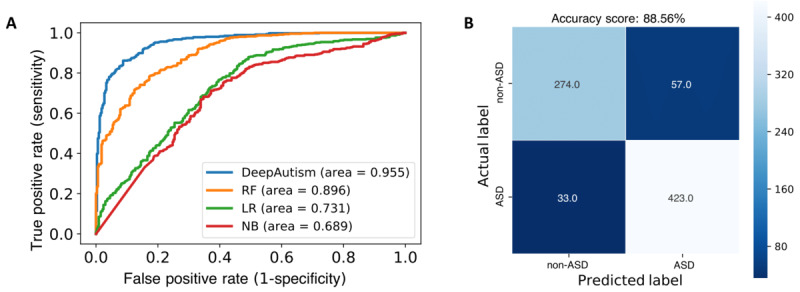
Results: The selected contributory common variants were significantly enriched in chromosome X while chromosome Y was also discriminatory in determining the identification of autistic individuals from nonautistic individuals. The ARSD, MAGEB16, and MXRA5 genes had the largest effect in the contributory variants. Thus, screening algorithms were adapted to include these common variants. The deep learning model yielded an area under the receiver operating characteristic curve of 0.955 and an accuracy of 88% for identifying autistic individuals from nonautistic individuals. Our classifier demonstrated a considerable improvement of ~13% in terms of classification accuracy compared to standard autism screening tools.
Conclusions: Common variants are informative for autism identification. Our findings also suggest that the deep learning process is a reliable method for distinguishing the diseased group from the control group based on the common variants of autism.
Keywords: autism spectrum disorder; common genetic variants, diagnostic classification; deep learning.
©Haishuai Wang, Paul Avillach. Originally published in JMIR Medical Informatics (http://medinform.jmir.org), 07.04.2021.
Conflict of interest statement
Conflicts of Interest: None declared.
Figures
Comment in
-
Code Error in "Diagnostic Classification and Prognostic Prediction Using Common Genetic Variants in Autism Spectrum Disorder: Genotype-Based Deep Learning".JMIR Med Inform. 2025 May 6;13:e66556. doi: 10.2196/66556. JMIR Med Inform. 2025. PMID: 40327366 Free PMC article. No abstract available.
References
-
- Rylaarsdam L, Guemez-Gamboa A. Genetic Causes and Modifiers of Autism Spectrum Disorder. Front Cell Neurosci. 2019;13:385. doi: 10.3389/fncel.2019.00385. https://doi.org/10.3389/fncel.2019.00385 - DOI - PMC - PubMed
-
- Frazier TW, Thompson L, Youngstrom EA, Law P, Hardan AY, Eng C, Morris N. A twin study of heritable and shared environmental contributions to autism. J Autism Dev Disord. 2014 Aug;44(8):2013–25. doi: 10.1007/s10803-014-2081-2. http://europepmc.org/abstract/MED/24604525 - DOI - PMC - PubMed
-
- Sutton H. Autism caused mostly by genetics, according to study. Disability Compliance for Higher Education. 2019 Aug 22;25(2):9–9. doi: 10.1002/dhe.30707. http://paperpile.com/b/cCsC73/7Rzn - DOI
-
- McDonald NM, Senturk D, Scheffler A, Brian JA, Carver LJ, Charman T, Chawarska K, Curtin S, Hertz-Piccioto I, Jones EJH, Klin A, Landa R, Messinger DS, Ozonoff S, Stone WL, Tager-Flusberg H, Webb SJ, Young G, Zwaigenbaum L, Jeste SS. Developmental Trajectories of Infants With Multiplex Family Risk for Autism: A Baby Siblings Research Consortium Study. JAMA Neurol. 2020 Jan 01;77(1):73–81. doi: 10.1001/jamaneurol.2019.3341. http://europepmc.org/abstract/MED/31589284 2752283 - DOI - PMC - PubMed
-
- de la Torre-Ubieta L, Won H, Stein JL, Geschwind DH. Advancing the understanding of autism disease mechanisms through genetics. Nat Med. 2016 Apr;22(4):345–61. doi: 10.1038/nm.4071. http://europepmc.org/abstract/MED/27050589 nm.4071 - DOI - PMC - PubMed
Publication types
LinkOut - more resources
Full Text Sources
