. 2021 Mar 10;288(1946):20202753.
doi: 10.1098/rspb.2020.2753. Epub 2021 Mar 10.

Priority effects alter interaction outcomes in a legume-rhizobium mutualism

Affiliations

Priority effects alter interaction outcomes in a legume-rhizobium mutualism

Julia A Boyle et al. Proc Biol Sci. .

Abstract

Priority effects occur when the order of species arrival affects the final community structure. Mutualists often interact with multiple partners in different orders, but if or how priority effects alter interaction outcomes is an open question. In the field, we paired the legume Medicago lupulina with two nodulating strains of Ensifer bacteria that vary in nitrogen-fixing ability. We inoculated plants with strains in different orders and measured interaction outcomes. The first strain to arrive primarily determined plant performance and final relative abundances of rhizobia on roots. Plants that received effective microbes first and ineffective microbes second grew larger than plants inoculated with the same microbes in the opposite order. Our results show that mutualism outcomes can be influenced not just by partner identity, but by the interaction order. Furthermore, hosts receiving high-quality mutualists early can better tolerate low-quality symbionts later, indicating that priority effects may help explain the persistence of ineffective symbionts.

Keywords: Medicago lupulina; historical contingency; mutualism; priority effects; rhizobia; symbiosis.


Figures
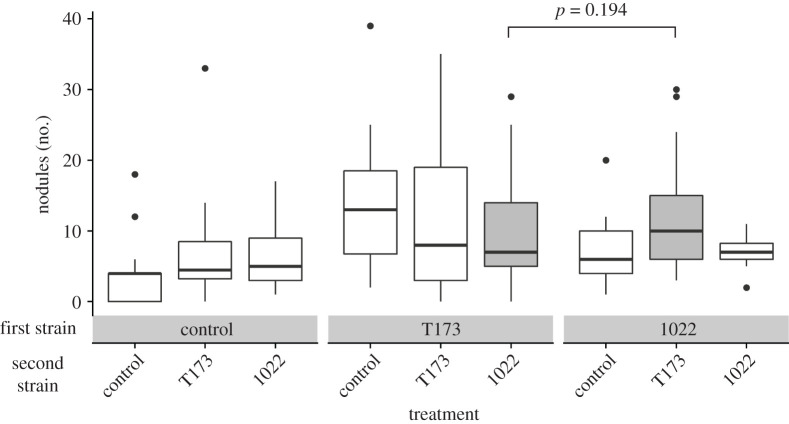
Figure 1.
Figure 1.
Number of nodules formed by plants inoculated with mutualistic Ensifer meliloti strain 1022 (1022), ineffective strain Ensifer sp. T173 (T173) or a sham inoculation with no bacteria (control) at the first and second time points. The boxplots show the median with the lower and upper hinges corresponding to the 25th and 75th percentiles, and the upper and lower whiskers represent the largest or smallest value, respectively, that is no further than 1.5 times the inter-quartile range from the hinge. The solid line compares the T173–1022 and 1022–T173 treatments (filled with grey) using a planned comparison (p = 0.194).
Figure 2.
Figure 2.
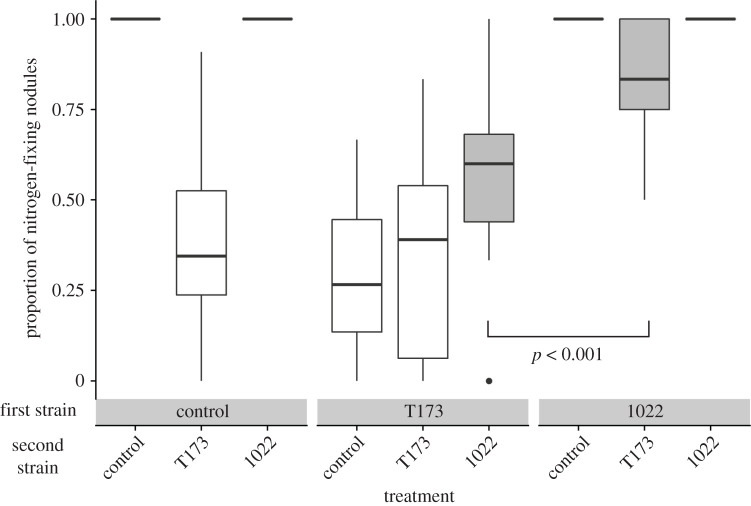
Proportion of nitrogen-fixing (i.e. pink) nodules formed by plants inoculated with mutualistic Ensifer meliloti strain 1022 (1022), ineffective strain Ensifer sp. T173 (T173) or a sham inoculation with no bacteria (control) at the first and second time points. The boxplots show the median with the lower and upper hinges corresponding to the 25th and 75th percentiles and the upper and lower whiskers represent the largest or smallest value, respectively, that is no further than 1.5 times the inter-quartile range from the hinge. The proportion was calculated by dividing the number of effective nodules by the total number of nodules for each plant. Only plants inoculated with T173 made any ineffective (i.e. white) nodules. The solid line compares the T173–1022 and 1022–T173 treatments (filled with grey) using a planned comparison of the proportion of effective nodules (p = 0.0002).
Figure 3.
Figure 3.
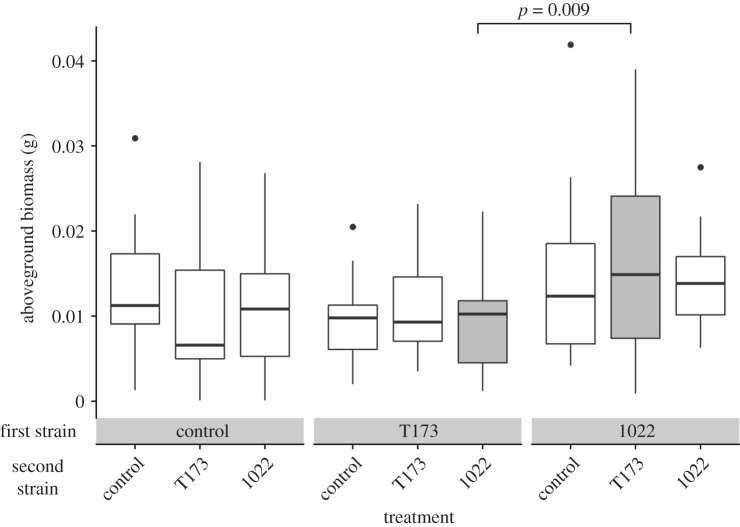
Aboveground biomass of plants inoculated with mutualistic Ensifer meliloti strain 1022 (1022), ineffective strain Ensifer sp. T173 (T173) or a sham inoculation with no bacteria (control) at the first and second time points. The boxplots show the median with the lower and upper hinges corresponding to the 25th and 75th percentiles and the upper and lower whiskers represent the largest or smallest value, respectively, that is no further than 1.5 times the inter-quartile range from the hinge. The solid line compares the T173–1022 and 1022–T173 treatments (filled with grey) in a planned comparison (p = 0.009). One outlier with a biomass over 0.05 g was omitted from this figure in treatment 1022–control.

References

    1. Fukami T. 2015. Historical contingency in community assembly: integrating niches, species pools, and priority effects. Annu. Rev. Ecol. Evol. Syst. 46, 1-23. (10.1146/annurev-ecolsys-110411-160340) - DOI
    1. Fukami T, Mordecai EA, Ostling A. 2016. A framework for priority effects. J. Veg. Sci. 27, 655-657. (10.1111/jvs.12434) - DOI
    1. Dickson TL, Hopwood JL, Wilsey BJ. 2012. Do priority effects benefit invasive plants more than native plants? An experiment with six grassland species. Biol. Invasions 14, 2617-2624. (10.1007/s10530-012-0257-2) - DOI
    1. Fitzpatrick CR, Copeland J, Wang PW, Guttman DS, Kotanen PM, Johnson MTJ. 2018. Assembly and ecological function of the root microbiome across angiosperm plant species. Proc. Natl Acad. Sci. USA 115, E1157-E1165. (10.1073/pnas.1717617115) - DOI - PMC - PubMed
    1. Beijerinck MW. 1913. De infusies en de ontdekking der backteriën. Jaarboek van de Koninklijke Akademie voor Wetenschappen. Amsterdam, The Netherlands: Müller.

Publication types