


An ERP Study on the Role of Phonological Processing in Reading Two-Character Compound Chinese Words of High and Low Frequency
- PMID: 33716906
- PMCID: PMC7947322
- DOI: 10.3389/fpsyg.2021.637238
An ERP Study on the Role of Phonological Processing in Reading Two-Character Compound Chinese Words of High and Low Frequency
Abstract
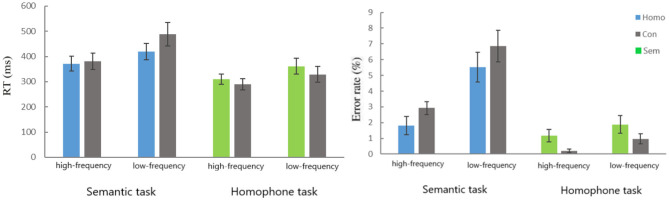
Unlike in English, the role of phonology in word recognition in Chinese is unclear. In this event-related potential experiment, we investigated the role of phonology in reading both high- and low-frequency two-character compound Chinese words. Participants executed semantic and homophone judgment tasks of the same precede-target pairs. Each pair of either high- or low-frequency words were either unrelated (control condition) or related semantically or phonologically (homophones). The induced P200 component was greater for low- than for high-frequency word-pairs both in semantic and phonological tasks. Homophones in the semantic judgment task and semantically-related words in the phonology task both elicited a smaller N400 than the control condition, word frequency-independently. However, for low-frequency words in the phonological judgment task, it was found that the semantically related pairs released a significantly larger P200 than the control condition. Thus, the semantic activation of both high- and low-frequency words may be no later than phonological activation.
Keywords: Chinese word recognition; N400; P200; homophonic; word frequency.
Copyright © 2021 Wang, Jiang, Huang and Qiu.
Conflict of interest statement
The authors declare that the research was conducted in the absence of any commercial or financial relationships that could be construed as a potential conflict of interest.
Figures



References
LinkOut - more resources
Full Text Sources
Other Literature Sources
