


Association Between Substance Use Behaviors, Developmental Assets and Mental Health: A Glance at Latin American Young College Students
- PMID: 33716908
- PMCID: PMC7947607
- DOI: 10.3389/fpsyg.2021.639578
Association Between Substance Use Behaviors, Developmental Assets and Mental Health: A Glance at Latin American Young College Students
Abstract
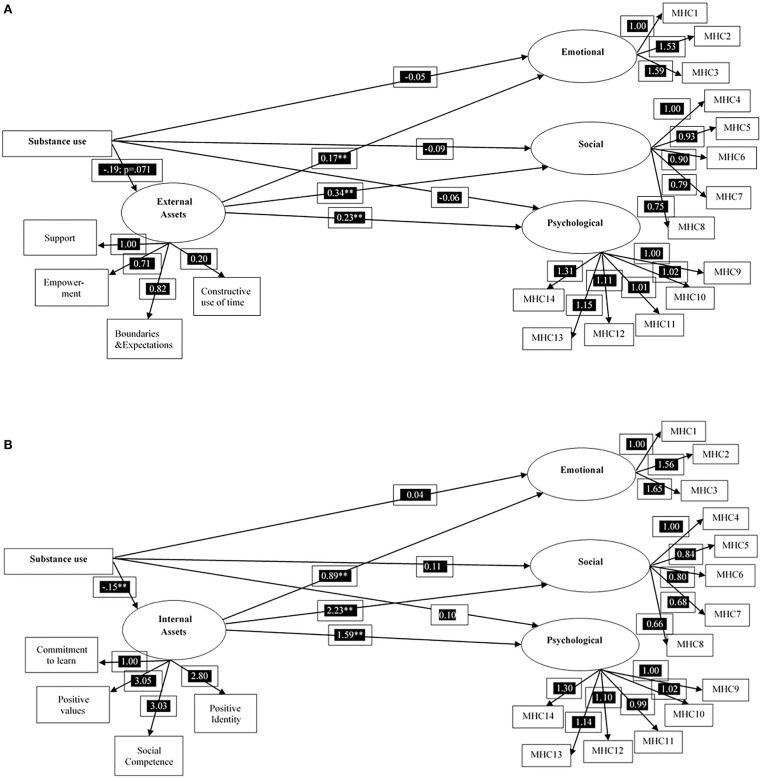
Positive Youth Development (PYD) is an approach that promotes resilience and focuses on youth strengths rather than their weaknesses as done by the traditional deficit-based perspective. Research in Europe and North America show that developmental assets are associated with school success, psychological well-being, and lower health risks among youth and young adults. However, not much research has been done on these associations in Latin American contexts. The purpose of this research study is to assess the association between substance use behaviors, such as drunkenness and the use of illicit drugs, and mental health, together with the mediating role of developmental assets representing youth strengths (e.g., social competence) and contextual resources (e.g., social support at home or school). Cross-national data was collected from Colombian (n = 210; 70.4% females) and Peruvian (n = 349; 66.5% females) 1st year university students. Results shed light on the protective role of developmental assets regarding substance use behaviors and mental well-being. Specifically, the results showed direct negative associations between developmental assets and substance use behaviors and positive associations of developmental assets with mental health indicators. Internal assets appear to be a stronger predictor of social, emotional, and psychological well-being compared to external assets. We did not find any statistical significance in the association of substance use behavior and mental health. We discuss implications regarding research, policy, and practice.
Keywords: Colombia; Peru; developmental assets; risk behaviors; well-being; young people.
Copyright © 2021 Manrique-Millones, Wiium, Pineda-Marín, Fernández-Arata, Alfonso-Murcia, López-Martínez and Millones-Rivalles.
Conflict of interest statement
The authors declare that the research was conducted in the absence of any commercial or financial relationships that could be construed as a potential conflict of interest.
Figures
References
-
- Adams B. G., Wiium N., Abubakar A. (2018). Developmental assets and academic performance of adolescents in Ghana, Kenya, and South Africa. Child Youth Care Forum 48, 207–222. 10.1007/s10566-018-9480-z - DOI
-
- Benson P. L. (1990). The Troubled Journey: A Portrait of 6th-12th Grade Youth. Minneapolis, MN: The Search Institute.
-
- Benson P. L. (1997). All Kids are Our Kids: What Communities Must Do to Raise Caring and Responsible Children and Adolescents. San Francisco, CA: Jossey-Bass.
-
- Benson P. L. (2003). Developmental assets and asset-building community: conceptual and empirical foundations, in Developmental Assets and Asset-Building Communities, The Search Institute Series on Developmentally Attentive Community and Society, Vol. 1, eds Lerner R. M., Benson P. L. (Boston, MA: Springer; ). 10.1007/978-1-4615-0091-9_2 - DOI
-
- Benson P. L. (2007). Developmental assets: an overview of theory, research, and practice, in Approaches to Positive Youth Development, eds Silbereisen R. K., Lerner R. M. (London: SAGE Publications Ltd; ), 33–58. 10.4135/9781446213803.n2 - DOI
LinkOut - more resources
Full Text Sources
Other Literature Sources
