


The Role of Intranasal Oxytocin on Social Cognition: An Integrative Human Lifespan Approach
- PMID: 33717829
- PMCID: PMC7951958
- DOI: 10.1007/s40473-020-00214-5
The Role of Intranasal Oxytocin on Social Cognition: An Integrative Human Lifespan Approach
Abstract
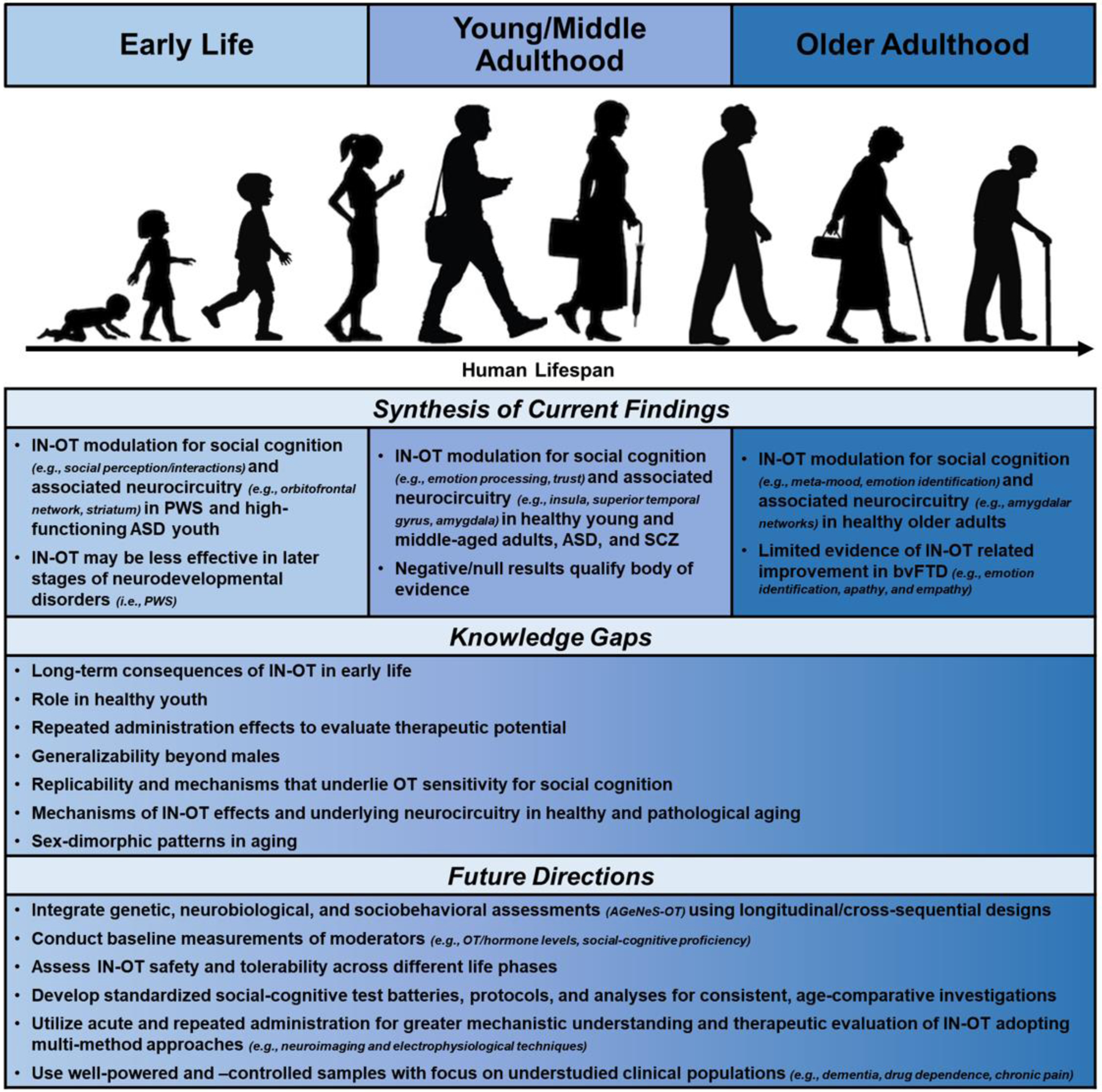
Purpose of review: This narrative review synthesizes research from the last two decades on the modulatory role of intranasal OT administration (IN-OT) on social cognition in early life, young/middle adulthood, and older adulthood. Advances and knowledge gaps are identified, and future research directions are discussed within an integrative human lifespan framework to guide novel research on IN-OT and social cognition.
Recent findings: Current evidence regarding IN-OT modulation of social-cognitive processes, behavior, and related neurocircuitry is mixed, with some studies suggesting benefits (e.g., improved social perception/interactions, emotion processing) depending on contextual (e.g., social stimuli) and interindividual factors (e.g., age, sex, clinical status). Current research, however, is limited by a focus on isolated life phases, males, and select clinical populations as well as a lack of standardized protocols.
Summary: This literature-based reflection proposes that greater generalizability of findings and scientific advancement on social-cognitive modulation via IN-OT require standardized, multi-method, longitudinal, and cross-sequential assessments in well-powered, well-controlled, and representative samples in line with an integrative lifespan approach, which considers development as a lifelong dynamic process involving both change and stability characterized by the interplay between genetic, neurobiological, and socio-behavioral factors.
Keywords: Hormone; Intranasal Administration; Lifespan Development; Neuropeptide; Oxytocin; Social Cognition.
Conflict of interest statement
The authors have no conflict of interest to declare.
Figures
References
-
- Sannino S, Chini B, Grinevich V. Lifespan oxytocin signaling: Maturation, flexibility, and stability in newborn, adolescent, and aged brain. Dev Neurobiol. Wiley Online Library; 2017;77:158–68. - PubMed
-
A review on OT system development and activity across three distinct life phases: early postnatal period, puberty/adolescence, and aging. This review discusses novel research avenues for use of IN-OT in neurodevelopmental disorders in early life, substance-use disorders among adolescents, and neurodegenerative disease in older populations.
-
- Quintana DS, Guastella AJ. An Allostatic Theory of Oxytocin. Trends Cogn Sci. Elsevier Current Trends; 2020;24:515–28. - PubMed
-
A review of the OT system and its role in behavior from etiological and developmental perspectives. The paper reconceptualizes OT as an allostatic hormone that modulates both social and non-social behavior to maintain stability across changing environments.
-
- Harari-Dahan O, Bernstein A. A general approach-avoidance hypothesis of Oxytocin: Accounting for social and non-social effects of oxytocin. Neurosci Biobehav Rev. Elsevier Ltd; 2014;47:506–19. - PubMed
-
- Strickland-Hughes CM, Dillon KE, West RL, Ebner NC. Own-age bias in face-name associations: Evidence from memory and visual attention in younger and older adults. Cognition. Elsevier B.V.; 2020;200:104253. - PubMed
Grants and funding
LinkOut - more resources
Full Text Sources
Research Materials