


Functional outcome of supracondylar humerus fracture in children with the use of pin configuration as per Bahk classification
- PMID: 33717880
- PMCID: PMC7920002
- DOI: 10.1016/j.jcot.2020.08.012
Functional outcome of supracondylar humerus fracture in children with the use of pin configuration as per Bahk classification
Abstract
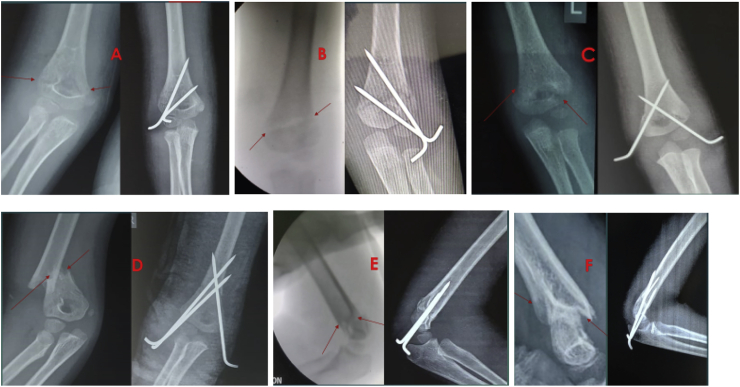
Introduction: A variety of fracture patterns are seen in supracondylar humerus fractures in children and these are well described by Bahk et al. Currently followed treatment protocol doesn't recognize these common fracture patterns and pin placement is done at the discretion of the treating surgeon. The aim of the study is to evaluate the usefulness of Bahk classification system in deciding the pin configuration for the specific fracture patterns and thereby assess the functional outcome in the management of supracondylar fractures in children.
Method: The study was done on 100 children of 2-12 years of age from February 2019 to January 2020. After closed reduction under general anesthesia, fractures were classified and pin configuration was decided according to Bahk classification. In the follow-up, patients were assessed for clinicoradiological outcomes based on Modified Flynn's criteria, Baumann angle, and anterior humeral line.
Results: In our study Typical transverse and low sagittal fracture were the most common fracture patterns. In the final follow up as per Flynn's criteria, 93% of the patients showed excellent results. Mean Baumann's angle was not significantly different from the uninjured side and anterior humeral line passed through anterior or middle third of the capitulum in 95% patients.
Conclusion: Using pin configuration suitable to fracture pattern as per Bahk classification improves functional outcome in supracondylar humerus fractures in children and minimizes complications.
Keywords: Anterior humeral line; Bahk classification; Baumann angle; Flynn criteria; Supracondylar humerus.
© 2020 Delhi Orthopedic Association. All rights reserved.
Conflict of interest statement
No author has any conflict of interest.
Figures
References
-
- Holmberg L. Fractures in the distal end of humerus in children. Acta Chir Scand. 1945;92:5–55.
-
- Brauer C.A., Lee B.M., Bae D.S. A systemic review of medial and lateral entry pinning versus lateral entry pinning for supracondylar fractures of the humerus. J Pediatr Orthop. 2007;27:181–186. - PubMed
-
- Bahk M.S., Srikumaran U., Ain M.C. Patterns of pediatric supracondylar humerus fractures. J Pediatr Orthop. 2008;28:493–499. - PubMed
-
- Blount W.P. Supracondylar (diacondylar , transcondylar) fractures. In: Wilkins W., editor. Fractures in Children. 1955. pp. 26–42. Baltimore.
-
- Lyons J.P., Ashley E., Hoffer M.M. Ulnar nerve palsies after percutaneous cross pinning of supracondylar fractures in children’s elbow. J Paediatr Orthop. 1998;18:43–45. - PubMed
LinkOut - more resources
Full Text Sources
Other Literature Sources