


Intra-operative referencing technique is non-inferior to use of fluoroscopy for acetabular component positioning in anterior hip arthroplasty
- PMID: 33717920
- PMCID: PMC7920138
- DOI: 10.1016/j.jcot.2020.10.032
Intra-operative referencing technique is non-inferior to use of fluoroscopy for acetabular component positioning in anterior hip arthroplasty
Erratum in
-
Erratum regarding previously published articles.J Clin Orthop Trauma. 2021 Oct;21:101561. doi: 10.1016/j.jcot.2021.101561. Epub 2021 Aug 5. J Clin Orthop Trauma. 2021. PMID: 34381302 Free PMC article.
Abstract
Background: Intra-operative fluoroscopy has been shown to improve the accuracy of acetabular component positioning when compared to no fluoroscopy in direct anterior approach (DAA) total hip arthroplasty (THA). Due to logistical reasons, our senior author has been performing DAA THA at one institution without the use of fluoroscopy and has created an intraoperative referencing technique to aid in acetabular component positioning. The purpose of this study is to evaluate the accuracy of acetabular component positioning using fluoroscopy when compared to an intra-operative referencing technique without fluoroscopy.
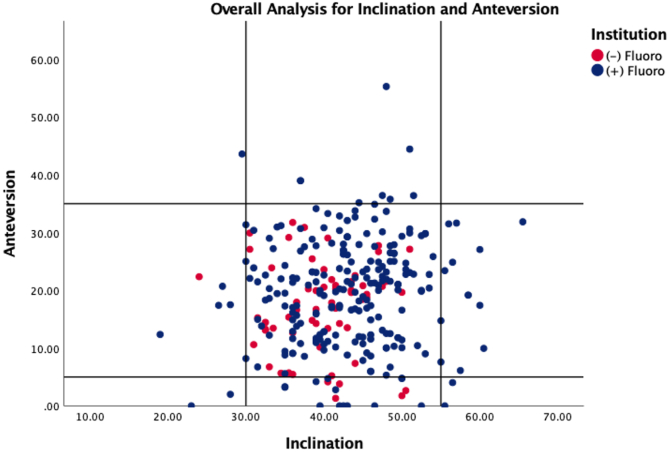
Methods: A total of 214 consecutive primary DAA THA were performed by one surgeon at two institutions and were retrospectively reviewed over a 3-year period. Intra-operative fluoroscopy was used with all patients at Institution A (N = 154). At institution B (N = 60), no fluoroscopy was used, and an intra-operative referencing technique was employed to assist in placement of the acetabular component.
Results: In the fluoroscopy group, 91% of components met our abduction target, 90% met our anteversion target, and 82.5% simultaneously met both targets. In the non-fluoroscopy group, 98% of components met our abduction target, 92% met our anteversion target, and 90% simultaneously met both targets. There was no difference between groups for placement of the component within both targets simultaneously (p = .171).
Conclusion: Use of our intra-operative referencing technique is non-inferior in placing acetabular components within a pre-defined safe zone when compared to use of intraoperative fluoroscopy. The intra-operative reference technique can be a helpful adjunct for ensuring accurate acetabular component positioning while simultaneously reducing cost and limiting radiation exposure.
Keywords: Acetabular component positioning; Direct anterior approach; Fluoroscopy; Total hip arthroplasty.
© 2020 Delhi Orthopedic Association. All rights reserved.
Figures

References
-
- Barrack R.L. Accuracy of acetabular component position in hip arthroplasty. J Bone Joint Surg Am. 2013;95(19):1760–1768. - PubMed
-
- Slotkin E.M., Patel P.D., Suarez J.C. Accuracy of fluoroscopic guided acetabular component positioning during direct anterior total hip arthroplasty. J Arthroplasty. 2015;30(9):102–106. - PubMed
-
- Jennings J.D. Intraoperative fluoroscopy improves component position during anterior hip arthroplasty. Orthopedics. 2015;38(11):e970–e975. - PubMed
-
- Gosthe R.G. Fluoroscopically guided acetabular component positioning: does it reduce the risk of malpositioning in obese patients? J Arthroplasty. 2017;32(10):3052–3055. - PubMed
LinkOut - more resources
Full Text Sources
Other Literature Sources
Miscellaneous