


T-Helper Cell Subset Response Is a Determining Factor in COVID-19 Progression
- PMID: 33718270
- PMCID: PMC7952877
- DOI: 10.3389/fcimb.2021.624483
T-Helper Cell Subset Response Is a Determining Factor in COVID-19 Progression
Abstract
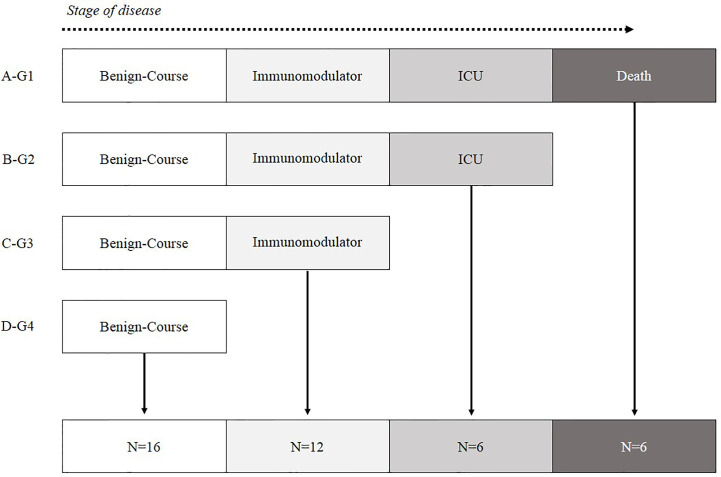
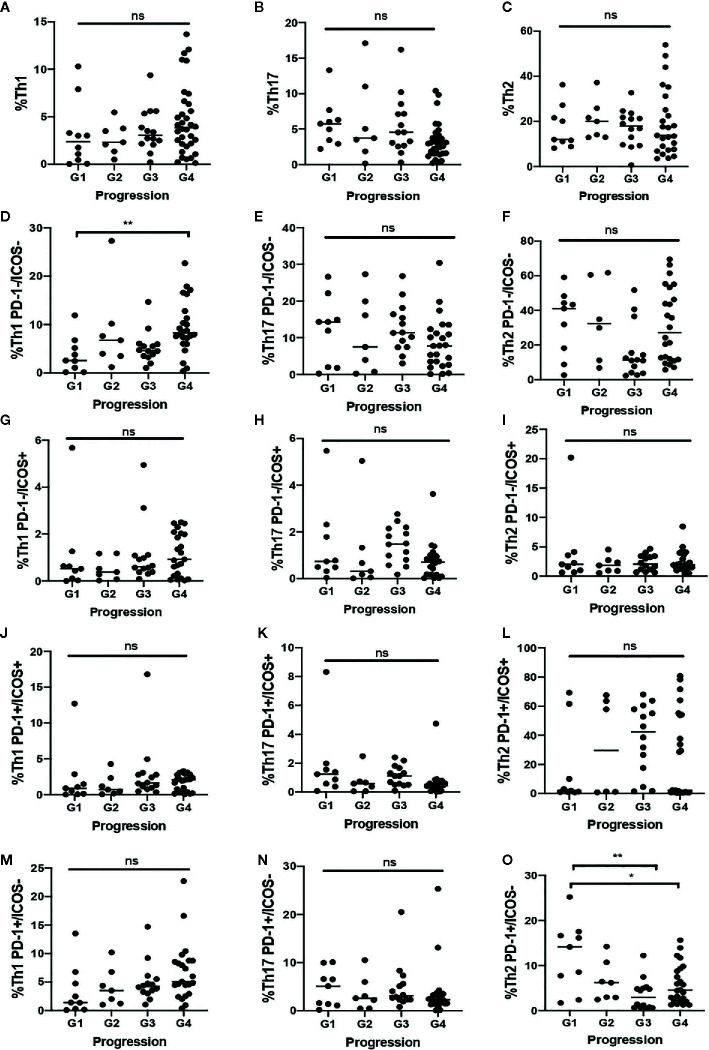
The immune response type organized against viral infection is determinant in the prognosis of some infections. This work has aimed to study Th polarization in acute COVID-19 and its possible association with the outcome through an observational prospective study. Fifty-eight COVID-19 patients were recruited in the Medicine Department of the hospital "12 de Octubre," 55 patients remaining after losses to follow-up. Four groups were established according to maximum degree of disease progression. T-helper cell percentages and phenotypes, analyzed by flow cytometer, and serum cytokines levels, analyzed by Luminex, were evaluated when the microbiological diagnosis (acute phase) of the disease was obtained. Our study found a significant reduction of %Th1 and %Th17 cells with higher activated %Th2 cells in the COVID-19 patients compared with reference population. A higher percent of senescent Th2 cells was found in the patients who died than in those who survived. Senescent Th2 cell percentage was an independent risk factor for death (OR: 13.88) accompanied by the numbers of total lymphocytes (OR: 0.15) with an AUC of 0.879. COVID-19 patients showed a profile of pro-inflammatory serum cytokines compared to controls, with higher levels of IL-2, IL-6, IL-15, and IP-10. IL-10 and IL-13 were also elevated in patients compared to controls. Patients who did not survive presented significantly higher levels of IL-15 than those who recovered. No significant differences were observed according to disease progression groups. The study has shown that increased levels of IL-15 and a high Th2 response are associated with a fatal outcome of the disease.
Keywords: COVID-19; SARS-Cov2; T-helper; cytokines; immunity.
Copyright © 2021 Gil-Etayo, Suàrez-Fernández, Cabrera-Marante, Arroyo, Garcinuño, Naranjo, Pleguezuelo, Allende, Mancebo, Lalueza, Díaz-Simón, Paz-Artal and Serrano.
Conflict of interest statement
The authors declare that the research was conducted in the absence of any commercial or financial relationships that could be construed as a potential conflict of interest.
Figures
References
-
- Alberts B., Johnson A., Lewis J., Raff M., Roberts K., Walter P. (2002). Molecular Biology of the Cell. Helper T Cells and Lymphocyte Activation. 4th edition, New York: Garland Science. Available at: https://www.ncbi.nlm.nih.gov/books/NBK26827/.
-
- Annunziato F., Galli G., Cosmi L., Romagnani P., Manetti R., Maggi E., et al. (1998). Molecules Associated with Human Th1 or Th2 Cells. Eur. Cytokine Netw. 9 (3 Suppl), 12–16. - PubMed
Publication types
MeSH terms
Substances
LinkOut - more resources
Full Text Sources
Other Literature Sources
Medical
Miscellaneous
