


Weather Conditions and COVID-19 Incidence in a Cold Climate: A Time-Series Study in Finland
- PMID: 33718314
- PMCID: PMC7946816
- DOI: 10.3389/fpubh.2020.605128
Weather Conditions and COVID-19 Incidence in a Cold Climate: A Time-Series Study in Finland
Abstract
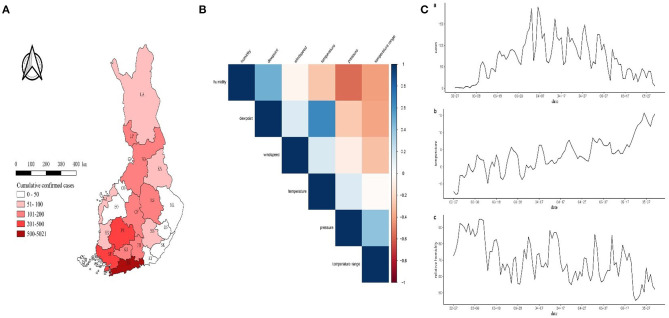
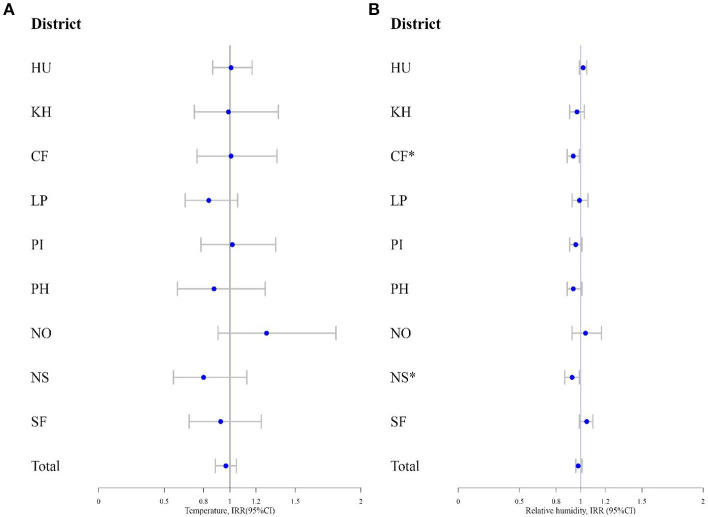
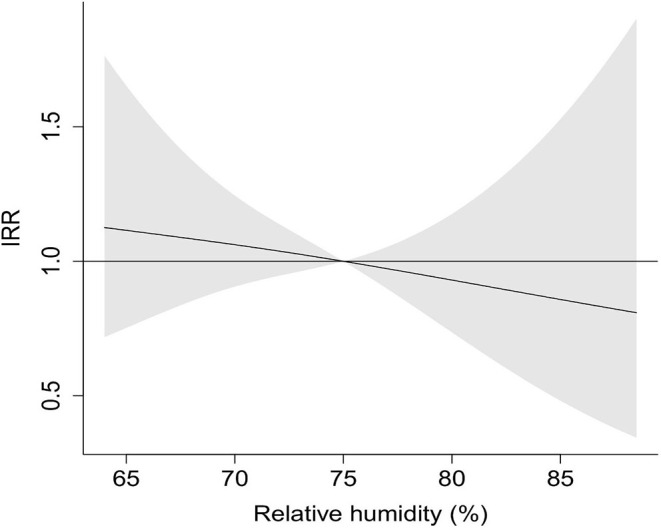
Background: The current coronavirus disease 2019 (COVID-19) is spreading globally at an accelerated rate. There is some previous evidence that weather may influence the incidence of COVID-19 infection. We assessed the role of meteorological factors including temperature (T) and relative humidity (RH) considering the concentrations of two air pollutants, inhalable coarse particles (PM10) and nitrogen dioxide (NO2) in the incidence of COVID-19 infections in Finland, located in arctic-subarctic climatic zone. Methods: We retrieved daily counts of COVID-19 in Finland from Jan 1 to May 31, 2020, nationwide and separately for all 21 hospital districts across the country. The meteorological and air quality data were from the monitoring stations nearest to the central district hospital. A quasi-Poisson generalized additional model (GAM) was fitted to estimate the associations between district-specific meteorological factors and the daily counts of COVID-19 during the study period. Sensitivity analyses were conducted to test the robustness of the results. Results: The incidence rate of COVID-19 gradually increased until a peak around April 6 and then decreased. There were no associations between daily temperature and incidence rate of COVID-19. Daily average RH was negatively associated with daily incidence rate of COVID-19 in two hospital districts located inland. No such association was found nationwide. Conclusions: Weather conditions, such as air temperature and relative humidity, were not related to the COVID-19 incidence during the first wave in the arctic and subarctic winter and spring. The inference is based on a relatively small number of cases and a restricted time period.
Keywords: COVID-19; Finland; air pollution; cold climate; weather.
Copyright © 2021 Heibati, Wang, Ryti, Dominici, Ducatman, Zhang and Jaakkola.
Conflict of interest statement
The authors declare that the research was conducted in the absence of any commercial or financial relationships that could be construed as a potential conflict of interest.
Figures
References
Publication types
MeSH terms
Substances
LinkOut - more resources
Full Text Sources
Other Literature Sources
Medical
Miscellaneous
