


Early Detection of Checkpoint Inhibitor-Associated Myocarditis Using 68Ga-FAPI PET/CT
- PMID: 33718446
- PMCID: PMC7946849
- DOI: 10.3389/fcvm.2021.614997
Early Detection of Checkpoint Inhibitor-Associated Myocarditis Using 68Ga-FAPI PET/CT
Abstract
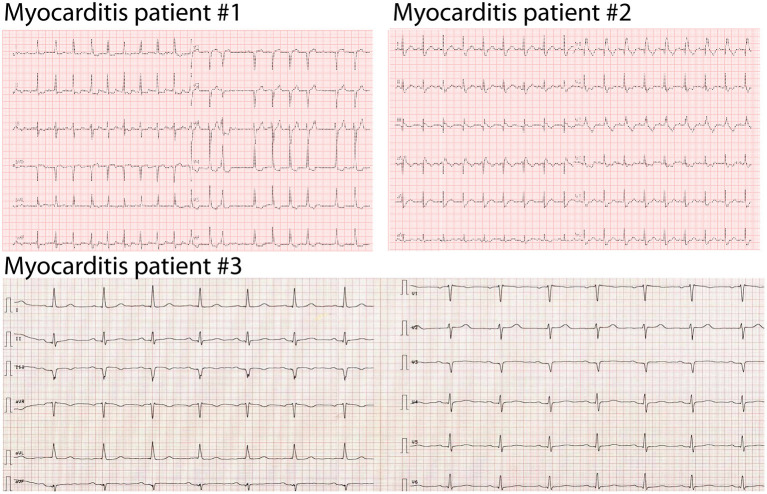
Objective: Checkpoint inhibitors (ICIs) have gained importance in recent years regarding the treatment of a variety of oncologic diseases. The possibilities of diagnosing cardiac adverse autoimmune effects of ICIs are still limited. We aimed to implement FAPI PET/CT imaging in detecting ICI-associated myocarditis. Methods: In a retrospective study, FAPI PET/CT scans of 26 patients who received ICIs from 01/2017 to 10/2019 were analyzed. We compared tracer enrichment in the heart of patients without any signs of a cardiac disease (n = 23) to three patients with suspected ICI-associated myocarditis. To exclude any significant coronary heart disease, cardiac catherization was performed. All three patients' myocardial biopsies were examined for inflammatory cells. Results: Three patients showed clinical manifestations of an ICI syndrome including myocarditis with elevated levels of hsTnT (175 pg/ml, 1,771 pg/ml, 157 pg/ml). Further cardiological assessments revealed ECG abnormalities, lymphocyte infiltration of the myocardium in the biopsies or wall motion abnormalities in echocardiography. These patients' FAPI PET/CTs showed cardiac enrichment of the marker which was less distinct or absent in patients receiving ICIs without any signs of immunological adverse effects or cardiac impairment (n = 23) [Median SUV myocarditis patients: 1.79 (IQR: 1.65, 1.85), median SUV non-myocarditis patients: 1.15 (IQR: 0.955, 1.52)]. Conclusions: Apart from the successful implementation of ICIs in oncological treatments, ICI-associated myocarditis is still a challenging adverse effect. FAPI PET/CT may be used in order to identify affected patients at an early stage. Moreover, when integrated into cancer stage diagnostics, it contributes to cardiac risk stratification besides biomarker, ECG and echocardiography.
Keywords: cardio-oncology; cardiotoxcity; checkpoint- inhibitors; myocarditis; positron emission tomography.
Copyright © 2021 Finke, Heckmann, Herpel, Katus, Haberkorn, Leuschner and Lehmann.
Conflict of interest statement
LHL has served on the advisory board for Daiichi Sankyio, Senaca and Servier, and received speakers' honoraria from Novartis and MSD. DF, MH, UH, HK and LHL have filed a patent for the use of FAPI imaging for the detection of pathological cardiac remodeling. The remaining authors declare that the research was conducted in the absence of any commercial or financial relationships that could be construed as a potential conflict of interest.
Figures

References
-
- Caforio AL, Pankuweit S, Arbustini E, Basso C, Gimeno-Blanes J, Felix SB, et al. . Current state of knowledge on aetiology, diagnosis, management, and therapy of myocarditis: a position statement of the European Society of Cardiology Working Group on Myocardial and Pericardial Diseases. Eur Heart J. (2013) 34:2636–48. 10.1093/eurheartj/eht210 - DOI - PubMed
LinkOut - more resources
Full Text Sources
Other Literature Sources
Medical
Research Materials
