Review
. 2021 Feb 24:10:19.
doi: 10.12703/r/10-19. eCollection 2021.

Insight into the role of phosphatidylserine in complement-mediated synapse loss in Alzheimer's disease

Affiliations
Review

Insight into the role of phosphatidylserine in complement-mediated synapse loss in Alzheimer's disease

Dimitra Sokolova et al. Fac Rev. .

Abstract

The innate immune system plays an integral role in the brain. Synaptic pruning, a fundamental process in developmental circuit refinement, is partially mediated by neuroimmune signalling at the synapse. In particular, microglia, the major tissue-resident macrophages of the brain, and the classical complement cascade, an innate immune pathway that aids in the clearance of unwanted material, have been implicated in mediating synapse elimination. Emerging data suggest that improper signalling of the innate immune pathway at the synapse leads to pathological synapse loss in age-related neurodegenerative diseases, including Alzheimer's disease. Now the key questions are whether synapses are targeted by complement and, if so, which synapses are vulnerable to elimination. Here, we review recent work implicating C1q, the initiator of the classical complement cascade, and surrounding glia as mediators of synapse loss. We examine how synapses could undergo apoptosis-like pathways in the Alzheimer brain, which may lead to the externalisation of phosphatidylserine on synapses. Finally, we discuss potential roles for microglia and astrocytes in this 'synaptic apoptosis'. Critical insight into neuroimmune regulatory pathways on synapses will be key to developing effective targets against pathological synapse loss in dementia.

Keywords: Alzheimer’s disease; MFG-E8; TAM; TREM2; astrocyte; caspase-3; classical complement cascade; microglia; mitochondrial dysfunction; phosphatidylserine; synapse loss; synaptosis.


Conflict of interest statement

The following patents have been granted or applied for: PCT/2015/010288, US14/988387 and EP14822330 (S.H.). All the other authors declare that they have no competing interests.Morgan Sheng is a member of the Board of Directors for Prevail Therapeutics, a Co-Founder and SAB member for RBNC, consults for Genentech Inc, and is an SAB member for Biogen Inc and Cerevel Therapeutics, LLC.No competing interests were disclosed.No competing interests were disclosed.

Figures
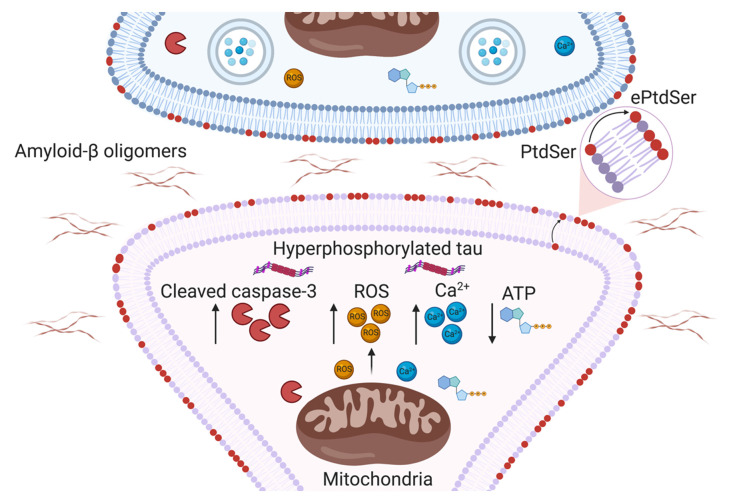
Figure 1.
Figure 1.. Potential mechanisms leading to synaptic phosphatidylserine externalisation in Alzheimer’s disease.
Schematic representation of potential pathways by which oligomeric amyloid-beta and hyperphosphorylated tau may increase the vulnerability of synapses to loss in Alzheimer’s disease. Synaptic mitochondrial dysfunction may lead to a build-up of cleaved caspase-3, reactive oxygen species (ROS) and Ca2+, accompanied by a decrease in ATP. These events can modulate the activity of flippases and scramblases, enzymes which regulate the localisation of phosphatidylserine (PtdSer), such that PtdSer is locally externalised to the outer leaflet of synaptic membranes. ePtdSer, externalised phosphatidylserine.
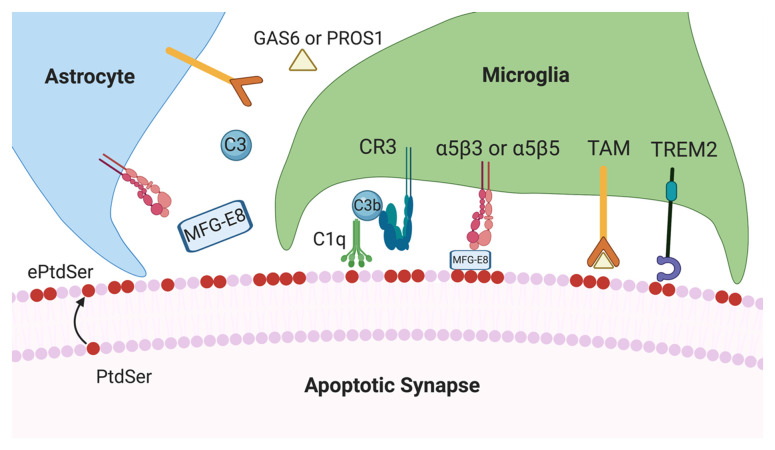
Figure 2.
Figure 2.. Potential cross-talk between microglia and astrocytes in synapse elimination in Alzheimer’s disease.
Schematic representation of proposed glial mechanisms that may mediate the clearance of synapses upon potential externalisation of phosphatidylserine (PtdSer). C1q and C3 proteins secreted by neighbouring microglia and astrocytes, respectively, may mediate engulfment by microglia upon C3b–CR3 interaction. Triggering receptor expressed on myeloid cells 2 (TREM2) may be an important determinant of synapse loss, potentially via recognition of externalised phosphatidylserine (ePtdSer). Astrocytic milk fat globule-EGF factor 8 protein (MFG-E8) may facilitate the interaction between ePtdSer and α5β3 or α5β5 glial phagocytic receptors. Other putative glial PtdSer signalling pathways, such as GAS6/PROS1 and TAM (TYRO, AXL and MER) family of receptors, may also be involved in clearing of synapses with ePtdSer.

References

    1. Bartels T, De Schepper S, Hong S: Microglia modulate neurodegeneration in Alzheimer's and Parkinson's diseases. Science. 2020; 370(6512): 66–9. 10.1126/science.abb8587 - DOI - PubMed
    1. Efthymiou AG, Goate AM: Late onset Alzheimer's disease genetics implicates microglial pathways in disease risk. Mol Neurodegener. 2017; 12(1): 43. 10.1186/s13024-017-0184-x - DOI - PMC - PubMed
    1. Sims R, van der Lee SJ, Naj AC, et al. : Rare coding variants in PLCG2, ABI3, and TREM2 implicate microglial-mediated innate immunity in Alzheimer's disease. Nat Genet. 2017; 49(9): 1373–84. 10.1038/ng.3916 - DOI - PMC - PubMed
    1. Kunkle BW, Grenier-Boley B, Sims R, et al. : Genetic meta-analysis of diagnosed Alzheimer's disease identifies new risk loci and implicates Aβ, tau, immunity and lipid processing. Nat Genet. 2019; 51(3): 414–30. 10.1038/s41588-019-0358-2 - DOI - PMC - PubMed
    2. Faculty Opinions Recommendation

    1. Jansen IE, Savage JE, Watanabe K, et al. : Genome-wide meta-analysis identifies new loci and functional pathways influencing Alzheimer's disease risk. Nat Genet. 2019; 51(3): 404–13. 10.1038/s41588-018-0311-9 - DOI - PMC - PubMed

LinkOut - more resources