


Cultural differences in vocal emotion recognition: a behavioural and skin conductance study in Portugal and Guinea-Bissau
- PMID: 33718984
- PMCID: PMC8885546
- DOI: 10.1007/s00426-021-01498-2
Cultural differences in vocal emotion recognition: a behavioural and skin conductance study in Portugal and Guinea-Bissau
Abstract
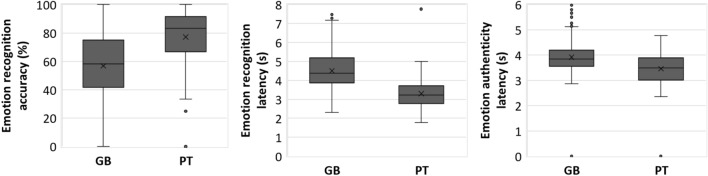
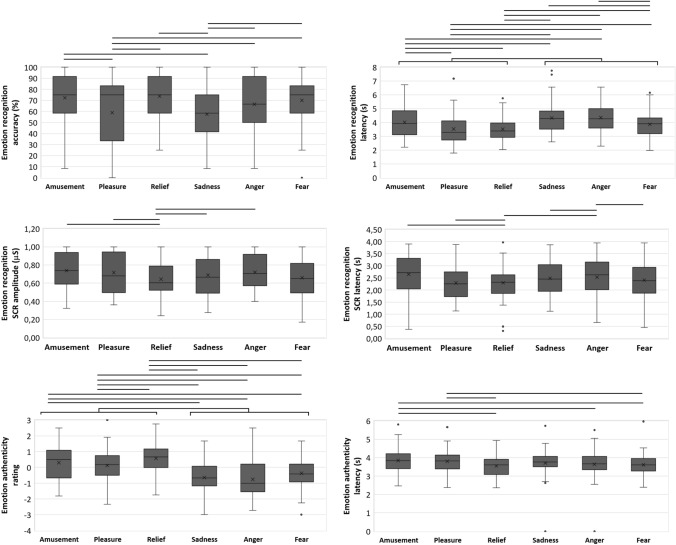
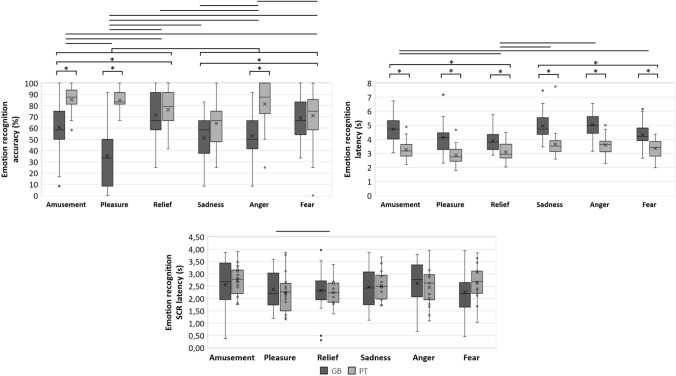
Cross-cultural studies of emotion recognition in nonverbal vocalizations not only support the universality hypothesis for its innate features, but also an in-group advantage for culture-dependent features. Nevertheless, in such studies, differences in socio-economic-educational status have not always been accounted for, with idiomatic translation of emotional concepts being a limitation, and the underlying psychophysiological mechanisms still un-researched. We set out to investigate whether native residents from Guinea-Bissau (West African culture) and Portugal (Western European culture)-matched for socio-economic-educational status, sex and language-varied in behavioural and autonomic system response during emotion recognition of nonverbal vocalizations from Portuguese individuals. Overall, Guinea-Bissauans (as out-group) responded significantly less accurately (corrected p < .05), slower, and showed a trend for higher concomitant skin conductance, compared to Portuguese (as in-group)-findings which may indicate a higher cognitive effort stemming from higher difficulty in discerning emotions from another culture. Specifically, accuracy differences were particularly found for pleasure, amusement, and anger, rather than for sadness, relief or fear. Nevertheless, both cultures recognized all emotions above-chance level. The perceived authenticity, measured for the first time in nonverbal cross-cultural research, in the same vocalizations, retrieved no difference between cultures in accuracy, but still a slower response from the out-group. Lastly, we provide-to our knowledge-a first account of how skin conductance response varies between nonverbally vocalized emotions, with significant differences (p < .05). In sum, we provide behavioural and psychophysiological data, demographically and language-matched, that supports cultural and emotion effects on vocal emotion recognition and perceived authenticity, as well as the universality hypothesis.
© 2021. The Author(s).
Conflict of interest statement
The authors declared that they had no conflict of interest with respect to their authorship or the publication of this article.
Figures
References
-
- Barrett LF, Mesquita B, Gendron M. Context in emotion perception. Current Directions in Psychological Science. 2011;20(5):286–290. doi: 10.1177/0963721411422522. - DOI
-
- Batista, D., Silva, H., & Fred, A. (2017). Experimental characterization and analysis of the BITalino platforms against a reference device. 2017 39th Annual International Conference of the IEEE Engineering in Medicine and Biology Society (EMBC), 2418–2421. https://doi.org/10.1109/EMBC.2017.8037344 - PubMed
MeSH terms
LinkOut - more resources
Full Text Sources
Other Literature Sources
