


Racial Disparities in Diabetes Technology Use and Outcomes in Type 1 Diabetes in a Safety-Net Hospital
- PMID: 33719610
- PMCID: PMC8442173
- DOI: 10.1177/1932296821995810
Racial Disparities in Diabetes Technology Use and Outcomes in Type 1 Diabetes in a Safety-Net Hospital
Abstract
Background: Limited data exist regarding diabetes technology use among adults with type 1 diabetes (T1D) in urban racially/ethnically diverse safety-net hospitals. We examined racial/ethnic differences in the use of continuous glucose monitor (CGM) and continuous subcutaneous insulin infusion (CSII) in this setting.
Methods: A retrospective review of 227 patients ≥ 18 years of age with T1D seen in an urban, safety-net endocrinology clinic during 2016-2017 was completed (mean age: 39; 80% English-speaking; 50% had public insurance). Diabetes technology use, defined as either CGM or CSII or both CGM and CSII, and clinical outcomes were examined by race/ethnicity.
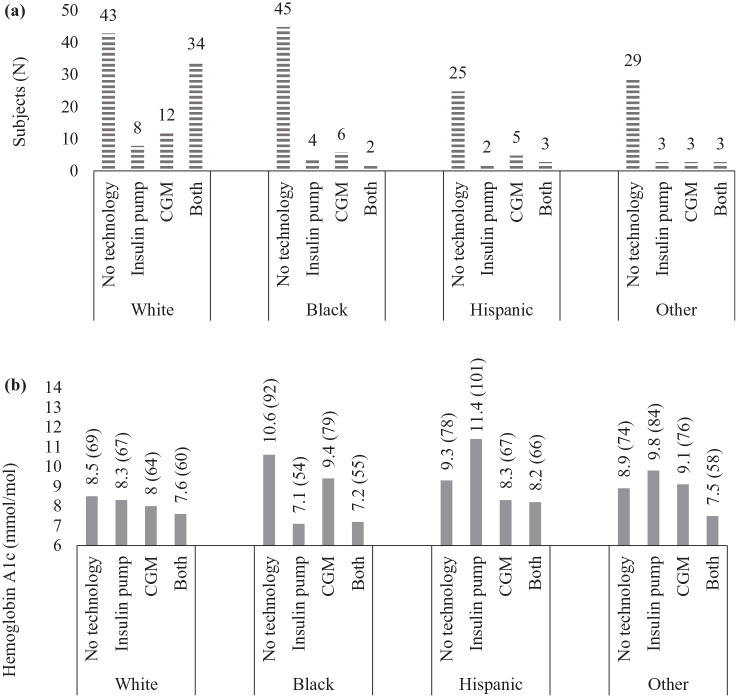
Results: Overall, 30% used CGM and 26% used CSII. After adjusting for age, language, insurance, and annual income, diabetes technology use in non-White patients was significantly lower than in White patients, predominantly lower in Black (aOR 0.25 [95% CI 0.11-0.56]) and patients identified as other race/ethnicity (aOR 0.30 [95% CI 0.11-0.77]). At the highest household income level (≥$75,000/y), Black and Hispanic individuals were significantly less likely than White individuals to use diabetes technology (P < .0007). Mean hemoglobin A1c (HbA1c) was lower in patients using any diabetes technology compared with patients using no technology (P < .0001). Use of CGM and CSII together was associated with the lowest HbA1c across all racial/ethnic groups.
Conclusions: Racial/ethnic disparities in diabetes technology use and glycemic control were observed even after adjusting for sociodemographic factors. Further research should explore barriers to accessing diabetes technology in non-White populations.
Keywords: diabetes technology; health care disparities; safety-net hospital; type 1 diabetes mellitus.
Conflict of interest statement
Figures
References
-
- Bergenstal R, Tamborlane W, Ahmann A, et al. Effectiveness of sensor-augmented insulin-pump therapy in type 1 diabetes. N Engl J Med. 2010;363:311-320. - PubMed
-
- Beck RW, Riddlesworth T, Ruedy K, et al. Effect of continuous glucose monitoring on glycemic control in adults with type 1 diabetes using insulin injections. JAMA. 2017;317:371. - PubMed
-
- Polonsky WH, Hessler D, Ruedy KJ, Beck RW.The impact of continuous glucose monitoring on markers of quality of life in adults with type 1 diabetes: further findings from the DIAMOND randomized clinical trial. Diabetes Care. 2017;40:736-741. - PubMed
-
- Lind M, Polonsky W, Hirsch IB, et al. Continuous glucose monitoring vs conventional therapy for glycemic control in adults with type 1 diabetes treated with multiple daily insulin injections the gold randomized clinical trial. JAMA. 2017;317:379-387. - PubMed
Publication types
MeSH terms
Substances
Grants and funding
LinkOut - more resources
Full Text Sources
Other Literature Sources
Medical
