


Disparities in Telemedicine Use for Subspecialty Diabetes Care During COVID-19 Shelter-In-Place Orders
- PMID: 33719622
- PMCID: PMC8442172
- DOI: 10.1177/1932296821997851
Disparities in Telemedicine Use for Subspecialty Diabetes Care During COVID-19 Shelter-In-Place Orders
Abstract
Background: During the COVID-19 pandemic, telemedicine use rapidly and dramatically increased for management of diabetes mellitus. It is unknown whether access to telemedicine care has been equitable during this time. This study aimed to identify patient-level factors associated with adoption of telemedicine for subspecialty diabetes care during the pandemic.
Methods: We conducted an explanatory sequential mixed-methods study using data from a single academic medical center. We used multivariate logistic regression to explore associations between telemedicine use and demographic factors for patients receiving subspecialty diabetes care between March 19 and June 30, 2020. We then surveyed a sample of patients who received in-person care to understand why these patients did not use telemedicine.
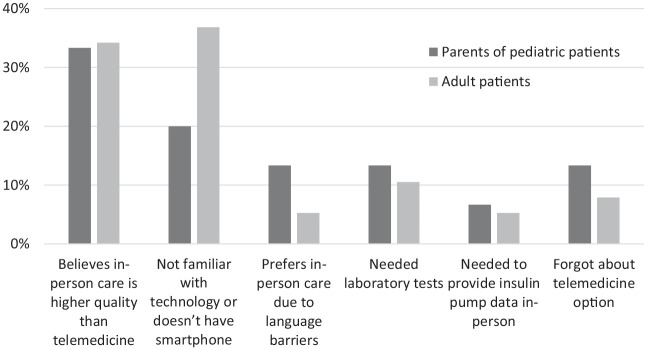
Results: Among 1292 patients who received subspecialty diabetes care during the study period, those over age 65 were less likely to use telemedicine (OR: 0.34, 95% CI: 0.22-0.52, P < .001), as were patients with a primary language other than English (OR: 0.53, 95% CI: 0.31-0.91, P = .02), and patients with public insurance (OR: 0.64, 95% CI: 0.49-0.84, P = .001). Perceived quality of care and technological barriers were the most common reasons cited for choosing in-person care during the pandemic.
Conclusions: Our findings suggest that, amidst the COVID-19 pandemic, there have been disparities in telemedicine use by age, language, and insurance for patients with diabetes mellitus. We anticipate telemedicine will continue to be an important care modality for chronic conditions in the years ahead. Significant work must therefore be done to ensure that telemedicine services do not introduce or widen population health disparities.
Keywords: COVID-19; diabetes mellitus; health disparities; telemedicine.
Conflict of interest statement
T.K. has received consulting fees from Eli Lilly.
A.N. has received research support from Cisco Systems, Inc; has received consulting fees from Nokia Growth Partners, Grand Rounds, Intuity Medical, Medtronic, Eli Lilly, and Roche; serves as advisor to Steady Health (received stock options); has received speaking honoraria from Academy Health and Symposia Medicus; has written for WebMD (received compensation); and is a medical advisor and cofounder of Tidepool (for which he has received no compensation).
Figures
References
-
- The Commonwealth Fund. The impact of the COVID-19 pandemic on outpatient care: visits return to prepandemic levels, but not for all providers and patients. Published October 15, 2020. Accessed November 23, 2020. https://www.commonwealthfund.org/publications/2020/oct/impact-covid-19-p....
-
- Nouri S, Khoong EC, Lyles CR, Karliner L.Addressing equity in telemedicine for chronic disease management during the Covid-19 pandemic. NEJM Catalyst Innovations in Care Delivery. 2020;1(3).
-
- Katzow MW, Steinway C, Jan S.Telemedicine and health disparities during COVID-19. Pediatrics. 2020;146(2):e20201586. - PubMed
-
- Pew Research Center. Mobile fact sheet. Published 2019. Updated June 12, 2019. Accessed October 9, 2020. https://www.pewresearch.org/internet/fact-sheet/mobile/.
Publication types
MeSH terms
Grants and funding
LinkOut - more resources
Full Text Sources
Other Literature Sources
Medical
