


Challenging the "'Mean Kid"' Perception: Boys' and Girls' Profiles of Peer Victimization and Aggression from 4th to 10th Grades
- PMID: 33719703
- PMCID: PMC9465533
- DOI: 10.1177/0886260521997949
Challenging the "'Mean Kid"' Perception: Boys' and Girls' Profiles of Peer Victimization and Aggression from 4th to 10th Grades
Abstract
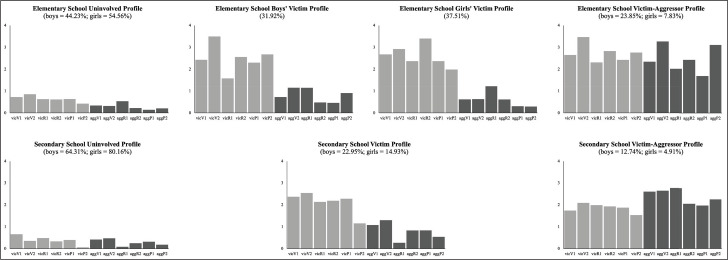
Student involvement in peer aggression is assumed to include the uninvolved, victims, aggressors, and victim-aggressor groups. Yet, evidence supporting this four-group configuration is equivocal. Although most studies report the four groups, several of the aggressor groups could have been labeled as moderate victim-aggressors. This study first reviews studies identifying subgroups of students involved in verbal, relational, and physical aggression. The study then assesses students' perceived involvement in elementary (n = 2,071; Grades 4-6) and secondary school (n = 1,832; Grades 7-10), as well as the associations with outcomes (school belonging, depressive thoughts, and perceived school violence). Latent profile analysis identified three profiles (uninvolved, victim-only, and victim-aggressor) across all grades and genders. In primary school, the uninvolved, victim, and victim-aggressor respectively included 54.56%, 37.51%, and 7.83% of the girls, and 44.23%, 31.92%, and 23.85% of the boys. In secondary school, the uninvolved, victim, and victim-aggressor respectively included 80.16%, 14.93% and 4.91% of the girls, and 64.31%, 22.95% and 12.74% of the boys. Victims and victim-aggressors reported poorer adjustment than uninvolved students. Victims and victim-aggressors reported lower levels of school belonging and higher levels of depressive thoughts than uninvolved students. Also, victim-aggressors perceived more violence in their school than victims and uninvolved students, and victims perceived more violence than uninvolved students. These findings question the existence of an aggressor-only profile, at least, according to student perception, suggesting the need for a new perspective when intervening with students involved in peer aggression.
Keywords: bullying; latent profile analysis; peer aggression; perpetrators; victims.
Conflict of interest statement
The author(s) declared no potential conflicts of interest with respect to the research, authorship, and/or publication of this article.
Figures
References
-
- APA. (2020). APA dictionary of psychology . American Psychological Association.
-
- Archer J., & Côté S. (2005). Sex differences in aggressive behavior: A developmental and evolutionary perspective. In Tremblay R. E. Hartup W. W., & Archer J. (Eds.), Developmental origins of aggression (pp. 425–443). Guilford Press.
-
- Basow S. A. (2008). Gender socialization: Or, how long a way has baby come? In Chrisler J. C. Golden C., & Rozee P. D. (Eds.), Lectures on the psychology of woman (4th ed.; pp. 80–95). McGraw-Hill.
-
- Bauer D. J., & Curran P. J. (2003). Distributional assumptions of growth mixture models overextraction of latent trajectory classes. Psychological Methods , 8(3), 338–363. - PubMed
-
- Baumeister R. F., & Leary M. R. (1995). The need to belong: Desire for interpersonal attachments as a fundamental human motivation. Psychological Bulletin , 117(3), 497–529. - PubMed
Publication types
MeSH terms
LinkOut - more resources
Full Text Sources
Other Literature Sources
Medical
