


Peer support workers in co-production and co-creation in public mental health and addiction services: Protocol for a scoping review
- PMID: 33720989
- PMCID: PMC7959669
- DOI: 10.1371/journal.pone.0248558
Peer support workers in co-production and co-creation in public mental health and addiction services: Protocol for a scoping review
Abstract
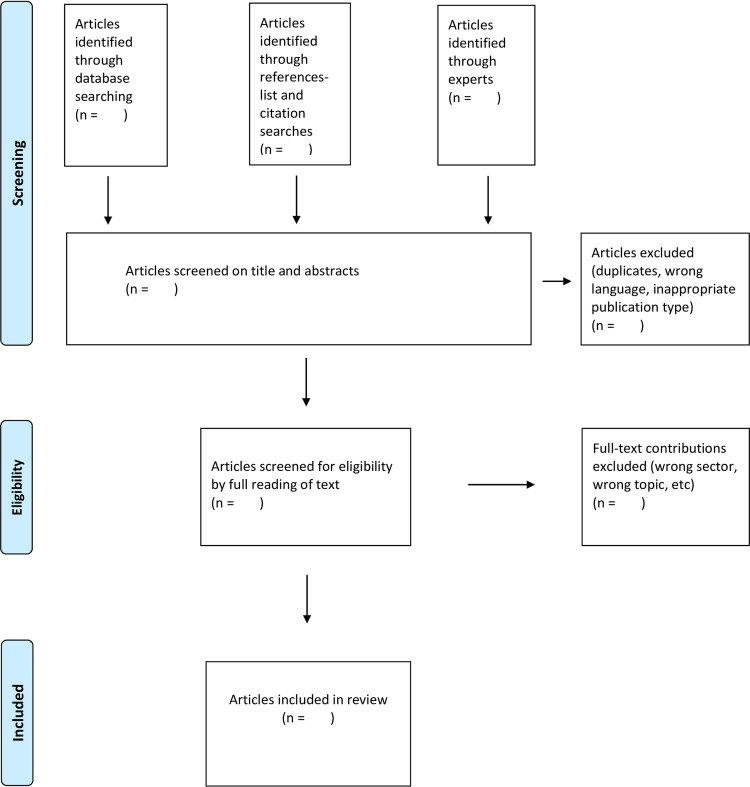
Worldwide, there is a growing interest to employ people with lived experiences in health and social services. Particularly in mental health and addiction services, individuals with lived experience of mental health problems enter the workplace as peer support workers (PSW´s). Their aim in the services is to bring in the perspective of service users in interactive processes at the micro and macro levels. The services´ ability to exploit the knowledge from PSW´s lived experiences will influence both the content and quality of the services, its effectiveness and its capacity to innovate and change. The concepts of co-production and co-creation are used to describe these interactive processes in the services in the literature. While co-production is aimed at improving individual services, co-creation seeks to develop service systems. This scoping review aims to provide an overview of the research status of PSW´s different involvement, in co-production and co-creation, in public mental health and addiction services. Studies describing PSW´s involvement in co-production and co-creation will be contrasted and compared. Knowledge about PSW´s involvement in co-production and co-creation is vital for understanding and further developing these interactive processes with PSW´s. The studies reviewed will describe PSW´s different types of involvement in co-production and co-creation in public mental health and addiction services or across organizational and institutional boundaries. The research question is: How are peer support workers involved in co-production and co-creation in public mental health and addiction services, and what are the described outcomes? Literature searches are conducted in Medline, PsycINFO, Embase, Oria, WorldCat, Google Scholar, Scopus, Academic Search Elite, Cinahl, and Web of Science, from the inception of each database to January 4, 2021. Expected results are that PSW´s are often described as a frontline worker who spends most of their working hours in a joint effort to co-produce with service users. Fewer studies describe PSW´s involved in interactive processes to re-design or transform public services systems. It is anticipated that this scoping review will increase the knowledge of the services' abilities to exploit PSW´s expertise and inform policy and research.
Conflict of interest statement
The authors have declared that no competing interests exist.
Figures
References
-
- Moran GS, Kalha J, Mueller-Stierlin AS, Kilian R, Krumm S, Slade M, et al. Peer support for people with severe mental illness versus usual care in high-, middle- and low-income countries: study protocol for a pragmatic, multicentre, randomised controlled trial (UPSIDES-RCT). Trials. 2020;21: 371. 10.1186/s13063-020-4177-7 - DOI - PMC - PubMed
-
- Osborne SP, Radnor Z, Kinder T, Vidal I. The SERVICE Framework: A Public-service-dominant Approach to Sustainable Public Services: The SERVICE Framework. Br J Manag. 2015;26: 424–438. 10.1111/1467-8551.12094 - DOI
-
- Gillard S, Edwards C, Gibson S, Holley J. Peer worker roles in mental health services in England. ncbi.nlm.nih.gov; 2014. Available: https://www.ncbi.nlm.nih.gov/books/NBK373845/
-
- Voorberg WH, Bekkers VJJM, Tummers LG. A Systematic Review of Co-Creation and Co-Production: Embarking on the social innovation journey. Public Manag Rev. 2015;17: 1333–1357. 10.1080/14719037.2014.930505 - DOI
Publication types
MeSH terms
LinkOut - more resources
Full Text Sources
Other Literature Sources
Medical
