. 2021 Oct;70(10):2961-2969.
doi: 10.1007/s00262-021-02889-5. Epub 2021 Mar 15.

The impact of selenium on regulatory T cell frequency and immune checkpoint receptor expression in patients with diffuse large B cell lymphoma (DLBCL)

Affiliations

The impact of selenium on regulatory T cell frequency and immune checkpoint receptor expression in patients with diffuse large B cell lymphoma (DLBCL)

Mehdi Dehghani et al. Cancer Immunol Immunother. 2021 Oct.

Abstract

For many decades, selenium (Se) has been known as a potential anti-cancer agent that can also improve the function of immune cells in a variety of solid tumors. However, there is no report on the role of Se on CD4+ T cell subsets like CD4+CD25+FOXP3+ regulatory T cells (Tregs) in lymphoma patients. In this randomized clinical trial, we investigated the effect of 3-month Se consumption on the frequency of CD4+CD25+FOXP3+ Tregs and the expression of immune checkpoint receptors in thirty-two non-Hodgkin lymphoma (NHL) patients (16 patients with Se (Se+) and 16 without Se (Se-) consumption) with diffuse large B-cell lymphoma (DLBCL) subtype at stable remission. The change in the frequency of Tregs and expression of immune checkpoint receptors including CTLA-4, LAG-3, TIM-3, and PD-L1 genes were evaluated after 3 months in both groups using flow cytometry and SYBR Green Real-time PCR method, respectively. The results showed that the frequency of CD4+CD25+FOXP3+ Tregs and expression of immune checkpoint receptors did not significantly change after 3-month Se consumption in DLBCL patients. However, alteration in the frequency of CD4+CD25-FOXP3+ Treg subsets was positively correlated with change in CTLA-4, LAG-3, and TIM-3 expression in the Se+ group. Three-month Se supplementation did not prevent relapse in Se+ group. Taken together, Se supplementation alone did not affect the frequency of CD4+CD25+FOXP3+ Tregs, expression of checkpoint receptors, and prevention of relapse in DLBCL patients at stable remission phase but might influence the functional properties of other Treg subsets like CD4+CD25-FOXP3+ Tregs.

Keywords: Diffuse large B-cell lymphoma (DLBCL); Immune checkpoint receptors; Regulatory T cells (Tregs); Selenium (Se).


Conflict of interest statement

The authors declared that they have no conflict of interest.

Figures
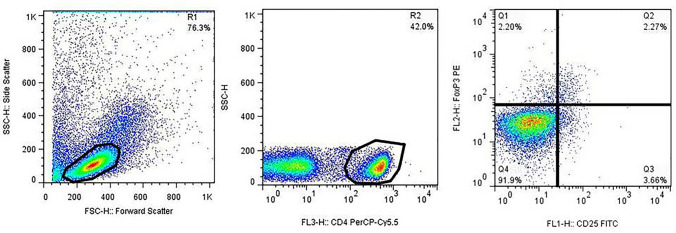
Fig. 1
Fig. 1
Flow cytometry analysis of Tregs. For Treg quantification, the lymphocytes (R1) were defined based on the forward vs. side scatter data acquisition plotting. Then, the CD4+ cells (R2) were first selected in the lymphocyte population (R1) followed by the gating of CD25+FOXP3+ cells (Q2 quadrant) within CD4+ lymphocytes
Fig. 2
Fig. 2
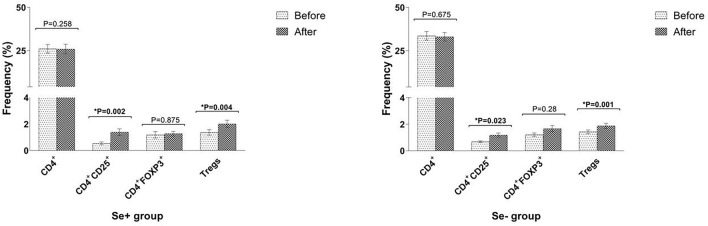
Change in the frequency of Tregs and related subsets after 3 months in Se+ and Se− groups. Change in the frequency of Tregs and related subsets was calculated after 3 months in both Se+ and Se− groups. Data are presented as mean ± SD and analyzed by Graphpad Prism version 8. P value < 0.05 was considered as statistically significant. Se selenium, Tregs regulatory T cells
Fig. 3
Fig. 3
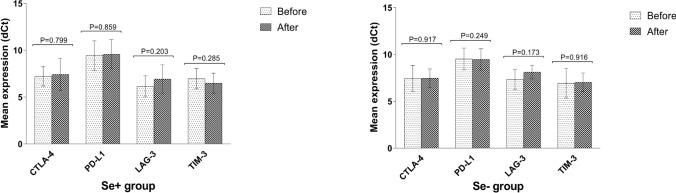
Change in the expression of immune checkpoint receptors after 3 months in Se+ and Se− groups. Change in the mean expression level of immune checkpoint receptors (dCt) was defined after 3 months in both Se+ and Se− groups. Data are presented as mean ± SD and analyzed by Graphpad Prism version 8. P value < 0.05 was considered as statistically significant. Se selenium
Fig. 4
Fig. 4
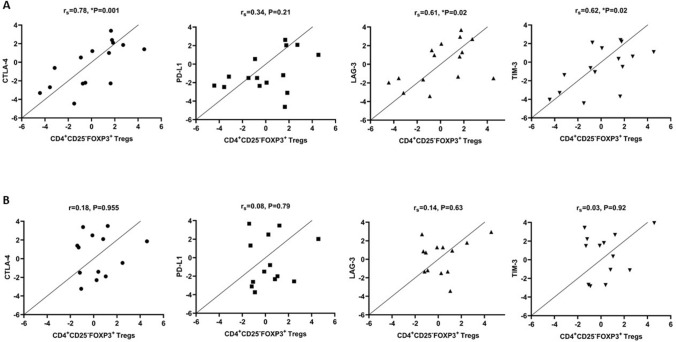
The relationship between change in the frequency of CD4+CD25FOXP3+ Tregs and expression of immune checkpoint receptors in Se+ (a) and Se− (b) groups. Data are presented as mean ± SD and analyzed by Graphpad Prism version 8. P value < 0.05 was considered as statistically significant. Se selenium, rs Spearman correlation coefficient

References

    1. Shankland KR, Armitage JO, Hancock BW. Non-hodgkin lymphoma. Lancet. 2012;380(9844):848–857. doi: 10.1016/S0140-6736(12)60605-9. - DOI - PubMed
    1. Ansell SM. Harnessing the power of the immune system in non-Hodgkin lymphoma: immunomodulators, checkpoint inhibitors, and beyond. Hematol 2014 Am Soc Hematol Educ Prog Book. 2017;2017(1):618–21. - PMC - PubMed
    1. D’Arena G, Vitale C, Coscia M, Festa A, Di Minno NMD, De Feo V, et al. Regulatory T Cells and their prognostic relevance in hematologic malignancies. J Immunol Res. 2017;2017:1832968. doi: 10.1155/2017/1832968. - DOI - PMC - PubMed
    1. Bates GJ, Fox SB, Han C, Leek RD, Garcia JF, Harris AL, et al. Quantification of regulatory T cells enables the identification of high-risk breast cancer patients and those at risk of late relapse. J Clin Oncol. 2006;24(34):5373–5380. doi: 10.1200/JCO.2006.05.9584. - DOI - PubMed
    1. Curiel TJ, Coukos G, Zou L, Alvarez X, Cheng P, Mottram P, et al. Specific recruitment of regulatory T cells in ovarian carcinoma fosters immune privilege and predicts reduced survival. Nat Med. 2004;10(9):942. doi: 10.1038/nm1093. - DOI - PubMed

MeSH terms

LinkOut - more resources