


Sugar modulation of anaerobic-response networks in maize root tips
- PMID: 33721892
- PMCID: PMC8133576
- DOI: 10.1093/plphys/kiaa029
Sugar modulation of anaerobic-response networks in maize root tips
Abstract
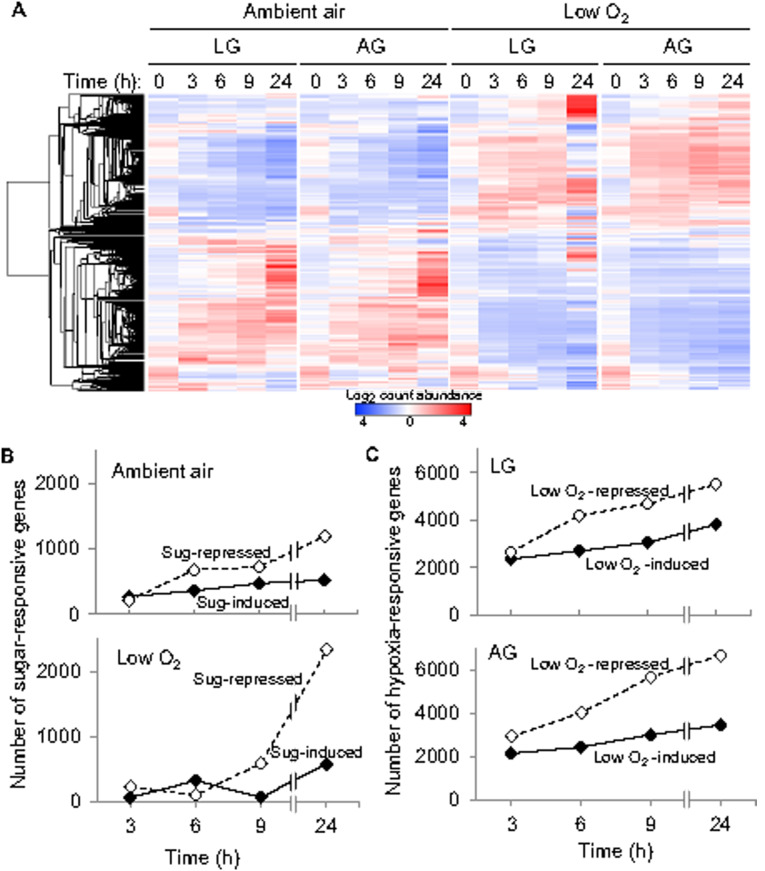
Sugar supply is a key component of hypoxia tolerance and acclimation in plants. However, a striking gap remains in our understanding of mechanisms governing sugar impacts on low-oxygen responses. Here, we used a maize (Zea mays) root-tip system for precise control of sugar and oxygen levels. We compared responses to oxygen (21 and 0.2%) in the presence of abundant versus limited glucose supplies (2.0 and 0.2%). Low-oxygen reconfigured the transcriptome with glucose deprivation enhancing the speed and magnitude of gene induction for core anaerobic proteins (ANPs). Sugar supply also altered profiles of hypoxia-responsive genes carrying G4 motifs (sources of regulatory quadruplex structures), revealing a fast, sugar-independent class followed more slowly by feast-or-famine-regulated G4 genes. Metabolite analysis showed that endogenous sugar levels were maintained by exogenous glucose under aerobic conditions and demonstrated a prominent capacity for sucrose re-synthesis that was undetectable under hypoxia. Glucose abundance had distinctive impacts on co-expression networks associated with ANPs, altering network partners and aiding persistence of interacting networks under prolonged hypoxia. Among the ANP networks, two highly interconnected clusters of genes formed around Pyruvate decarboxylase 3 and Glyceraldehyde-3-phosphate dehydrogenase 4. Genes in these clusters shared a small set of cis-regulatory elements, two of which typified glucose induction. Collective results demonstrate specific, previously unrecognized roles of sugars in low-oxygen responses, extending from accelerated onset of initial adaptive phases by starvation stress to maintenance and modulation of co-expression relationships by carbohydrate availability.
© American Society of Plant Biologists 2020. All rights reserved. For permissions, please email: journals.permissions@oup.com.
Figures


Comment in
-
Averting a sweet demise: sugars change the transcriptional hypoxia response in maize roots.Plant Physiol. 2021 Mar 15;185(2):280-281. doi: 10.1093/plphys/kiaa053. Plant Physiol. 2021. PMID: 33721906 Free PMC article. No abstract available.
References
-
- Afgan E, Baker D, Batut Bvan den Beek M, Bouvier D, Čech M, Chilton J, Clements D, Coraor N, Grüning BA, Guerler A, Hillman-Jackson J, Hiltemann S, Jalili V, Rasche H, Soranzo N, Goecks J, Taylor J, Nekrutenko A, Blankenberg D (2018) The Galaxy platform for accessible, reproducible and collaborative biomedical analyses: 2018 update. Nucleic Acids Res 46: W537–W544 - PMC - PubMed
-
- Andorf CM, Kopylov M, Dobbs D, Koch KE, Stroupe ME, Lawrence CJ, Bass HW (2014) G-Quadruplex (G4) motifs in the maize (Zea mays L.) genome are enriched at specific locations in thousands of genes coupled to energy status, hypoxia, low sugar, and nutrient depravation. J Genet Genomics 41: 627–647 - PubMed
-
- Alonso AP, Val DL, Shachar-Hill Y (2011) Central metabolic fluxes in the endosperm of developing maize seeds and their implications for metabolic engineering. Metab Eng 13: 96–107 - PubMed
Publication types
MeSH terms
Substances
LinkOut - more resources
Full Text Sources
Research Materials
Miscellaneous
