. 2021 May 18;65(6):e00144-21.
doi: 10.1128/AAC.00144-21. Print 2021 May 18.

Cefepime Population Pharmacokinetics and Target Attainment in Critically Ill Patients on Continuous Renal Replacement Therapy

Affiliations

Cefepime Population Pharmacokinetics and Target Attainment in Critically Ill Patients on Continuous Renal Replacement Therapy

Mohammad H Al-Shaer et al. Antimicrob Agents Chemother. .

Abstract

Sepsis causes half of acute kidney injuries in the intensive care unit (ICU). ICU patients may need continuous renal replacement therapy (CRRT), which will affect their antimicrobial exposure. We aimed to build a cefepime population pharmacokinetic (PK) model in CRRT ICU patients and perform simulations to assess target attainment. Patients who were ≥18 years old, were admitted to the ICU, and received cefepime 2 g every 8 h as a 4-h infusion while on CRRT were enrolled prospectively. Samples were collected from the predialyzer ports, postdialyzer ports, and effluent fluid at 1, 2, 3, 4, and 8 h after the first dose and at steady state. Age, sex, weight, urine output, and CRRT parameters were recorded. Pmetrics was used for population PK and simulations. The target exposure was 100% of the dosing interval during which the free beta-lactam concentration is above the MIC (fT>MIC). Ten patients were included; their mean age was 53 years, and mean weight was 119 kg. Seventy percent were males. Cefepime was described by a five-compartment model. The downtime was applied to the CRRT flow rates, which were used to describe the rates of transfer between the compartments. At MICs of ≤8 mg/liter, intermittent infusion of 2 g cefepime every 8 h achieved good target attainment both early in therapy and at steady state. Only extended- and continuous-infusion regimens achieved good target attainment at MICs of 16 mg/liter. In conclusion, 2 g cefepime infused over 30 min followed by extended infusion of 2 g every 8 h achieved good target attainment at MICs of ≤16 mg/liter with different CRRT flow rates and may be considered in resistant bacterial infections.

Keywords: CRRT; Monte Carlo simulation; cefepime; population pharmacokinetics.


Figures

FIG 1
FIG 1
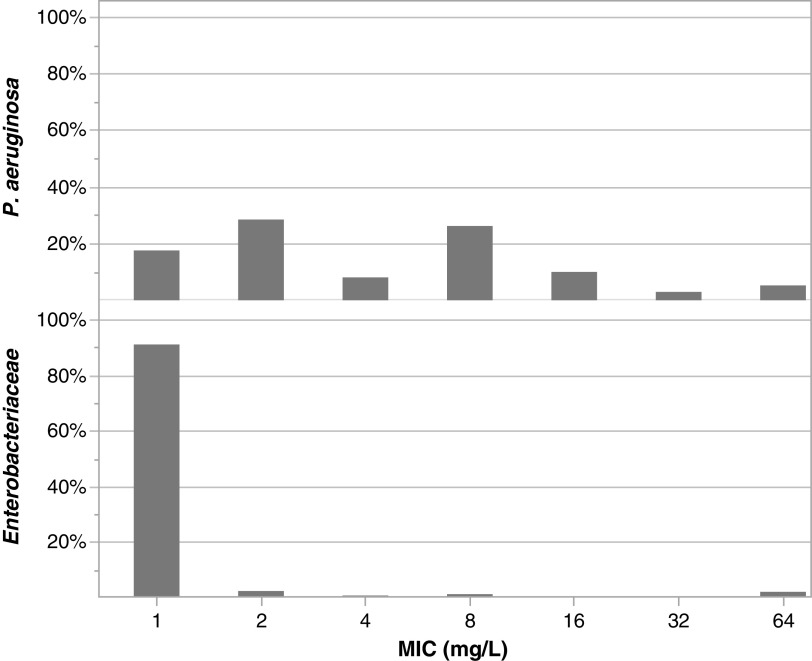
Local Pseudomonas aeruginosa and Enterobacteriaceae MIC distribution for cefepime.
FIG 2
FIG 2
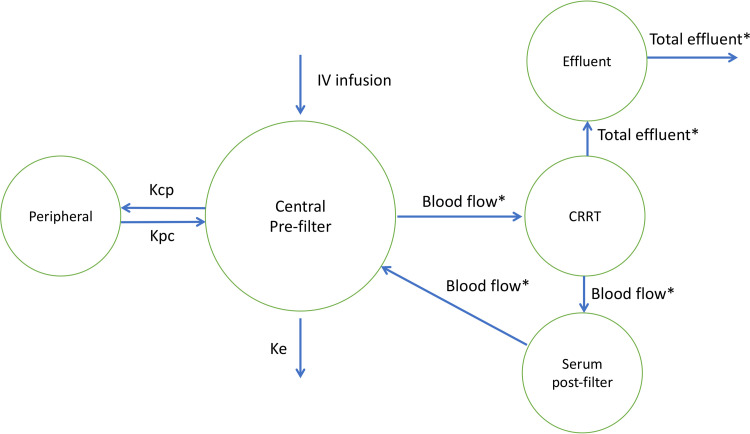
Cefepime five-compartment model in patients on CRRT. *, CRRT downtime was applied as run time and as a fraction of the dosing interval on these flow rates. CRRT, continuous renal replacement therapy; IV, intravenous; Kcp, transfer rate from the central to the peripheral compartment; Ke, rate of elimination; Kpc, transfer rate from the peripheral to the central compartment.
FIG 3
FIG 3
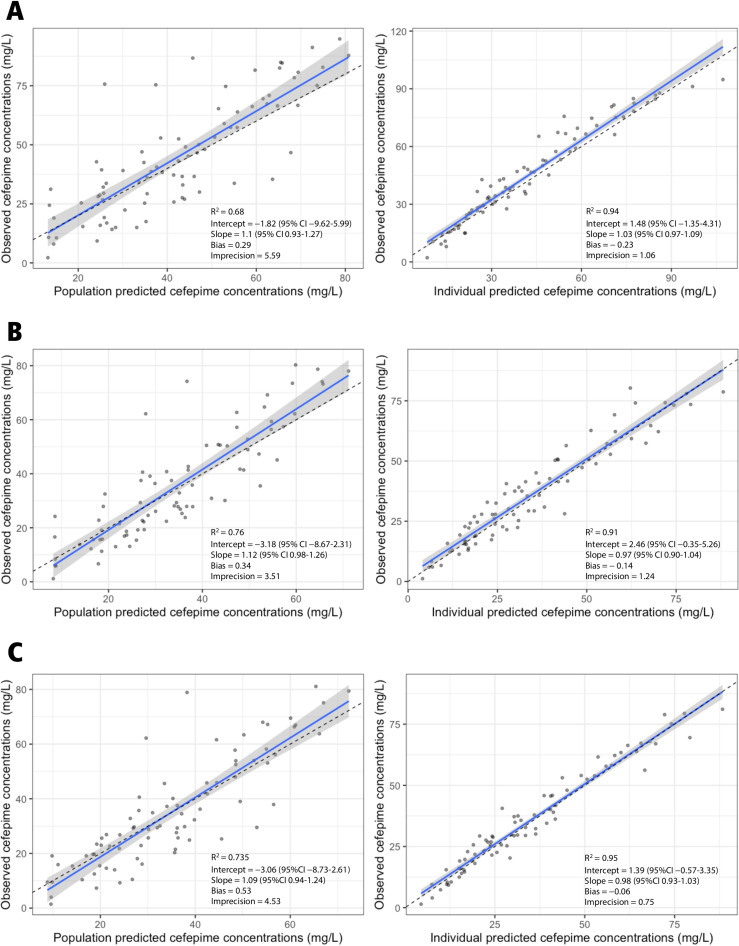
Observed versus population and individual predicted cefepime concentrations in predialyzer (A), effluent (B), and postdialyzer (C) compartments.
FIG 4
FIG 4
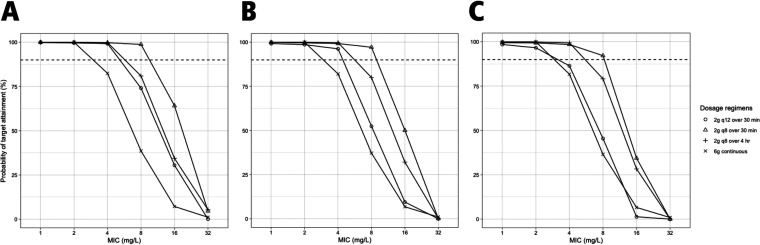
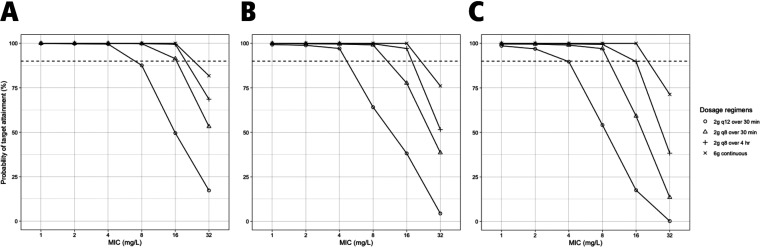
Probability of target attainment (100% fT>MIC) for cefepime within the first 24 h with total effluent flow rates of 20 (A), 30 (B), and 40 (C) ml/kg/h. The dashed lines indicate 90% probability of target attainment. The mean (SD) weight used for the simulations was 119 kg (27 kg). Blood flow rate and CRRT downtime were fixed at 300 ml/min and 0 h, respectively.
FIG 5
FIG 5
Probability of target attainment (100% fT>MIC) for cefepime after 72 h with total effluent flow rate of 20 (A), 30 (B), and 40 (C) ml/kg/h. Dashed lines indicate 90% probability of target attainment. The mean (SD) weight used for the simulations was 119 kg (27 kg). Blood flow rate and CRRT downtime were fixed at 300 ml/min and 0 h, respectively.
FIG 6
FIG 6
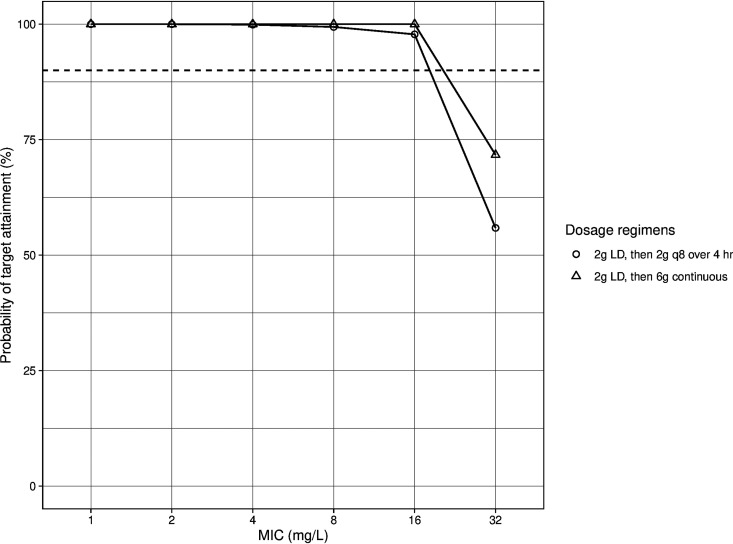
Probability of target attainment (100% fT>MIC) for cefepime loading dose followed by extended and continuous infusion within the first 24 h. Dashed lines indicate 90% probability of target attainment. The mean (SD) weight used for the simulations was 119 kg (27 kg). Total effluent flow rate, blood flow rate, and CRRT downtime were fixed at 30 ml/kg/h, 300 ml/min, and 0 h, respectively. LD, loading dose.

References

    1. Fleischmann C, Scherag A, Adhikari NKJ, Hartog CS, Tsaganos T, Schlattmann P, Angus DC, Reinhart K, International Forum of Acute Care Trialists. 2016. Assessment of global incidence and mortality of hospital-treated sepsis. Current estimates and limitations. Am J Respir Crit Care Med 193:259–272. 10.1164/rccm.201504-0781OC. - DOI - PubMed
    1. Kaukonen K-M, Bailey M, Suzuki S, Pilcher D, Bellomo R. 2014. Mortality related to severe sepsis and septic shock among critically ill patients in Australia and New Zealand, 2000-2012. JAMA 311:1308–1316. 10.1001/jama.2014.2637. - DOI - PubMed
    1. McPherson D, Griffiths C, Williams M, Baker A, Klodawski E, Jacobson B, Donaldson L. 2013. Sepsis-associated mortality in England: an analysis of multiple cause of death data from 2001 to 2010. BMJ Open 3:e002586. 10.1136/bmjopen-2013-002586. - DOI - PMC - PubMed
    1. Bellomo R, Kellum JA, Ronco C, Wald R, Martensson J, Maiden M, Bagshaw SM, Glassford NJ, Lankadeva Y, Vaara ST, Schneider A. 2017. Acute kidney injury in sepsis. Intensive Care Med 43:816–828. 10.1007/s00134-017-4755-7. - DOI - PubMed
    1. Chapuis TM, Giannoni E, Majcherczyk PA, Chioléro R, Schaller MD, Berger MM, Bolay S, Décosterd LA, Bugnon D, Moreillon P. 2010. Prospective monitoring of cefepime in intensive care unit adult patients. Crit Care 14:R51. 10.1186/cc8941. - DOI - PMC - PubMed

LinkOut - more resources