


Relationship between social support, physical symptoms, and depression in women with breast cancer and pain
- PMID: 33723675
- PMCID: PMC8919209
- DOI: 10.1007/s00520-021-06136-6
Relationship between social support, physical symptoms, and depression in women with breast cancer and pain
Abstract
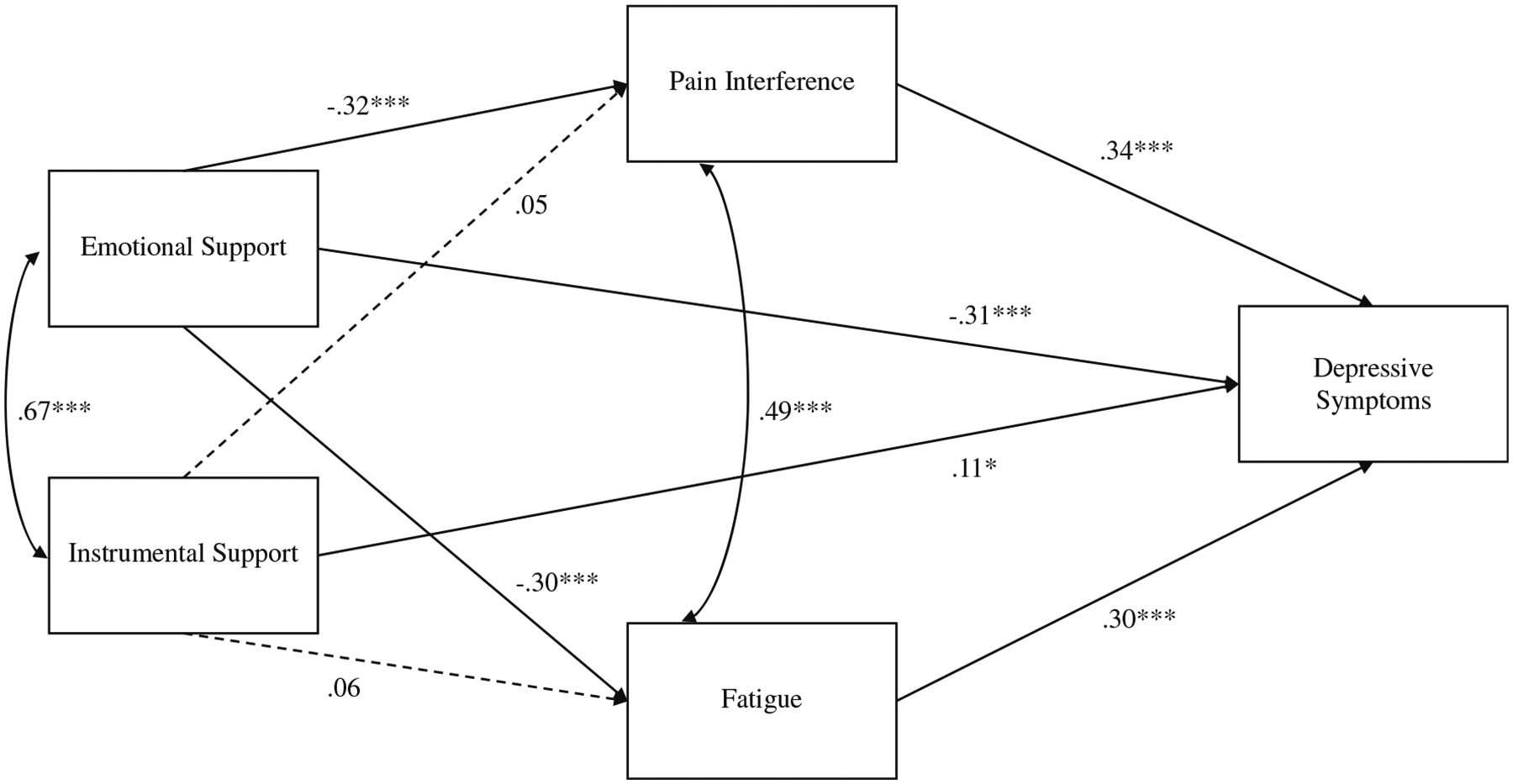
Purpose: Fatigue and pain are common among women with breast cancer, and often related to depressive symptoms. Social support may influence levels of fatigue, pain interference, and depressive symptoms. We tested a theory-based, structural model examining the relationship between social support (i.e., emotional and instrumental) and depressive symptoms via fatigue and pain interference in women with breast cancer.
Methods: Women (N = 327) with stages I-III breast cancer were enrolled in a randomized trial investigating a behavioral pain intervention. Measures of social support, fatigue, pain interference, and depressive symptoms were completed at enrollment. Data were analyzed using structural equation modeling to test direct and indirect pathways relating social support, fatigue, pain interference, and depressive symptoms.
Results: Our model evidenced good fit. Significant direct effects emerged linking higher levels of emotional support with lower levels of fatigue (β = -.30), pain interference (β = -.32), and depressive symptoms (β = -.31). More instrumental support was significantly associated with more depressive symptoms (β = .11), but not fatigue or pain interference. Higher levels of fatigue (β = .30) and pain interference (β = .34) were significantly related to higher levels of depressive symptoms. More emotional support related to less depressive symptoms via lower levels of fatigue (β = -.09) and pain interference (β = -.11).
Conclusion: Women reporting higher levels of emotional support endorsed fewer depressive symptoms, and that relationship was driven by lower levels of fatigue and pain interference. Our results highlight novel pathways that healthcare professionals can leverage to optimize social support topics in psychosocial interventions targeting breast cancer symptoms. This model should be replicated using longitudinal data.
Keywords: Breast cancer; Depression; Emotional support; Fatigue; Instrumental support; Pain interference.
© 2021. The Author(s), under exclusive licence to Springer-Verlag GmbH Germany, part of Springer Nature.
Conflict of interest statement
Figures
References
-
- DeSantis CE et al. (2019) Breast cancer statistics, 2019. CA Cancer J Clin 69(6):438–451 - PubMed
-
- Runowicz CD, Leach CR, Henry NL, Henry KS, Mackey HT, Cowens-Alvarado RL, Cannady RS, Pratt-Chapman ML, Edge SB, Jacobs LA, Hurria A, Marks LB, LaMonte SJ, Warner E, Lyman GH, Ganz PA (2016) American Cancer Society/American Society of Clinical Oncology breast cancer survivorship care guideline. J Clin Oncol 34(6):611–635 - PubMed
-
- Abrahams HJG, Gielissen MFM, Verhagen CAHHVM, Knoop H (2018) The relationship of fatigue in breast cancer survivors with quality of life and factors to address in psychological interventions: a systematic review. Clin Psychol Rev 63:1–11 - PubMed
Publication types
MeSH terms
Grants and funding
LinkOut - more resources
Full Text Sources
Other Literature Sources
Medical
