


An emerging role for microglia in stress-effects on memory
- PMID: 33724565
- PMCID: PMC9373920
- DOI: 10.1111/ejn.15188
An emerging role for microglia in stress-effects on memory
Abstract
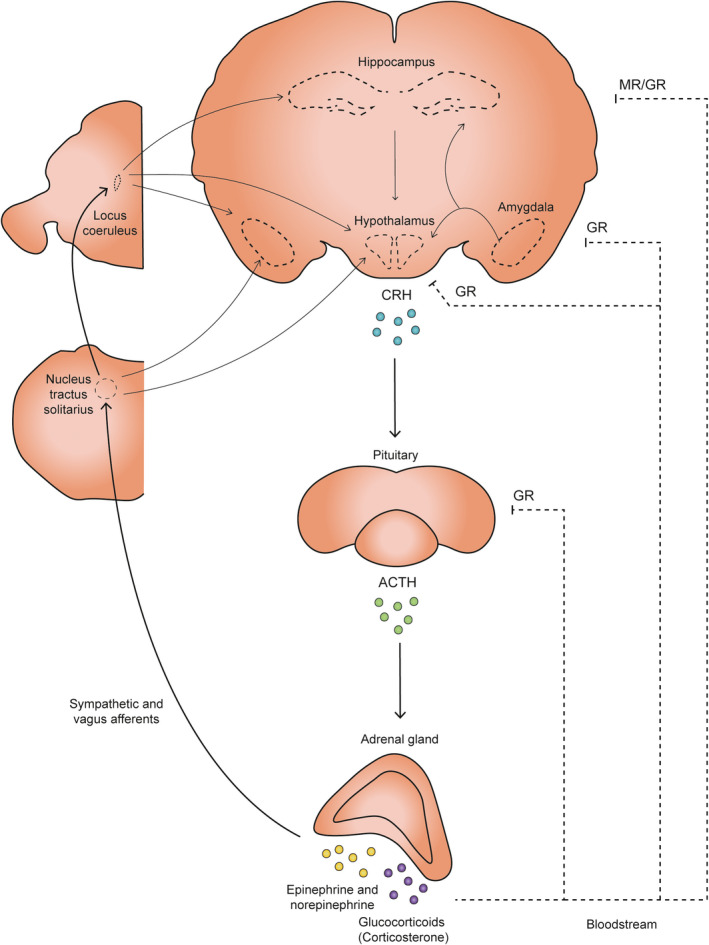
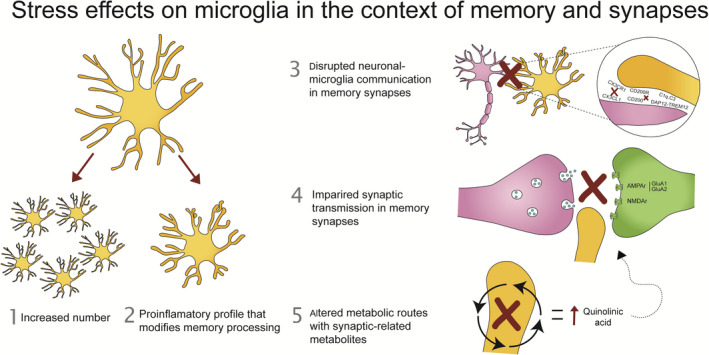
Stressful experiences evoke, among others, a rapid increase in brain (nor)epinephrine (NE) levels and a slower increase in glucocorticoid hormones (GCs) in the brain. Microglia are key regulators of neuronal function and contain receptors for NE and GCs. These brain cells may therefore potentially be involved in modulating stress effects on neuronal function and learning and memory. In this review, we discuss that stress induces (1) an increase in microglial numbers as well as (2) a shift toward a pro-inflammatory profile. These microglia have (3) impaired crosstalk with neurons and (4) disrupted glutamate signaling. Moreover, microglial immune responses after stress (5) alter the kynurenine pathway through metabolites that impair glutamatergic transmission. All these effects could be involved in the impairments in memory and in synaptic plasticity caused by (prolonged) stress, implicating microglia as a potential novel target in stress-related memory impairments.
Keywords: corticosterone; glucocorticoids; learning; norepinephrine; synapses.
© 2021 Federation of European Neuroscience Societies and John Wiley & Sons Ltd.
Conflict of interest statement
The authors declare no conflict of interest.
Figures
References
-
- Alcocer‐Gómez, E. , Ulecia‐Morón, C. , Marín‐Aguilar, F. , Rybkina, T. , Casas‐Barquero, N. , Ruiz‐Cabello, J. , Ryffel, B. , Apetoh, L. , Ghiringhelli, F. , Bullón, P. , Sánchez‐Alcazar, J. A. , Carrión, A. M. , & Cordero, M. D. (2016). Stress‐induced depressive behaviors require a functional NLRP3 inflammasome. Molecular Neurobiology, 53(7), 4874–4882. 10.1007/s12035-015-9408-7 - DOI - PubMed
Publication types
MeSH terms
Substances
LinkOut - more resources
Full Text Sources
Other Literature Sources
