. 2021 May;27(5):1323-1329.
doi: 10.3201/eid2705.204688. Epub 2021 Mar 16.

Clinical Evaluation of Roche SD Biosensor Rapid Antigen Test for SARS-CoV-2 in Municipal Health Service Testing Site, the Netherlands

Clinical Evaluation of Roche SD Biosensor Rapid Antigen Test for SARS-CoV-2 in Municipal Health Service Testing Site, the Netherlands

Zsὁfia Igloi et al. Emerg Infect Dis. 2021 May.

Abstract

Rapid detection of infection is essential for stopping the spread of severe acute respiratory syndrome coronavirus 2 (SARS-CoV-2). The Roche SD Biosensor rapid antigen test for SARS-CoV-2 was evaluated in a nonhospitalized symptomatic population. We rapid-tested a sample onsite and compared results with those from reverse transcription PCR and virus culture. We analyzed date of onset and symptoms using data from a clinical questionnaire. Overall test sensitivity was 84.9% (95% CI 79.1-89.4) and specificity was 99.5% (95% CI 98.7-99.8). Sensitivity increased to 95.8% (95% CI 90.5-98.2) for persons who sought care within 7 days of symptom onset. Test band intensity and time to result correlated strongly with viral load; thus, strong positive results could be read before the recommended time. Approximately 98% of all viable specimens with cycle threshold <30 were detected. Rapid antigen tests can detect symptomatic SARS-CoV-2 infections in the early phase of disease, thereby identifying the most infectious persons.

Keywords: COVID-19; Roche; SARS-CoV-2; clinical evaluation; coronavirus disease; diagnostics; rapid antigen test; respiratory infections; severe acute respiratory syndrome coronavirus 2; the Netherlands; viruses; zoonoses.


Figures
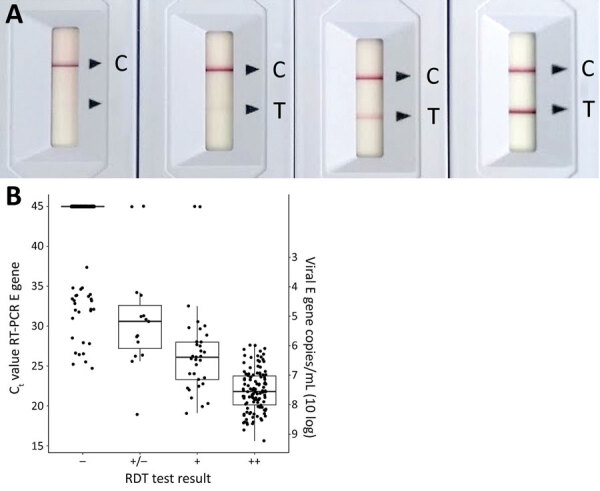
Figure 1
Figure 1
Comparison of results for rapid antigen detection tests and PCR for diagnosis of severe acute respiratory syndrome coronavirus 2, the Netherlands. A) Example of the 4 grade scaling system used for result readout. Results were determined by the absence or presence of the T band as well as band intensity. An absent T band is read as negative. Positive results were further distinguished as follows: very faint band, +/−; medium intensity band, +; and strong band, ++. Final readout of results was done after the manufacturer’s recommended 15 minutes. B) Correlation of RT-PCR Ct and Ag RDT test band intensity. RT-PCR Ct results were grouped by the 4 categories of the Ag RDT result readout (n = 970). Horizontal line in each box indicates median Ct; box borders indicate 75% interquartile range (IQR), whiskers represent the range of values 1.5 times the IQR, and dots represent individual test results. Ag RDT, antigen rapid detection test; C, control; Ct, cycle threshold; E gene, envelope gene; RT-PCR, reverse transcription pPCR; T, test; −, negative; +/− weak positive; +, positive; ++, strong positive.
Figure 2
Figure 2
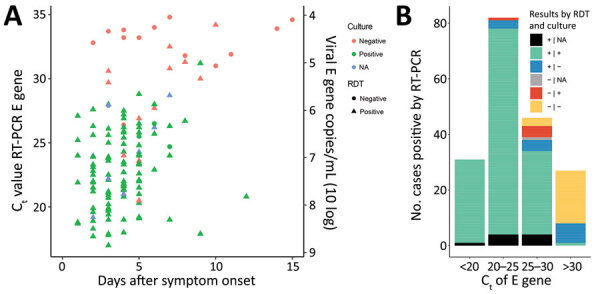
Relationships of time from symptom onset to testing and cycle threshold values to results for rapid antigen detection tests and PCR for diagnosis of severe acute respiratory syndrome coronavirus 2, the Netherlands. A) Cycle thresholds of positive samples in relation to days since symptom onset, Ag RDT positivity, and culture outcomes of participation with known disease onset date (n = 140). B) PCR-positive samples by cycle threshold (n = 186) in relation to Ag RDT and culture test results. Ag RDT, antigen rapid detection test; Ct, cycle threshold; E gene, envelope gene; NA, not available; RT-PCR, reverse transcription PCR.

References

    1. World Health Organization. Listings of WHO’s response to COVID-19. 29 June 2020. [cited 2021 Mar 8]. https://www.who.int/news/item/29-06-2020-covidtimeline
    1. World Health Organization. Laboratory testing for 2019 novel coronavirus (2019-nCoV) in suspected human cases. 2020. [cited 2021 Mar 8]. https://www.who.int/publications/i/item/10665-331501
    1. Beetz C, Skrahina V, Förster TM, Gaber H, Paul JJ, Curado F, et al. Rapid large-scale COVID-19 testing during shortages. Diagnostics (Basel). 2020;10:464. 10.3390/diagnostics10070464 - DOI - PMC - PubMed
    1. (FINDdx) FIND. SARS-COV-2 diagnostic pipeline. 2020. [cited 2021 Mar 8]. https://www.finddx.org/covid-19/pipeline/
    1. Dinnes J, Deeks JJ, Adriano A, Berhane S, Davenport C, Dittrich S, et al.; Cochrane COVID-19 Diagnostic Test Accuracy Group. Rapid, point-of-care antigen and molecular-based tests for diagnosis of SARS-CoV-2 infection. Cochrane Database Syst Rev. 2020;8:CD013705. - PMC - PubMed