


Environmental impact of personal protective equipment distributed for use by health and social care services in England in the first six months of the COVID-19 pandemic
- PMID: 33726611
- PMCID: PMC8150566
- DOI: 10.1177/01410768211001583
Environmental impact of personal protective equipment distributed for use by health and social care services in England in the first six months of the COVID-19 pandemic
Abstract
Objective: To quantify the environmental impact of personal protective equipment (PPE) distributed for use by the health and social care system to control the spread of SARS-CoV-2 in England, and model strategies for mitigating the environmental impact.
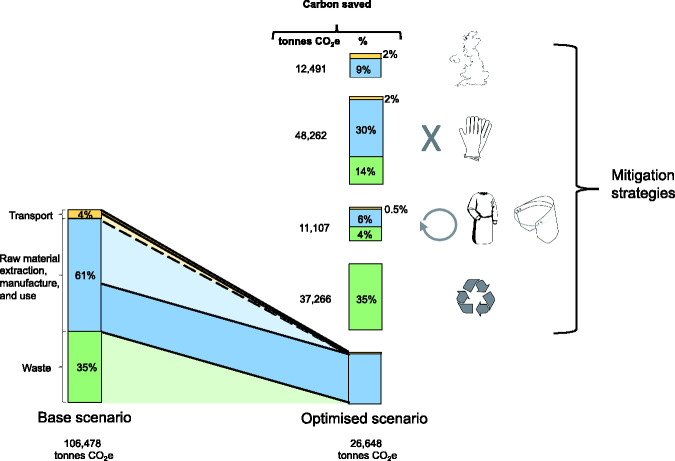
Design: Life cycle assessment was used to determine environmental impacts of PPE distributed to health and social care in England during the first six months of the COVID-19 pandemic. The base scenario assumed all products were single-use and disposed of via clinical waste. Scenario modelling was used to determine the effect of environmental mitigation strategies: (1) eliminating international travel during supply; (2) eliminating glove use; (3) reusing gowns and face shields; and (4) maximal recycling.
Setting: Royal Sussex County Hospital, Brighton, UK.
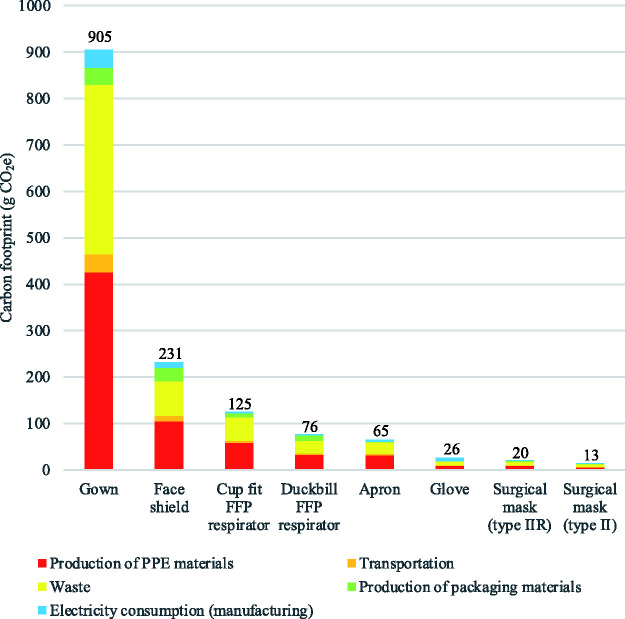
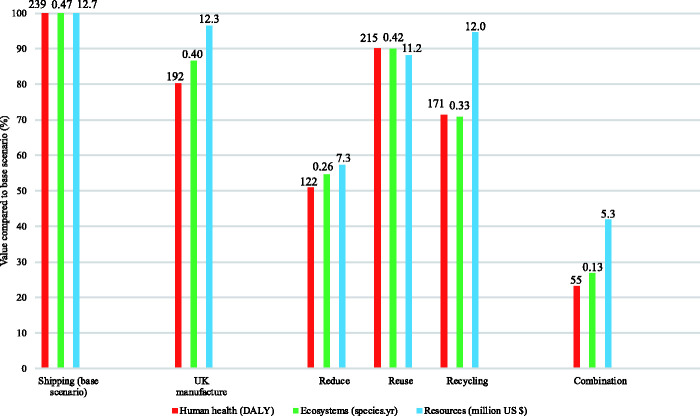
Main outcome measures: The carbon footprint of PPE distributed during the study period totalled 106,478 tonnes CO2e, with greatest contributions from gloves, aprons, face shields and Type IIR surgical masks. The estimated damage to human health was 239 DALYs (disability-adjusted life years), impact on ecosystems was 0.47 species.year (loss of local species per year), and impact on resource depletion was costed at US $12.7m (GBP £9.3m). Scenario modelling indicated UK manufacture would have reduced the carbon footprint by 12%, eliminating gloves by 45%, reusing gowns and gloves by 10% and maximal recycling by 35%.
Results: A combination of strategies may have reduced the carbon footprint by 75% compared with the base scenario, and saved an estimated 183 DALYS, 0.34 species.year and US $7.4m (GBP £5.4m) due to resource depletion.
Conclusion: The environmental impact of PPE is large and could be reduced through domestic manufacture, rationalising glove use, using reusables where possible and optimising waste management.
Keywords: Environmental issues; health policy; public health.
Figures
References
-
- Reuters. Top supplier Malaysia sees no quick end to shortages in $8 billion gloves Industry. See https://www.reuters.com/article/us-health-coronavirus-malaysia-gloves/to... (2020, last checked 13 August 2020).
-
- Karlsson U, Fraenkel CJ. Complete protection from covid-19 is possible for health workers. BMJ 2020; 370: m2641–m2641. - PubMed
-
- UK Government Department of Health and Social Care. The supply of personal protective equipment (PPE) during the COVID-19 pandemic. See https://www.nao.org.uk/report/supplying-the-nhs-and-adult-social-care-se... (2020, last checked 3 December 2020).
-
- Public Health England. Recommended PPE for healthcare workers by secondary care inpatient clinical setting, NHS and independent sector. See. https://assets.publishing.service.gov.uk/government/uploads/system/uploa... (2020, last checked 13 August 2020).
-
- Department of Health and Social Care. Experimental statistics – personal protective equipment distributed for use by health and social care services in England: 25 Feb to 23 Aug 2020. See https://www.gov.uk/government/publications/ppe-deliveries-england-17-aug... (2020, last checked 2 September 2020).
MeSH terms
Substances
LinkOut - more resources
Full Text Sources
Other Literature Sources
Medical
Research Materials
Miscellaneous
