


Effect of whey vs. soy protein supplementation on recovery kinetics following speed endurance training in competitive male soccer players: a randomized controlled trial
- PMID: 33726784
- PMCID: PMC7968192
- DOI: 10.1186/s12970-021-00420-w
Effect of whey vs. soy protein supplementation on recovery kinetics following speed endurance training in competitive male soccer players: a randomized controlled trial
Abstract
Background: Soccer-specific speed-endurance training induces short-term neuromuscular fatigue and performance deterioration over a 72-h recovery period, associated with elevated markers of exercise-induced muscle damage. We compared the effects of whey vs. soy protein supplementation on field activity, performance, muscle damage and redox responses following speed-endurance training in soccer players.
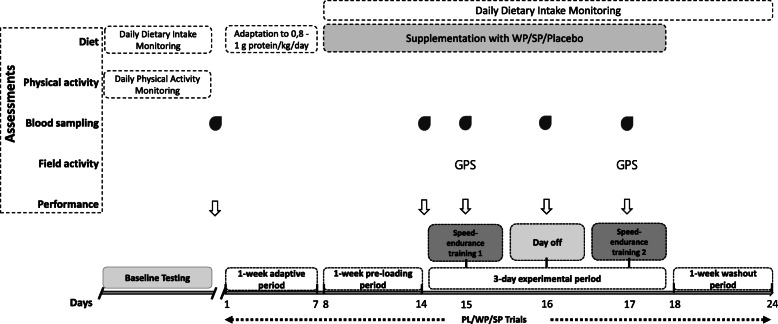
Methods: Ten well-trained, male soccer players completed three speed-endurance training trials, receiving whey protein (WP), soy protein (SP) or an isoenergetic placebo (PL; maltodextrin) according to a randomized, double-blind, crossover, repeated-measures design. A pre-loading period was applied in each trial during which protein supplementation was individually adjusted to reach a total protein intake of 1.5 g/kg/day, whereas in PL protein intake was adjusted at 0.8-1 g/kg/day. Following pre-loading, two speed-endurance training sessions (1 and 2) were performed 1 day apart, over a 3-day experimental period. During each session, field activity and heart rate were continuously monitored using global positioning system and heart rate monitors, respectively. Performance (isokinetic strength of knee extensors and flexors, maximal voluntary isometric contraction, speed, repeated sprint ability, countermovement jump), muscle damage (delayed-onset of muscle soreness, creatine kinase activity) and redox status (glutathione, total antioxidant capacity, protein carbonyls) were evaluated at baseline (pre), following pre-loading (post-load), and during recovery from speed-endurance training.
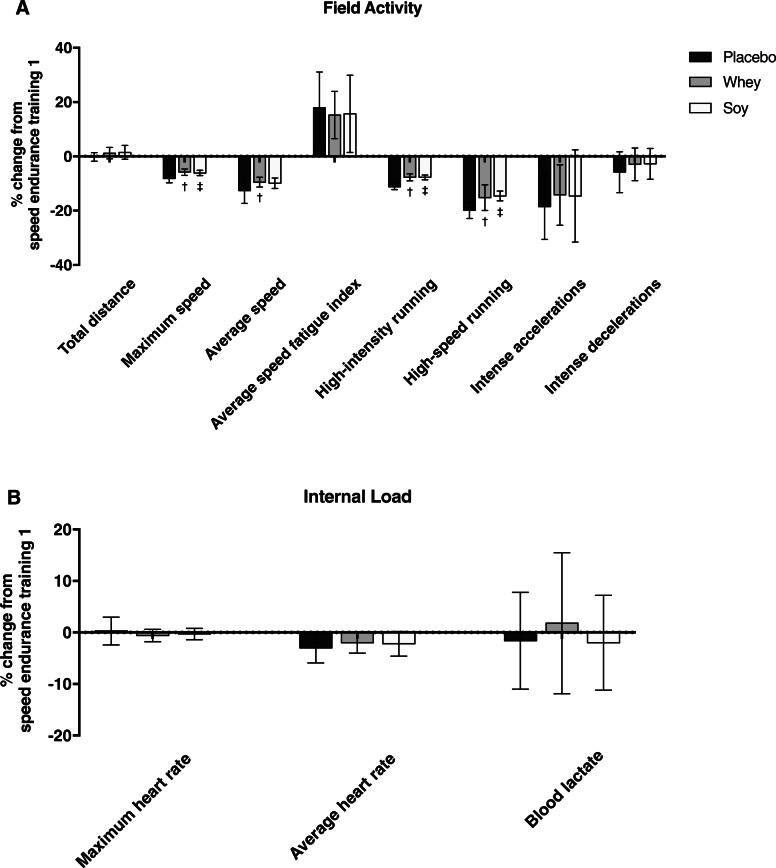
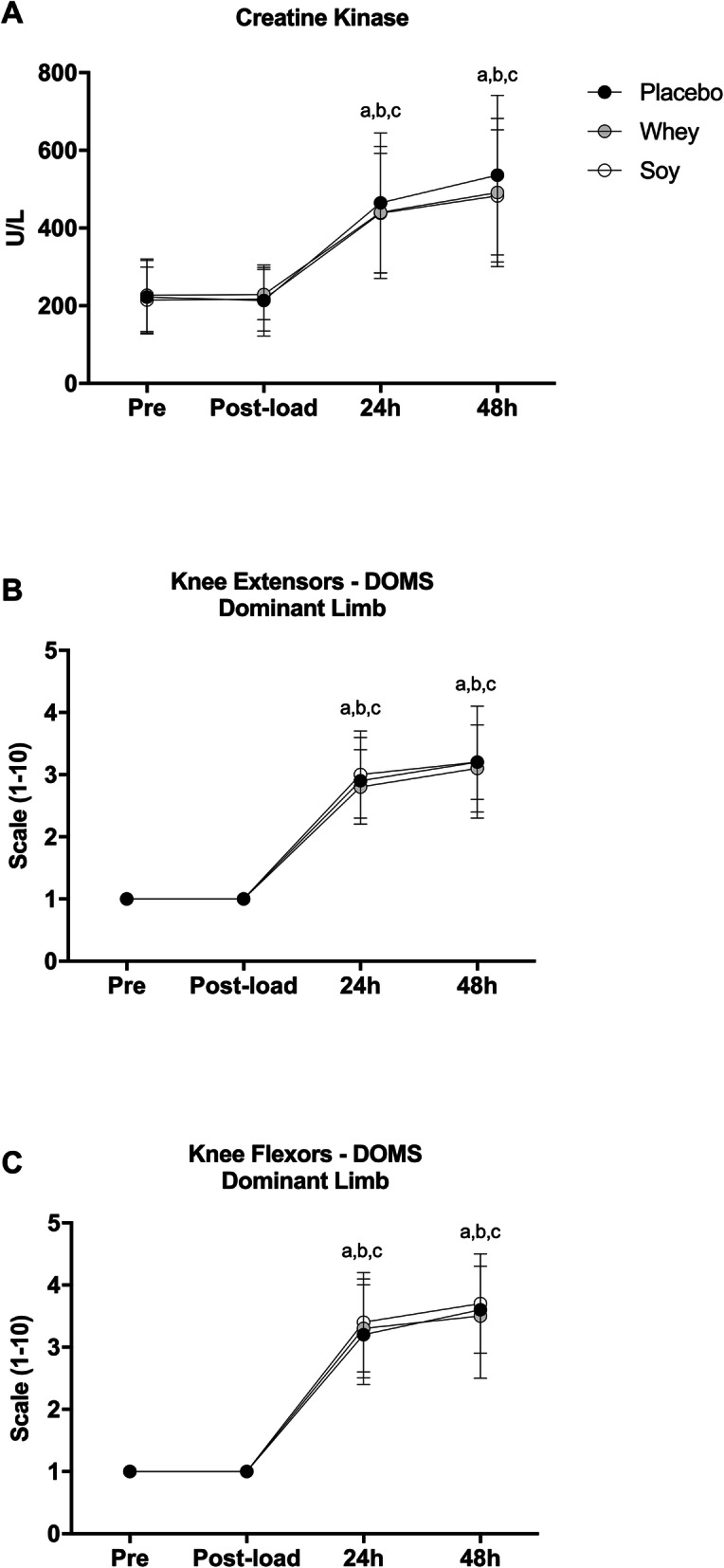
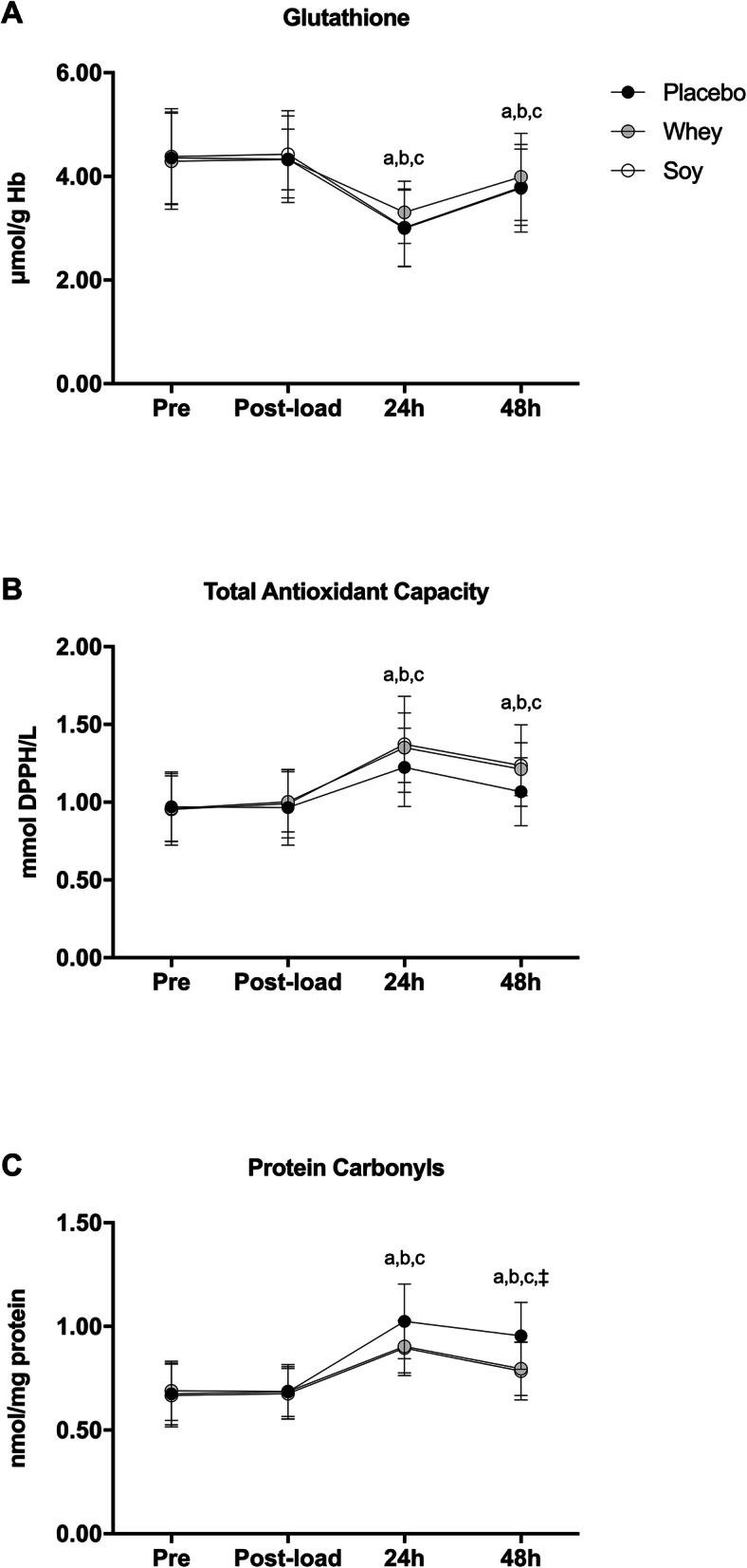
Results: High-intensity and high-speed running decreased (P ≤ 0.05) during speed-endurance training in all trials, but WP and SP mitigated this response. Isokinetic strength, maximal voluntary isometric contraction, 30-m speed, repeated sprint ability and countermovement jump performance were similarly deteriorated during recovery following speed-endurance training in all trials (P ≤ 0.05). 10 m speed was impaired at 24 h only in PL. Delayed-onset of muscle soreness, creatine kinase, total antioxidant capacity and protein carbonyls increased and glutathione decreased equally among trials following speed-endurance training (P ≤ 0.05), with SP inducing a faster recovery of protein carbonyls only at 48 h (P ≤ 0.05) compared to WP and PL.
Conclusions: In conclusion, increasing daily protein intake to 1.5 g/kg through ingestion of either whey or soy protein supplements mitigates field performance deterioration during successive speed-endurance training sessions without affecting exercise-induced muscle damage and redox status markers.
Trial registration: Name of the registry: clinicaltrials.gov.
Trial registration: NCT03753321 . Date of registration: 12/10/2018.
Keywords: Exercise-induced muscle damage; Intensified training; Performance; Protein ingestion; Recovery.
Conflict of interest statement
The authors declare no conflict of interest.
Figures
References
-
- Krustrup P, Mohr M, Steensberg A, Bencke J, Kjaer M, Bangsbo J. Muscle and blood metabolites during a soccer game: implications for sprint performance. Med Sci Sports Exerc. 2006;38(6):1165–1174. doi: 10.1249/01.mss.0000222845.89262.cd. - DOI - PubMed
-
- Fransson D, Nielsen TS, Olsson K, Christensson T, Bradley PS, Fatouros IG, et al. Skeletal muscle and performance adaptations to high-intensity training in elite male soccer players: speed endurance runs versus small-sided game training. Eur J Appl Physiol. 2018;118(1):111–121. doi: 10.1007/s00421-017-3751-5. - DOI - PMC - PubMed
Publication types
MeSH terms
Substances
Associated data
LinkOut - more resources
Full Text Sources
Other Literature Sources
Medical
