. 2021 Mar 16;11(1):6037.
doi: 10.1038/s41598-021-84050-x.

Bacteria-host transcriptional response during endothelial invasion by Staphylococcus aureus

Affiliations

Bacteria-host transcriptional response during endothelial invasion by Staphylococcus aureus

Rasmus Birkholm Grønnemose et al. Sci Rep. .

Abstract

Staphylococcus aureus is the cause of serious vascular infections such as sepsis and endocarditis. These infections are notoriously difficult to treat, and it is believed that the ability of S. aureus to invade endothelial cells and persist intracellularly is a key mechanism for persistence despite ongoing antibiotic treatment. Here, we used dual RNA sequencing to study the simultaneous transcriptional response of S. aureus and human endothelial cells during in vitro infections. We revealed discrete and shared differentially expressed genes for both host and pathogen at the different stages of infection. While the endothelial cells upregulated genes involved in interferon signalling and antigen presentation during late infection, S. aureus downregulated toxin expression while upregulating genes related to iron scavenging. In conclusion, the presented data provide an important resource to facilitate functional investigations into host-pathogen interaction during S. aureus invasive infection and a basis for identifying novel drug target sites.


Conflict of interest statement

The authors declare no competing interests.

Figures
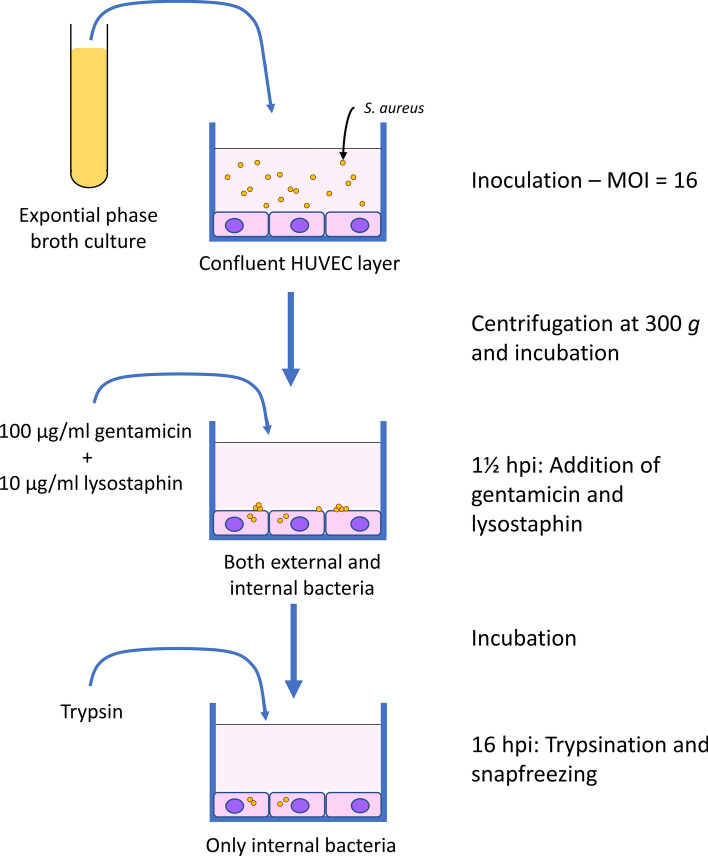
Figure 1
Figure 1
Flow chart of the infection assay. An exponential phase broth culture is prepared and used to inoculate microtiter plates containing confluent HUVEC layers using a multiplicity of infection of ∼ 16. After sedimentation of the bacteria by centrifugation at 300 g, the plates are incubated at 37 °C for 1½h. Then, 100 μg/ml gentamicin and 10 μg/ml lysostaphin is added to kill and lyse all extracellular bacteria. For sample collection at 1 hpi and 16 hpi, the plates are washed and trypsinized followed by snap freezing and storage at − 80 °C until RNA preparation.
Figure 2
Figure 2
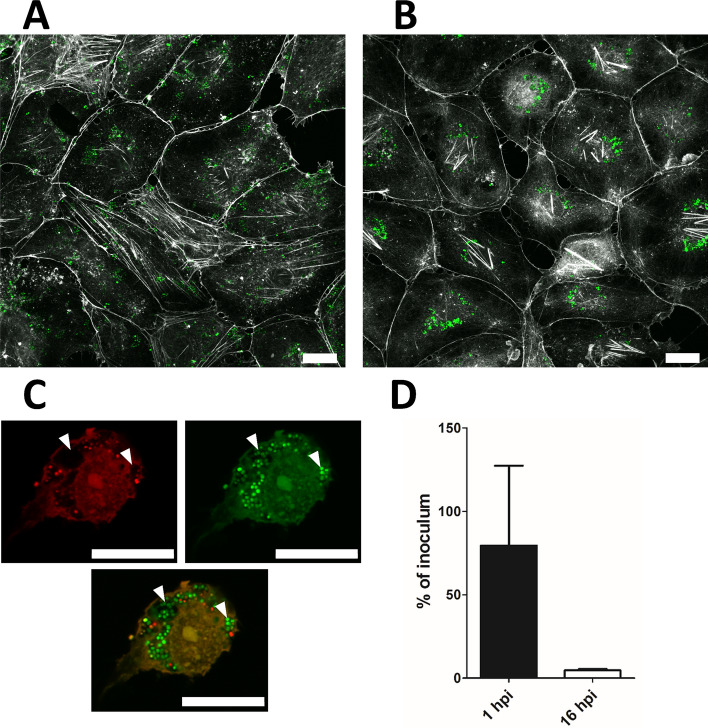
Infected HUVECs were visualized by confocal laser scanning microscopy (A–C) and quantified for bacterial numbers by plating (D). (A–B) GFP-producing S. aureus (green)have invaded the majority of the HUVECs (white, Acti-stain 670) at both 1 hpi (A) and 16 hpi (B). (C) At 16 hpi, bacteria are localised inside vacuolar compartments. Cells were stained with LIVE/DEAD cell viability stain (propidium iodide, red, and SYTO9, green). (D) Number of colony-forming units of S. aureus at 1 hpi and 16 hpi compared to the inoculum. Scale bars in (AC) indicate 20 μm.
Figure 3
Figure 3
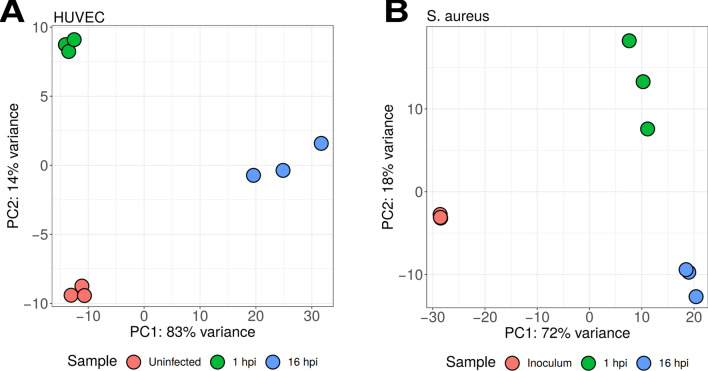
Principal component analysis (PCA) of HUVEC (A) and S. aureus (B) at different time-points during infection showing clustering into distinct expression profile groups corresponding to each infection time-point.
Figure 4
Figure 4
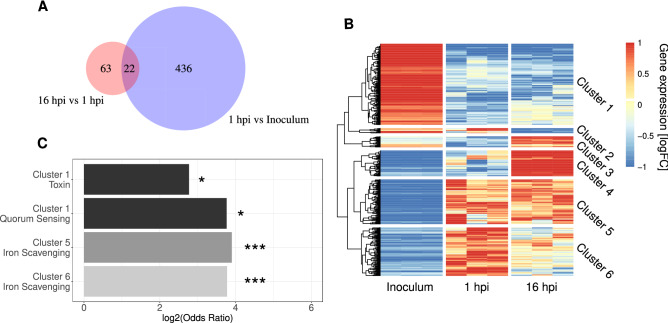
Analysis of differentially expressed genes for S. aureus between the inoculum, 1 hpi, and 16 hpi after logFC shrinkage. (A) Venn diagram visualizing the differentially expressed genes in the two comparisons with overlap showing the commonly regulated genes. (B) Heat map displaying the overall expression profile of all 521 differentially expressed genes grouped into 6 clusters indicating either up- or downregulation at specific time points during infection. Gene expression values were log2 transformed and hierarchically clustered according to Euclidean distances with the complete linkage approach. (C) Virulence ontology enrichment analysis of known S. aureus virulence factors using Fisher’s exact test. *p < 0.05, **p < 0.01, ***p < 0.001.
Figure 5
Figure 5
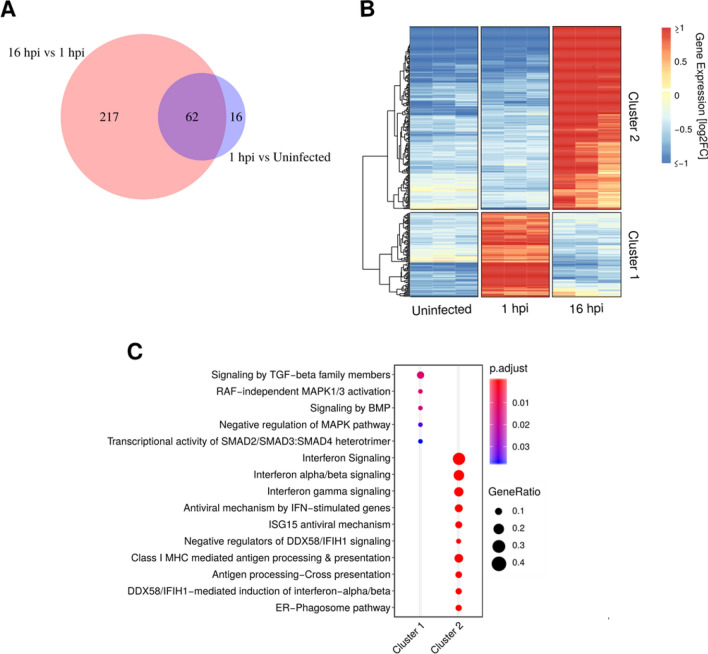
Analysis of differentially expressed genes for HUVEC between the uninfected, 1 hpi, and 16 hpi after logFC shrinkage. (A) Venn diagram visualizing the differentially expressed genes in the two comparisons with overlap showing the commonly regulated genes. (B) Heat map displaying the overall expression profile of all 295 differentially expressed genes grouped into 2 clusters indicating either up- or downregulation at specific time points during infection. Gene expression values have been log2 transformed and hierarchically clustered according to Euclidean distances with complete linkage. (C) Functional enrichment analysis of HUVEC genes that have been mapped to the Reactome Pathway database.
Figure 6
Figure 6
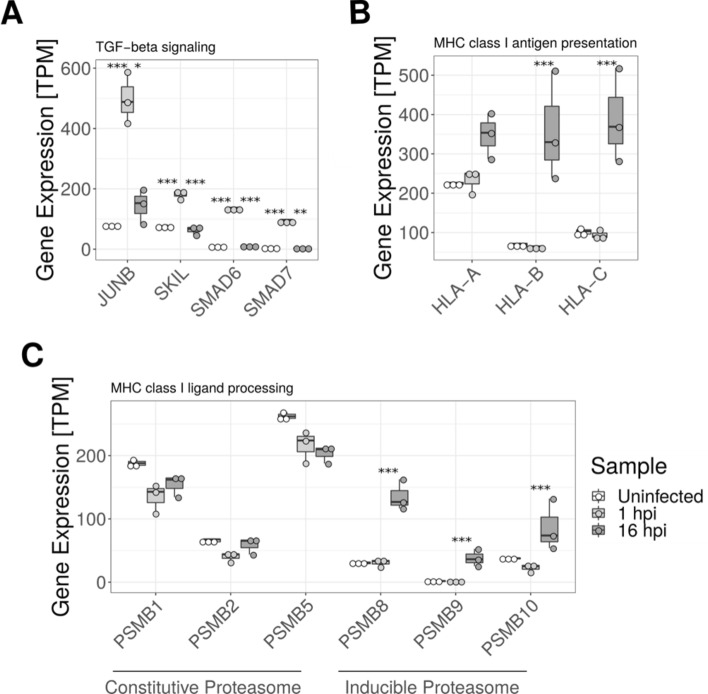
Examples of differentially expressed genes associated with enriched pathways. (A) Genes related to TGF-beta signaling (JUNB, SKIL, SMAD6, SMAD7). (B) Human leukocyte antigen (HLA) A/B/C. (C) Constitutive and inducible proteasomal subunits involved in processing of HLA associated peptides. *p < 0.05, **p < 0.01, ***p < 0.001.

References

    1. Otto M. Staphylococcus aureus toxins. Curr. Opin. Microbiol. 2014;17:32–37. doi: 10.1016/j.mib.2013.11.004. - DOI - PMC - PubMed
    1. Foster TJ, Geoghegan JA, Ganesh VK, Höök M. Adhesion, invasion and evasion: the many functions of the surface proteins of Staphylococcus aureus. Nat. Rev. Microbiol. 2014;12(1):49–62. doi: 10.1038/nrmicro3161. - DOI - PMC - PubMed
    1. Edwards AM, Massey RC. How does Staphylococcus aureus escape the bloodstream? Trends Microbiol. 2011;19(4):184–190. doi: 10.1016/j.tim.2010.12.005. - DOI - PubMed
    1. Fraunholz M, Sinha B. Intracellular Staphylococcus aureus: live-in and let die. Front. Cell. Infect. Microbiol. 2012;2:43. doi: 10.3389/fcimb.2012.00043. - DOI - PMC - PubMed
    1. Garzoni C, Kelley WL. Staphylococcus aureus: new evidence for intracellular persistence. Trends Microbiol. 2009;17(2):59–65. doi: 10.1016/j.tim.2008.11.005. - DOI - PubMed

Publication types

MeSH terms