


Over-the-Scope Clip Closure of Persistent Gastrocutaneous Fistula After Percutaneous Endoscopic Gastrostomy Tube Removal: A Report of Two Cases
- PMID: 33728166
- PMCID: PMC7946610
- DOI: 10.7759/cureus.13206
Over-the-Scope Clip Closure of Persistent Gastrocutaneous Fistula After Percutaneous Endoscopic Gastrostomy Tube Removal: A Report of Two Cases
Abstract
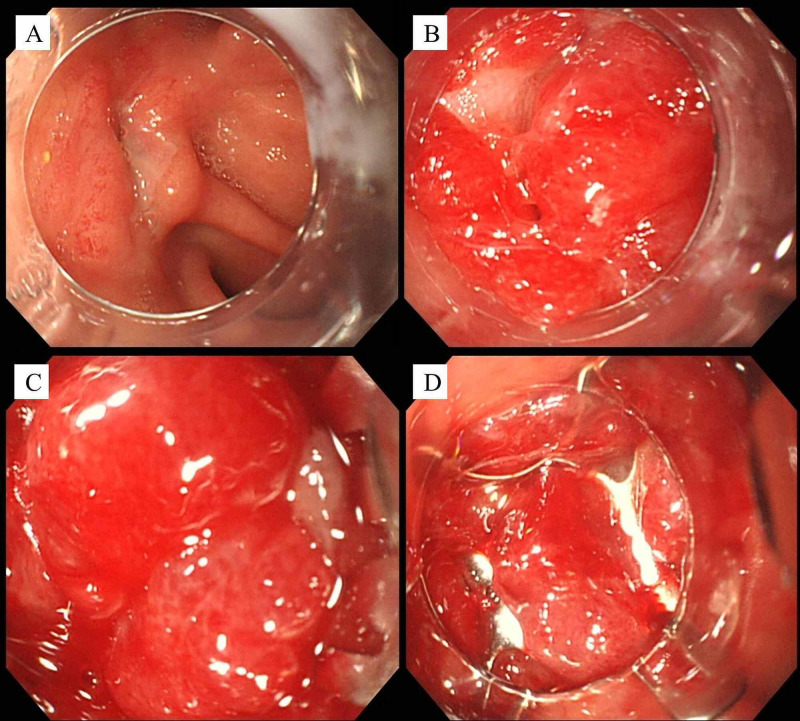
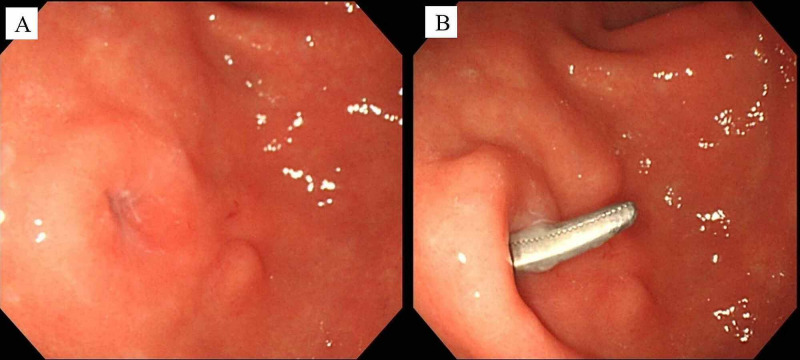
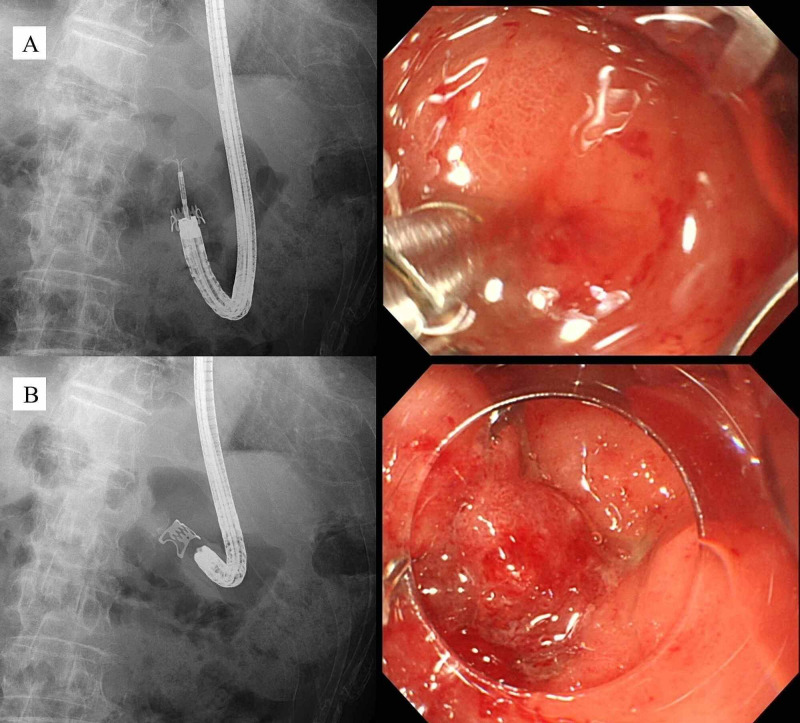
Persistent gastrocutaneous fistulas have conventionally been treated surgically. Over-the-scope clip (OTSC) was developed as an endoscopic closure device for full-thickness gastrointestinal defects and has become one of the treatment options for gastrocutaneous fistula. Herein, we report two cases of gastrocutaneous fistulas treated using OTSC. Case 1 was a 71-year-old woman and case 2 was an 88-year-old man, both of whom had severe frailty and had a persistent gastrocutaneous fistula after removal of the percutaneous endoscopic gastrostomy (PEG) tube. OTSC closure was chosen over surgical closure to reduce invasiveness. In case 1, OTSC was deployed using a suction method, which was technically successful. However, the fistula reopened two days later, indicating clinical failure of the OTSC. The cause of the failure may be due to an inadequate suction of the fistula into the applicator cap. Based on the experience of OTSC failure in case 1, OTSC in case 2 was deployed using the Anchor to pull the fistula into the cap more reliably. Fistula did not recur during the 30-month follow-up, indicating the clinical success of OTSC in case 2. The use of Anchor may increase the success rate of OTSC, but there is a dilemma that the use of Anchor increases cost. In summary, OTSC has the advantage of being less invasive compared to conventional surgery; however, the application of OTSC for chronic fistulas remains challenging due to issues regarding clinical success rate and cost.
Keywords: fistula; gastrocutaneous fistula; otsc; over-the-scope clip; peg; percutaneous endoscopic gastrostomy.
Copyright © 2021, Masaki et al.
Conflict of interest statement
The authors have declared that no competing interests exist.
Figures


References
-
- Complications after percutaneous endoscopic gastrostomy removal. Bender JS, Levison MA. https://journals.lww.com/surgical-laparoscopy/Abstract/1991/06000/Compli.... Surg Laparosc Endosc. 1991;1:101–103. - PubMed
-
- International multicenter experience with an over-the-scope clipping device for endoscopic management of GI defects (with video) Haito-Chavez Y, Law JK, Kratt T, et al. Gastrointest Endosc. 2014;80:610–622. - PubMed
-
- The provision of a percutaneously placed enteral tube feeding service. Westaby D, Young A, O'Toole P, Smith G, Sanders DS. Gut. 2010;59:1592–1605. - PubMed
-
- Factors associated with gastrostomy tube removal in patients with dysphagia after stroke. Wilmskoetter J, Herbert TL, Bonilha HS. Nutr Clin Pract. 2017;32:166–174. - PubMed
-
- A new endoscopic over-the-scope clip system for treatment of lesions and bleeding in the GI tract: first clinical experiences. Kirschniak A, Kratt T, Stüker D, Braun A, Schurr MO, Königsrainer A. Gastrointest Endosc. 2007;66:162–167. - PubMed
Publication types
LinkOut - more resources
Full Text Sources
Other Literature Sources
Miscellaneous